Showing posts with label Honda Prototype. Show all posts

Honda Announces New UNI-CUB Personal Mobility Device Designed for Harmony with People


Honda Motor Co., Ltd. today unveiled the new UNI-CUB personal mobility device, designed for harmony with people. Featuring a compact design and comfortable saddle, UNI-CUB offers the same freedom of movement in all directions that a person enjoys while walking. Representing the evolution of the U3-X personal mobility device that Honda announced in 2009, UNI-CUB features Honda's proprietary balance control technology and the world's first omni-directional driving wheel system (Honda Omni Traction Drive System). These technologies allow the rider to control speed, move in any direction, turn and stop, all simply by shifting his or her weight. Since the rider can freely move forward, backward, side-to-side and diagonally, he or she can quickly and easily maneuver among other people.
Moreover, UNI-CUB's compact saddle-style packaging makes it easy for the rider's legs to reach the ground and maintains eye-level height with other pedestrians. This configuration promotes harmony between the rider and others, letting the rider travel freely and comfortably inside facilities and among moving people.
Starting in June 2012, Honda will jointly conduct demonstration testing of UNI-CUB with Japan's National Museum of Emerging Science and Innovation. In addition to testing the feasibility of using UNI-CUB indoors, this project will explore the practical applications of the device in a wide range of environments in Japan and other countries.
The balance control technology of UNI-CUB is part of the Honda Robotics family of technologies, which originates with Honda's research into humanoid robots, including the world-famous ASIMO.
Going forward, Honda will continue its proactive research and development of next-generation mobility technologies, aiming always to offer more and more people the joy and fun that comes from freedom of movement.
Key specifications of UNI-CUB

Size (L x W x H) 520 x 345 x 745 mm
Seat height
745 – 825 mm

Battery type

Lithium-ion battery
Maximum speed 6 km/h
Range 6 km
Application environment
Barrier-free indoor environments

Key features of UNI-CUB:
Maneuverability promotes compatibility with people in many environments:
1. Omni-directional freedom of movement similar to human walking
UNI-CUB has a two-wheel configuration with a minimal wheelbase. The front wheel features the Honda Omni Traction Drive System that Honda first announced in 2009. The rear wheel moves laterally to facilitate turning. By leveraging the different rotational speeds of the front and rear wheel treads during lateral movements, UNI-CUB can move forwards and backwards, side-to-side and diagonally and also turn in place, making possible quick, nimble movement.
2. Movement in harmony with other people
Honda's proprietary balance control technology makes it possible for the rider to freely control the wheels of the UNI-CUB, much as human beings maintain their balance. With a design that takes into consideration the rider's environment, this system allows the rider to maneuver while moving side by side with or holding hands with another person.
3. Compact size for moving and climbing gradients in barrier-free indoor environments
Thanks to UNI-CUB's compact saddle-style packaging, the rider and vehicle together are about the same width as a person when walking. Optimized wheel design and high-precision drive/balance control enhance UNI-CUB's ability to climb gradients in barrier-free indoor environments.

Ease of control promotes freedom of movement:
4. Weight shift control combined with touch panel control
When the rider is using weight shift control, UNI-CUB's incline sensor detects the direction in which the rider is leaning, allowing UNI-CUB to calculate the direction and speed intended by the rider. And touch panel control via smartphone and other devices is another convenient control option.

Source;
http://www.hondanews.com/channels/corporate-headlines/releases/-honda-announces-new-uni-cub-personal-mobility-device-designed-for-harmony-with-people

Honda designs car without steering wheel

Alot of people are speculating that this will be the DNA of the next Honda S2000....


By David Millward, Transport Editor, Geneva

Instead of the steering wheel, this car is controlled with the aid of two levers.
The EV-Steer is intended to give the motorist the same experience as somebody riding a motor bike, who uses the handlebars to turn.
Instead of turning the wheel, the driver pulls and pushes the levers according to the direction of travel.

"It's fun, it is very tactile and it is very accurate," a Honda spokesman insisted.
"The car keeps the driver alert, because it is very sensitive to movement. Your whole body is kept moving.
"In fact it is a mini-cross trainer," the spokesman added, without the slightest note of irony.
While the car may lack a steering wheel, it is not short of dashboards. In fact it has three.
The middle one would normally display the routine information such as speed.
Then on either side, just above each of the levers are two more dashboards, which can be configured according to the driverメs wishes.
One, for example, can be dedicated for the satellite navigation system, while the other could be used to control the audio system or car temperature.
The car. which has a top speed of just under 100 mph, has already been driven thousands of miles on a Japanese test track.
Fitted with an electric engine, the car can travel up to 100 miles on a single charge. Charging the battery takes around three hours.
A mid-range sports, Honda expects to go into full production of the EV-Steer within the next three years. and will have a price tag between £30,000 and £35,000.

Source;

Geneva 2012: Honda CR-V European Prototype [Live Photos]

This handsome looking new crossover from Honda is the prototype for the CR-V that will replace the current one on the European market in autumn 2012. The styling is bolder and more upmarket than before, with a sculpted new grille and headlights.

The full production version of the 2012 CR-V is going to officially debut at the Paris Salon in autumn, but the looks will remain unchanged. As of yet, the interior is not fully complete, and the engine range has yet to be announced. But a bit of educated guesswork reveals petrol range will include a 2.0-liter i-VTEC, while the diesel one will focus on the 2.2 i-CTDi, which we know was refined for better economy in the new Civic hatchback. The 1.6-liter diesel that makes its debut in Geneva as well is unlikely to be offered at least for another year.


Source;

Honda Announces Ambitious 2012 Le Mans Prototype Program

Honda Performance Development HPD) has an ambitious sports-prototype effort for the 2012 season as it takes part in both LMP1 and LMP2 categories in two series: FIA's World Endurance Championship (WEC) and the American Le Mans Series (ALMS).

This year marks the largest customer endurance program to date for HPD as it will have a total of seven HPD-powered cars on the grid in both series.

"In recent years, teams running HPD engines and chassis have delivered remarkable results at some of the world's greatest sports car races, starting with an amazing LMP2 victory--and second and third overall finishes--at our endurance racing debut, the 2007 Mobil 1 12 Hours of Sebring," Steve Eriksen, HPD vice president said. " Another highlight was Strakka Racing's LMP2 victory and fifth-place overall finish at the 24 Hours of Le Mans in 2010, also on our first attempt!"

Eriksen realizes that the return to LMP1 (first time since 2010) and continuing the LMP2 program will be the biggest challenge yet for the team's engineers and associates.

"I'm extremely confident in our capabilities and look forward to another exciting season in 2012," he said. "We expect that the proven design, development and engineering expertise of HPD and its technical partners will provide our teams with the tools they need to succeed. It will be an exciting season."

HPD has three accomplished racing organizations that will campaign its ARX-03a open prototype in the LMP1 class. Strakka Racing, a UK-based team continues its three-year association with HPD, moving from LM P2 to the premier LM P1 category in the new FIA World Endurance Championship. Drivers are Jonny Kane, Nick Leventis and Danny Watts.

JRM Racing, which won the FIA GT1 championship last year, is also campaigning an LMP1 ARX-03a HPD prototype this year with David Brabham (long an HPD stalwart), Karun Chandok and Peter Dumbreck at the helm for the eight-race WEC schedule.

An American-based team recently announced plans to take part in the full WEC schedule. Florida-based Starworks Motorsport had a second-place result at the recent 24 Hours of Daytona (with another engine/chassis combination) and will join the LMP2 grid for the first time with team regulars Ryan Dalziel and Enrico Potoliccio at the wheel.

Greg Pickett's Muscle Milk Racing team debuts the ARX-03a chassis in the American Le Mans Series championship with team regulars Klaus Graf and Lucas Luhr driving the LMP1 open race car.

Level 5 Motorsports, fresh off an undefeated ALMS season with HPD power in ALMS LMP2 competition, continues with a pair of new ARX-03b chassis for drivers Christophe Bouchut and Scott Tucker. The team also plans to return to the 24 Hours of Le Mans and follow up on their strong third-place result in LMP2 last year. Black Swan Racing is moving to LMP2 with HPD power, campaigning a Lola B10/80 coupe in the ALMS championship, after winning the GTC title in 2010. The driving duo of team owner Tim Pappas and Jerome Bleekmolen move up to this prototype class as part of the HPD lineup.

HPD is continuing its technical partnership with Wirth Research in the UK, building on the global successes they've achieved together in recent years. This include numbers class and/or outright victories in all the world's premier sports car races and championships, including both the Le Mans 24-Hour race and the Sebring 12-Hour contest.

Source:
http://www.motorauthority.com/news/1072740_honda-announces-ambitious-2012-le-mans-prototype-program

Honda Pegasus Study Inspired by... Harley Earl's GM Firebird Concepts

Automotive designers find inspiration in all kinds of places. For independent designer Andrus Ciprian from Romania, it was Harley Earls' legendary GM Firebird concept cars of the 1950s. The thing is that he didn't use this inspiration on a GM product but on a futuristic Honda racing car design study that he named Pegasus.

The Romanian designer has dreamed up a small gas-turbine jet engine as the power source for the imaginary winged prototype, while other features include specially designed wheels that increase air-flow to the brakes. Full mage gallery after the break.

Source;
http://carscoop.blogspot.com/2010/07/honda-pegasus-study-inspired-by-harley.html

Honda to unveil electric car in US by 2015-Nikkei

Hmmm....Never say never.
TOKYO, Aug 22 (Reuters) - Honda Motor Co Ltd (7267.T) plans to develop an electric car to debut in the U.S. market by around 2015 as tighter environmental regulations push demand for zero-emission vehicles, the Nikkei newspaper said on Saturday.

A spokesperson for the company, Japan's No. 2 automaker, said it was developing an electric car but had not decided when to launch it.

The company could also not comment on the Nikkei business daily's report, without sources, that a prototype of the car would be unveiled at the Tokyo Motor Show in October.

The vehicle is expected to be around the size of a minicar, the Nikkei said.

Other automakers such as Toyota Motor Corp (7203.T) and Volkswagen AG (VOWG.DE) have also announced plans to launch electric cars in the next few years.

But they say it could take decades for the vehicles to spread due to their high cost, limited driving range and long charging times with the current battery technology.

Nissan Motor Co (7201.T), Japan's third biggest automaker, unveiled its electric car "Leaf" earlier this month with plans to begin selling it in the United States, Japan and Europe towards the end of 2010.

(Reporting by Chisa Fujioka and Yoshifumi Takemoto; Editing by Alex Richardson)

Source (via autoblog);
http://www.reuters.com/article/rbssAutoTruckManufacturers/idUST33069520090822

Here's Autoblogs take;

"Honda has repeatedly told the world it doesn't see battery electric vehicles as being viable anytime soon. Instead, the company has planned to retain its focus on hydrogen fuel cells.

However, the realities of hydrogen distribution (or lack thereof), may be pushing Honda to do something it doesn't necessarily want to.

Honda will reportedly unveil a prototype for a battery powered mini car at the Tokyo Motor Show in October, with a production version expected to hit the streets by 2015. Despite the company's preference for hydrogen fuel cells, a plug-in may be necessary in order to meet the numbers of zero emission vehicles mandated by new California standards in coming years.

The automaker could certainly leverage the work it has done on the electrically driven FCX Clarity in combination with lithium batteries from its joint venture with GS Yuasa."

Source;
http://www.autoblog.com/2009/08/24/report-honda-to-show-ev-prototype-in-tokyo-production-in-2015/

MUGEN Euro confirms Type R prototype development

This won't be coming to North America, so don't get too excited. (Although there were rumours at one point of the UK Civic coming here with an Acura badge....)
"In standard trim, the Civic Type R is a thrilling machine to drive," said Hiro Toyoda, Vice President of MUGEN EURO. "It is a fantastic base model from which we hope to develop one of the quickest point to point front-wheel-drive road cars in the country."

Toyoda san is referring to a prototype of a MUGEN EURO-developed Type R which is still in concept stage. MUGEN EURO is a subsidiary of the tuner with the same name but is based in Northampton, UK.

The car is being run on the same powertrain as the 2007 Civic MUGEN RR from Japan but will have its power and torque increased. That model had 240hp (177kW), was 10kg lighter than the standard model and was limited to only 300 units.

The brakes, the exhaust and suspension system are also being improved. Looks have been enhanced with a more purposeful aerodynamic kit that includes a larger rear boot spoiler.
No confirmation as to whether MUGEN EURO will eventually produce a customer car out of this prototype or not. For the moment UK fans will have to be content with the Civic Type-R (FN2R).

Source;
http://www.worldcarfans.com/109070320279/mugen-euro-confirms-type-r-prototype-development

More Honda FC Sport Pic's

Here is my orig. post on the subject with more pic's and information;
http://thehondaportal.blogspot.com/2008/11/2008-la-auto-show-honda-fc-sport.html

2008 LA Auto Show; Honda FC Sport Hydrogen Car

Honda FC Sport Design Study Suggests Hydrogen Sports Car Future
Innovative fuel cell packaging demonstrates green performance potential

11/19/2008 - LOS ANGELES -
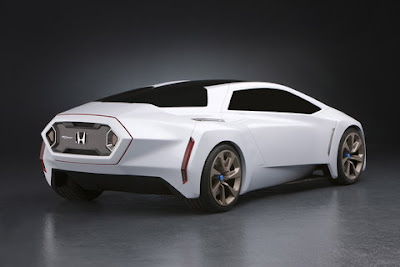
Honda today revealed the Honda FC Sport design study model, a hydrogen-powered, three-seat sports car concept, at the 2008 Los Angeles Auto Show.

The FC Sport emphasizes the design flexibility and potential of Honda's V Flow fuel cell technology - already deployed in the Honda FCX Clarity sedan - and reconfigures it into a lightweight sports car design with an ultra-low center of gravity, powerful electric motor performance and zero-emissions. The design study concept is inspired by supercar levels of performance through low weight and a high-performance, electrically driven fuel cell powertrain.

"The Honda FC Sport explores how to satisfy automotive performance enthusiasts in a world beyond petroleum," said Dan Bonawitz, vice president of American Honda Motor Co., Inc. "People who love sports cars will still have a reason to love in a hydrogen-powered future."

The high-output Honda fuel cell powertrain and a sleek, aerodynamic body contribute to the vehicle's performance potential. A modular approach to fuel cell component packaging and the electric drivetrain contribute to the FC Sport's low center of gravity with the majority of vehicle mass distributed between the axles, creating the balanced weight distribution sought after in sports cars.

The ideal placement of the Honda V-Flow fuel cell stack and related components demonstrates the benefits of a platform-specific, hydrogen-powered fuel cell powertrain. The FC Sport is configured to accommodate a custom-formed high-power fuel cell stack, located between the rear seats, and a battery pack placed low in the middle of the vehicle. The electric motor resides just forward of the rear axle. Two fuel storage tanks, visible from above, are located above the rear axle.

The optimal placement of fuel cell components for performance also allows for a relatively large passenger cabin by conventional supercar standards with enough space for three seating positions. The interior layout focuses primarily on the driver with a racecar-like center driving position. The enclosed canopy opens upward from the rear to allow for entry and exit. Two rear passenger seats flank the driver's left and right side.

The sleek, low-profile body is designed to convey a high-technology appearance with sculpting that combines angular shapes in the front of the vehicle that taper into geometric, hex forms in the rear. The rear hex forms house cooling radiators for the fuel cell. Formula 1-style barge boards behind the front wheels enhance high speed aerodynamics and convey the vehicle's racing pedigree. The hydrogen storage tanks, visible from the rear deck, showcase the FC Sports fuel cell technology in much the same way that a "naked bike" motorcycle showcases its engineering technology.

The glacier white body color conveys the FC Sport's clean environmental aspirations while the dark wheels and deeply tinted glass provide a symbolic contrast befitting of the vehicle's unique combination of clean power and high performance. Green construction techniques further contribute to a reduced carbon footprint. An organic, bio-structure theme is carried through to the body construction where exterior panels are intended to use plant-derived bio-plastics.

The Advanced Design Studio of Honda R&D Americas, in Pasadena, California, developed the FC Sport design study with the primary objective of using existing fuel cell technology as the basis for an ultimate Honda sports car. Designer Jason Wilbur led the design efforts.

Honda R&D Americas, Inc. began its operations in California in 1975 with local market research activities and has steadily grown its capabilities over the past 33 years to include all aspects of new vehicle design and development. Recent development efforts include trend-setting products such as the Honda Pilot, Ridgeline, Element, Civic Coupe and Civic Si.

In 2008, the company opened two new design centers in Southern California: the Acura Design Studio (Torrance), for the research and design of new Acura products; and the Advanced Design Studio (Pasadena), for the exploration and development of advanced design themes for both Honda and Acura.

The company operates 11 major R&D facilities in North America, including a full vehicle development center in Raymond, Ohio, and three design studios in Southern California. Honda R&D designers, engineers and support personnel are engaged in the development of Honda and Acura automobiles, powersports products, and power equipment for North America and global markets. The company's main centers of operation include the Los Angeles Center (Torrance, California), responsible for market research, concept development and styling design; the Ohio Center (Raymond, Ohio), responsible for complete product development, testing, and support of North American supplier and manufacturing operations; and a dynamic test facility in Cantil, California.

Source;
http://www.hondanews.com/categories/1097/releases/4879

Even More Acura NSX Renderings

A Temple of VTEC reader, 'ciwai', worked hard to try and take the camo off of the car, here's what they've come up with.

Link;
http://www.vtec.net/news/news-item?news_item_id=773441

Another NSX Rendering

Stumbled across this pic, one of a few floating around.

Here are the others that I have accumalated in another post;
http://thehondaportal.blogspot.com/2008/06/next-hondaacura-nsx-looking-to-reclaim.html

Next Honda/Acura NSX Looking to Reclaim it's Title as Japan's SUPERCAR

This is the NSX caught on the track with camo just recently
This is an older rendering on what the NSX might look like.
This is a pic out of a Japanese car MagX. (I think this is the most accurate pic.)
This is an older NSX, absolutley beautiful.

The next NSX is expected for the 2011 model year, but the prototype has already hit the track at Nürburgring, Germany, and it has one aim, to be faster than the Nissan GT-R and the upcoming Lexus LF-A.
It's a tall order, and one that Honda hopes it can achieve through the use of a 5.5-liter V10 expected to make 550 horses, with a torque peak expected to top 420 pound-feet. The engine is essentially a slightly larger version of the V8 that Honda will use for the next-generation, rear-wheel-drive RL sedan, and it will use cylinder deactivation under light loads for maximum efficiency. Additional gains will come from the use of an eight-speed, paddle-shifted automatic.
Getting the power to the ground will be a modified version of Honda's Super-Handling All-Wheel-Drive (SH-AWD) system. Packaging could be tight, however, as this NSX will place its V10 up front. A combination of steel and aluminum will be used for the chassis that will form the basis of this 2+2 sports car.