Showing posts with label Hydrogen cars. Show all posts

Honda CEO, Mr. Takanobu Ito, speaks at Geneva Motorshow 2010

Good morning, Ladies and Gentlemen. I am very pleased to join you today at the Geneva Motorshow. I would like to talk about Honda's vision of the future, by linking it to our past.

Honda began life more than 60 years ago as a maker of motorcycles. But we weren't strictly a motorcycle company. In the post-war era, the people of Japan needed basic mobility. And the first product Soichiro Honda created was a bicycle equipped with a small engine.

From that humble beginning, we now offer many different products to meet the needs of our customers: Cars... Motorcycles... Lawnmowers... Marine Engines...

One of our smallest creations is the U3-X, the omni-directional electric monocycle you have just seen. And the largest one is also our fastest... the HondaJet.

While the products have changed, our fundamental goal as a company has remained the same for the last 60 years and beyond. We will continue to supply mobility products that offer our customers fun and convenience. And to achieve this, we must create mobility that also meets society's green needs ... with a dramatic reduction of CO2 emissions.

FCX Clarity and SHS
On your right is the car of the future made today. FCX Clarity runs on electricity generated onboard by the reaction of hydrogen in the tank and oxygen in the air. It emits only water, and has a driving range of 460 kilometres. We believe that fuel cell electric vehicles are the ultimate solution to reduce CO2 emissions. We welcome the question - "Where will you get the Hydrogen?" In fact, Honda is leading the way in developing new technologies for hydrogen refuelling.

Recently, we developed a very compact solar hydrogen station. By creating a new high differential pressure electrolyser, Honda engineers were able to completely eliminate the compressor. This new system is 25 % more efficient, and is compact enough to be used in the home. So, my answer to the question is, "why not produce hydrogen in your home?"

3R-C and EV-N
On your left are 2 Honda design studies for zero-emission city commuter cars. Congested city traffic is one of the leading causes of vehicle emissions. We must make city transport cleaner. EV-N is a design study of the smallest city car that is capable of accommodating 4 people. 3R-C is another design study for city commuters with 3 wheels for one driver. Both are intended to be driven by electric motors.

Hybrid Expansion
In the days ahead, we will further expand our hybrid line-up. Hybrid is the most important and effective technology to cut CO2 emissions today. The Jazz hybrid will be introduced in Europe early next year. So, with Civic Hybrid, Insight, the new sporty CR-Z, and soon Jazz Hybrid, Honda aims to maximise the fuel efficiency of mobility today ...while we work towards the goal of zero-emission mobility for tomorrow.

CR-Z
And now, it is my pleasure to introduce to you the latest hybrid model from Honda... CR-Z. This unique car combines a hybrid system with a 6-speed manual transmission, in a dynamic coupé styling. It is for people who seek new values in a car. For people who want fun-to-drive spirit and lower CO2 emissions.

In the late 80s, I was in charge of body development for the Honda NSX, the world's first all aluminium, mass production sports car. Our challenge was to build a car with all-aluminium construction to improve both efficiency and dynamics. With the CR-Z, the challenge of our engineers was still to create a car with great dynamics and fuel efficiency.

CR-Z is a new kind of hybrid. Of course, it is a hybrid car that uses petrol and electricity. But more than that, it is a hybrid of a sporty car and an eco car. Given the different driving characteristics offered by the 3-mode drive system, once you are behind the wheel, you can choose sporty driving or eco driving ...at your will.

I am proud to present to you the CR-Z... a new hybrid that offers both fun and fuel efficiency in one dynamic package!
Thank you for your attention.
Source;

Honda Prefers Hydrogen as U.S. Pushes Battery Autos

Here's a nice article with a possible direction of the Auto Industry....
Aug. 12 (Bloomberg) -- Honda Motor Co. is backing hydrogen power for the cars of the future, a stance at odds with the Obama administration’s decision to drop automotive fuel-cell technology in favor of battery-run vehicles.

“Fuel-cell cars will become necessary,” said Takashi Moriya, head of Tokyo-based Honda’s group developing the technology. “We’re positioning it as the ultimate zero-emission car.”

Honda, the only carmaker leasing fuel-cell autos to individuals, opened a production line last year in Tochigi prefecture to make 200 FCX Clarity sedans. The Energy Department sought to eliminate hydrogen-station funding and instead lend $1.6 billion to Nissan Motor Co. and $465 million to Tesla Motors Inc. to build electric cars, and give $2.4 billion in grants to lithium-ion battery makers.

“Honda has a propensity to think very long term,” said Ed Kim, an analyst at AutoPacific Inc. in Tustin, California. “It’s also part of the company culture that if they’ve made a decision they think is correct, they’ll really stick with it.”

Honda isn’t alone. Toyota Motor Corp., Daimler AG, General Motors Corp. and Hyundai Motor Co. say hydrogen, the universe’s most abundant element, is among the few options to replace oil as a low-carbon transportation fuel.

U.S. Energy Secretary Steven Chu said in May his department would “be moving away” from hydrogen as it’s unlikely the U.S. can convert to the fuel even after 20 years. Nissan Chief Executive Officer Carlos Ghosn predicts battery cars may grab 10 percent of global auto sales by 2020. Honda hasn’t announced plans for a battery-electric car.

Honda’s American depositary receipts fell 3 cents to $31.93 at 4:02 p.m. in New York Stock Exchange composite trading. They have risen 50 percent this year.

Fuel Costs
Hydrogen, made mainly for industrial use from natural gas, costs about $5 to $10 per kilogram for vehicles in California, more than double an equivalent amount of gasoline. Fuel-cell cars also have at least double the efficiency of gasoline models, with Clarity averaging 60 miles per kilogram.

The Energy Department estimates future prices for hydrogen will fall to $2 to $3 a kilogram, Toyota said on Aug. 6.

The fuel can also be made from solar and wind power and even human waste.

Toyota President Akio Toyoda said Aug. 5 his company plans consumer sales of fuel-cell cars within six years. Toyota, like Honda, is making “exponential progress” with the technology, Justin Ward, manager of Toyota’s U.S. advanced powertrain program, said in an interview.
Battery cars are further along in the market. Mitsubishi Motors Corp. started selling the i-MiEV last month. Tesla sells the $109,000 Roadster and Nissan unveiled its electric Leaf this month, with sales to start in Japan and the U.S. next year.

Fueling Time
Honda says hydrogen vehicles match the refueling style drivers are used to: filling up in minutes at a service station. Nissan’s Leaf recharges fully in 30 minutes with a fast-charger, or up to 16 hours on a household outlet, said Tetsuro Sasaki, senior manager of Nissan’s battery test group.

A budget crisis slowed plans for more hydrogen stations in California, home to the biggest fleet of cars using the fuel. At the federal level, Chu sought $333.3 million in May for battery and advanced gasoline autos in the 2010 budget, up 22 percent. Hydrogen funds were cut 60 percent to $68 million, slashing money that would have gone to transportation projects.

The Clarity is available in the U.S. only in Los Angeles, where drivers can use as many as 16 hydrogen stations. The 5- passenger car has a top speed of 100 miles an hour and goes 240 miles (386 kilometers), more than double the 100-mile range of Nissan’s compact electric car. Through July, Honda leased cars to 10 drivers for $600 a month.

Filling Stations
The need for a network of hydrogen filling stations is a problem.

“We cannot do infrastructure alone,” said Moriya. “We’ve been developing the cars on our own without government support.”

The Senate and House voted in July to restore the funds. President Barack Obama must approve the final budget.

Honda and Toyota will have to reduce production costs to win over consumers. Fuel cells need platinum -- a precious metal that costs more than $1,200 an ounce -- and current durability is half that of gasoline engines, according to Moriya.

Honda plans to offer hydrogen-fueled cars at prices comparable to midsize gasoline autos by 2020, down from a company estimate that Clarity’s 2005 hand-built predecessor cost about $1 million. Moriya wouldn’t discuss the Clarity’s price.

Expensive Platinum
Honda engineers in Tochigi are trying to trim costs. For 13 months, technicians have worked in a semiconductor-style clean- room, coating rolls of plastic film for fuel-cell membranes. Nearby, a press stamps stainless-steel plates that will grip the material. Hundreds of the cells are then sealed in a metal case, forming the fuel-cell stack.

Honda’s hydrogen push has been undermined by plunging sales in the U.S., its main market. Last quarter, profit at Japan’s second-largest carmaker fell 96 percent to 7.5 billion yen ($79 million). Its research budget is 515 billion yen this fiscal year, down 8.5 percent. Funds for fuel cells were cut and some spending shifted to other “priorities,” Moriya said, without elaborating.
Honda probably spends “a few tens of billions of yen” a year on fuel cells, said analyst Mamoru Kato at Tokai Tokyo Research Center in Nagoya.

“Maybe, just maybe, fuel cells will be the future,” said Edwin Merner, who helps manage about $3 billion at Atlantis Investment Research in Tokyo. “And if you’re not in there, then you have a big disadvantage.”

Source;
http://www.bloomberg.com/apps/news?pid=20601109&sid=atHH0LYy6MYA

First Drive: Honda FCX Clarity

A drive in the world’s most advanced fuel cell car


Vancouver, British Columbia – Unveiled in November, 2007 at the Los Angeles Auto show, the production version of the Honda FCX Clarity fuel cell car – yes, the production version – is now being leased to a limited number of “early adopters” in southern California - including some movie stars such as Jamie Lee Curtis - on a three-year lease for US$600 a month. Honda plans to have about 200 FCX Claritys on the road in the U.S. and Japan by 2011.

The Honda FCX Clarity is a (U.S.) street legal, zero-emissions, fuel cell-powered mid-size sedan that meets all current North American safety standards and performs much like a standard four-cylinder gasoline-engined car, according to Honda. One was recently driven from southern California to Vancouver as part of the Hydrogen Road Tour 2009, a promotional rally sponsored by various government and corporate entities interested in the promotion of hydrogen as an automotive fuel – you can read CanadianDriver’s coverage here. I was one of a group of eager journalists to get a brief test drive in the FCX Clarity last week.

Unlike most other fuel cell vehicles now being tested in small fleets, the FCX Clarity doesn’t make use of an existing vehicle bodystyle that is converted to a fuel cell vehicle. The FCX Clarity is a clean-sheet design engineered and designed around its fuel cell drive components. As a result, Honda was able to package the components in a way that permitted a roomy four-passenger interior, a spacious trunk, and an eye-catching aerodynamic exterior design.

Under that stylish exterior, the FCX Clarity’s fuel cell components include a high pressure (5000 psi) hydrogen tank behind the rear seat; a third-generation Honda fuel cell stack in the console between the driver and front passenger that generates a maximum 100 kilowatts of electricity; a 288-volt lithium-ion battery under the rear seat to store the electricity; a combined 100-kW electric drive motor/coaxial gearbox/power drive unit in the engine bay that propels the car with the equivalent of 134 horsepower and 189 ft-lbs of torque.

Essentially, the FCX Clarity is an electric car powered by a fuel cell assisted by a powerful battery, and it has some similarities to Honda’s gasoline-electric hybrid cars. Pressurized hydrogen gas is fed into the fuel cell where it’s combined with oxygen to create electricity (the only byproduct is water). The electricity flows to a 100-kW AC synchronous electric motor where it is directed by the Power Drive Unit (PDU) through a one-speed (plus Reverse) coaxial gearbox to the front wheels.

During start-up and acceleration, electricity from the lithium ion battery supplements power from the fuel cell and during deceleration, the electric motor acts as a generator to charge the battery. When cruising on the highway, the car operates on electricity from the fuel cell stack alone. When the FCX Clarity is stopped, an idle stop system shuts down the fuel cell stack, and the electricity needed for the power steering, power brakes, air conditioning and other power features is supplied by the battery.

The FCX Clarity has come a long way from the original Honda FCX fuel cell car introduced in 2002. That car was a boxy, two-door subcompact car with a fuel cell that weighed 202 kilograms and developed 60 kW of power, and couldn’t operate at sub-zero temperatures. The current FCX Clarity, by comparison, is a mid-size four-door sedan with a 100-kW fuel cell that weighs only 67 kg, is less than half the size of Honda’s original fuel cell, and can operate at temperatures down to minus 30 degrees Celsius.

On the road, the FCX Clarity drives much like a battery-electric car. Off-the-line throttle response is immediate because of the abundant low-end torque of 189 ft-lbs from 0 to 3000 r.p.m. courtesy of the lithium ion battery and electric motor. Under acceleration, there is a slight hissing sound from the fuel cell and a whine from the electric motor, but it’s much quieter overall than a gasoline engine. The single speed coaxial gearbox has no gear changes – power delivery is just a smooth, linear progression.

The FCX Clarity’s curb weight of 1624 kg (3582 lbs) is a little more than an Accord EX 4-cylinder sedan at 1550 kg (3417 lbs) but Honda says its acceleration times are comparable. According to the Automobile Journalists Association of Canada (AJAC), an Accord EX 4-cylinder goes from 0 to 100 km/h in 9.5 seconds. The FCX Clarity’s top speed is 160 km/h.

A maximum driving range of 385 kilometres is not as good as a conventional gasoline-engined car, but it is twice that of many battery-electric cars.

With a fully independent suspension (double wishbone front suspension, independent multi-link rear suspension), and a low, wide stance, the FCX Clarity handles and rides with stability and comfort and while it’s electric power rack and pinion steering doesn’t offer much feedback, the car’s tight turning diameter of just 10.8 metres (35.4 feet) allows tight turns and excellent manoeuvrability.

Fuel economy is measured in miles per kilogram of hydrogen (mile/kg-h2) and the FCX Clarity averages 68 miles/kg H2. But because we don’t know what a kilogram of hydrogen gas would cost at a hydrogen station of the future, it’s difficult to compare the fuel costs of gasoline vs hydrogen. Honda does say that the FCX Clarity’s fuel efficiency is up to three times that of a gasoline-powered automobile and two times that of a gasoline-powered hybrid vehicle.

It takes only five minutes to fill up the FCX Clarity’s pressurized gaseous hydrogen fuel tank. The time is comparable to a conventional gasoline car or hybrid and much better than a battery-electric car which usually requires from three to eight hours to recharge, depending on the charging system.

The FCX Clarity’s futuristic four-passenger interior design includes a single round illuminated gauge facing the driver with an H2 meter, a battery meter, a Power/Charge display, and a round ball in the centre of the display that changes size and colour depending on the driver’s mileage – blue is good, yellow is normal, and amber is poor. As in other Hondas, the speedometer is a digital readout on top of the dash. A Power button starts up the fuel cell after a key has been inserted, and a very small electronic gear shift lever to the right of the steering wheel lets the driver select a gear, which is indicated in the gauge display.

All the interior fabric coverings are made from corn and plant biomass “to help move away from petroleum-based resins and other synthetic fibres,” according to Honda. That includes the seats, armrests, console trays, carpeting, roof linings and trunk linings.

The silver-coloured centre stack protrudes aggressively into the cabin for easier reach of the controls, and the navigation system includes a location finder for the nearest hydrogen station. Headroom and legroom for all four occupants is generous, but my guess is that the rear centre console will eventually be replaced by a centre seat to make it a five-passenger sedan. The FCX Clarity’s trunk volume of 371 litres (13.1 cu. ft.) is almost as good as the Accord sedan with 397 litres (14.0 cu. ft.)

The FCX Clarity is arguably, the most advanced fuel cell car in the world. It’s stylish, practical, comfortable, safe, street-legal, and emissions-free. In April 2009, an international group of 59 independent automotive journalists from 25 countries named it “2009 World Green Car” from amongst 22 contenders.

Honda has proven that it can build a practical, safe and clean zero-emissions vehicle, and others will soon follow. The next step is for energy companies, governments and investors to finance and build a viable hydrogen refuelling infrastructure. That will be a challenge, but if Honda were to put CEOs and elected representatives behind the wheel of an FCX Clarity for a day, I think the chances would be much better.

Greg Wilson is a Vancouver-based automotive journalist and editor of CanadianDriver. He is a member of the Automobile Journalists Association of Canada (AJAC).

Source;
http://www.canadiandriver.com/2009/06/12/first-drive-honda-fcx-clarity.htm?page=all

Awesome review, check out the other pics on the link above!

Fuel cells finally staged to power the future, thanks to Honda's FCXClarity.

The fuel cell has long been viewed as pie-in-the-sky engineering - something to dream about, but having little chance of ever changing the world's dependence on fossil-based fuels. In the past couple of years, however, things have started to change. Big time.

In the past, most fuel cells had a life cycle of around 1,500 hours (or approximately three years of normal use) before there is a noticeable decrease (15 per cent) in performance. The latest fuel cells address this shortcoming while accomplishing so much more.

For example, Kia's Fuel Cell Electric Vehicle (FCEV) program took a big step forward with the debut of the Borrego FCEV at last year's Los Angeles Auto Show. When compared to the 108 horsepower, fuel cell-powered Sportage I drove in 2007, the Borrego boasts a 44 per cent boost in power. The fuel cell and its 450-volt supercapacitor storage system is capable of putting 154 horsepower to the pavement while delivering a best-in-class system efficiency of 62 per cent. The upshot is a top speed of 160 km/h, a zero- to 100- km/h time of 12.8 seconds and a driving range of 680 kilometres from its 202-litre hydrogen tank.

As in life, it is usually the smallest of things that make the biggest difference - and it's usually a eureka moment that leads to the breakthrough. This is particularly true of the Honda FCX Clarity. In the FCX's case, the eureka moment came when Yozo Kami, executive chief engineer of the FCX, literally turned the fuel cell stack on its head.

In 1999, Honda's fuel cell was large (it needed 4.7 cubic feet to house it), weighed 202 kilograms and had an output of just 60 kilowatts. While the output had risen to 86 kW and the weight had dropped to 96 kg by 2003, size still represented a significant challenge - enough that it necessitated the use of a SUV-like vehicle to accommodate it. The FCX's V Flow (for vertical flow) fuel cell, introduced in 2007, is housed in a box about the size of a standard aircraft roll-on suitcase (1.9 cu. ft.), weighs just 67 kg and produces 100 kW of real-world power - a massive 50 per cent increase in the power-to-volume ratio.

The V Flow's other breakthrough seems so simple in hindsight. Conventional fuel cell stacks lie horizontally in the vehicle, which consumes valuable space. The V Flow stack stands vertically between the FCX's front seats. Reorienting the stack not only reduced its space requirement, it eliminated a major drawback: When the fuel cell combines hydrogen and oxygen (to produce electricity), it also produces water that needs to be drained. During the winter months, any water left within the fuel cell at shut down freezes which renders the fuel cell useless. The V Flow uses gravity to rid the cell of the water. This twist also allows the fuel cell to be started at -30 C, meaning it's capable of working just about anywhere in the world, including northern Canada.

To take the original FXC from concept to reality, Kami also needed a smaller electric drive motor and smaller battery pack. No problem. The FCX Clarity's coaxial electric motor is 162 millimetres narrower than its predecessor and by adopting a new 288-volt lithium-ion battery pack, the mass and space requirements dropped by 40 and 43 per cent, respectively. The latter means the battery is now small enough to fit under the rear seat. All of this work delivered a fuel cell powertrain that's a whopping 180 kg lighter and 40 per cent smaller than Honda's previous unit.

The electric motor delivers 134 horsepower and 189 pound-feet of torque anywhere from one to 3,056 rpm. The result is a ton of low-end grunt (enough to set off the traction control system if one nails the accelerator) and a sustained pull through the mid-range. It also delivers a top speed of 160 km/ hour and a real-world driving range of 440 km, both of which are a match for a conventional gasoline-powered vehicle.

After driving the FCX Clarity it became only too obvious to me that the fuel cell has finally come of age. The proof came in April at New York Auto Show. The FCX Clarity was named the 2009 World Green Car - it beat 22 contenders from 25 countries to take the prestigious crown.

Celebrities are also buying into the whole zero-emission thing. On Aug. 5, 2008, Jamie Lee Curtis became the second person to take delivery of an FCX Clarity. Curtis is one of approximately 200 customers who will lease the vehicle in the United States and Japan, the vast majority of vehicles being based in Southern California where there is some semblance of a refuelling infrastructure.
The globalization of the fuel cell system and hydrogen's potential to become the next fuel source is growing as more people start to recognize the need to develop realistic zero-emission vehicles. Europe and Japan will likely be the first to embrace fuel cells. In North America, it is going to take some serious political will to begin the shift away from today's gas-guzzling frenzy and towards tomorrow's hydrogen-driven world.

automotive@sympatico.ca

Source;
http://www.canada.com/Fuel+cells+finally+staged+power+future+thanks+Honda+FCXClarity/1590751/story.html

Honda ready for a world beyond gas

The hydrogen fuel-cell-powered Honda FC Sport design study model makes its Canadian public debut today at the 2009 Canadian International Auto Show in Toronto.

The oddly configured three-seat sports-car concept is designed to show the flexibility and potential of Honda's V Flow fuel-cell technology -- already deployed in the Honda FCX Clarity sedan.

"The Honda FC Sport explores new ways to satisfy automotive performance enthusiasts in a world beyond petroleum," said Jerry Chenkin, executive vice-president of Honda Canada.

"People who enjoy sports cars will not be forgotten by Honda in a hydrogen-powered future."
The high-output powertrain and a sleek, aerodynamic body contribute to the vehicle's performance potential. The majority of vehicle mass is distributed between the axles, creating the balanced weight distribution sought after in sports cars.

Source;
http://www2.canada.com/theprovince/news/driving/story.html?id=cf75dbc8-d52e-44b4-b423-050a5c7ee697

Honda Clarity Burns Hydrogen, Emits Only Water: Jason H. Harper

Here's a good article from Bloomberg.com with some information on the Honda FCX Clartiy....
Nov. 26 (Bloomberg) -- It’s not every day that you get to kick the wheels on the car of tomorrow. After all, the question of what will power future automobiles is a guessing game, with candidates ranging from electricity and compressed natural gas to hydrogen fuel cells.

Honda made an expensive bet in that guessing game by designing the hydrogen-powered FCX Clarity. It’s costly (perhaps $500,000 each to produce), yet the sedan emits only water.

Both Honda and Chevy are testing fuel-cell vehicles by making them available for lease by select customers. Hydrogen’s big upside is its cleanliness and ability to be produced from many sources, even water and human waste.

Fuel-cell stacks are akin to mini power stations in which the chemical energy of hydrogen and oxygen is converted into electricity, which then powers an electric motor. Since hydrogen is a gas, it’s stored under pressure in reinforced tanks.

There are big hurdles to clear because the technology is expensive and an entire hydrogen refueling infrastructure will need to be created. (Honda’s previous FCX, first delivered in 2002, cost about $1 million each to produce. Executives are coy but say the Clarity costs about half that.)

I pick up the Clarity in Manhattan with the intent of driving it dry, as I’m curious about the refueling process itself. Is it complicated?

I turn the key, push the start button and the center gauges soon turn blue, indicating it’s ready to drive. Like a hybrid or electric car, there’s no start-up noise.

I motor into traffic, trying not to ignore the fact that while the Clarity is as exotic and expensive as an Italian supercar, nobody else -- including errant yellow taxis -- knows this. Best to avoid fender benders.

Refueling Station

I’m on my way to Allentown, Pennsylvania, about 90 miles away. There I will find Air Products & Chemicals Inc. and its hydrogen refilling station. The Clarity has a range of 190 miles of highway driving, 280 of combined city/freeway. (Like hybrids, fuel-cell vehicles get better mileage in town, at slow speeds with less wind resistance.) A full tank is just enough for one back-and-forth trip.

In the Clarity’s case, hydrogen is delivered as pressurized gas, and one kilogram is roughly equivalent to one gallon of gas. Over 200 miles in the day, I average 55 miles per “gallon.” Yet the tank only holds about four kilograms of hydrogen, and if you run out, a flatbed truck is in your immediate future.

Only in California

The Clarity has its own production line, which over the next three years will put out some 200 cars. Only Southern California customers are currently getting them since the state has the most hydrogen stations. Customers are pre-vetted, and leases cost $600 a month for three years, including maintenance and insurance. (So far, only a few have been delivered.) Honda is obviously not making money on the project, but it does suggest a certain seriousness.

New York won’t see the Clarity soon. General Motors Corp., though, is offering its fuel-cell Chevy Equinox SUV at no cost to some 100 drivers in New York, Southern California and Washington, D.C. New York drivers can use a Shell station in White Plains.

The Clarity was expressly designed as a fuel-cell vehicle, and the result is an elegant and handsome four-door sedan. With no big engine in the front, the hood and overhang are quite short and offset by a raked windshield. The Clarity is basically one long swoop, with a high back trunk to minimize air drag. Futuristic, though not aggressively so.

Easy Handling

I’m surprised to find that it drives just about like any other Honda. It’s easy to negotiate in traffic, handles nicely and doesn’t feel especially sluggish. Nor did I have any problem keeping up with fast traffic on the highway.

It looks like a real car, too. The test version has a metallic burgundy paint job, attractive wheel rims and an interior that would make an Acura proud, with GPS navigation, cooled and heated seats and tons of room.

Electronic gauges monitor gas mileage, hydrogen levels and range, and how much power is recaptured while braking (a technology shared with hybrids). A small circle at the center expands and contracts depending on how much power is being used -- an intuitive way of gauging how efficiently you’re driving.

My range is dwindling as I near Allentown, and I’m glad to find Air Products, which has some 85 hydrogen stations in 15 countries. They’re expecting me, and representatives explain the simple refueling process.

I insert a narrow hose onto a nozzle inside the car’s gas latch and then turn a locking lever. It’s a “closed system,” so the hydrogen neither leaks nor releases fumes. The pump performs a check of the pressure inside the car’s hydrogen chamber, then begins fueling.

Minutes later, I’m back on the road to New York.

No doubt hydrogen technology has a long way to go to become practical, yet if the Clarity is any indication, the actual process of driving and refueling could be a painless one.

The Honda FCX Clarity at a Glance

Engine: Fuel-cell stack and electric drive motor, with 134 horsepower and 189 pound-feet of torque.

Transmission: One-speed direct drive.

Speed: 0 to 60 miles per hour in about 10 seconds.

Gas mileage per kilogram: 77 city; 67 highway.

Best features: Emits only water but drives like a gas-fueled car.

Worst feature: The fear of running out of hydrogen and being stranded.

Target buyer: The true environmental front runner (who also lives in Southern California).

Source;
http://www.bloomberg.com/apps/news?pid=20601093&sid=atizckxemqGw&refer=home#

More Honda FC Sport Pic's

Here is my orig. post on the subject with more pic's and information;
http://thehondaportal.blogspot.com/2008/11/2008-la-auto-show-honda-fc-sport.html

2008 LA Auto Show; Honda FC Sport Hydrogen Car

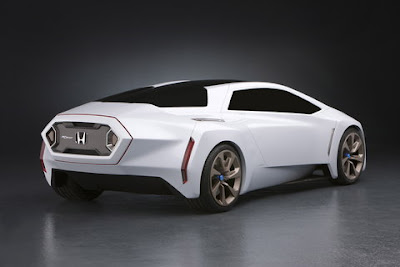
Honda FC Sport Design Study Suggests Hydrogen Sports Car Future
Innovative fuel cell packaging demonstrates green performance potential

11/19/2008 - LOS ANGELES -
Honda today revealed the Honda FC Sport design study model, a hydrogen-powered, three-seat sports car concept, at the 2008 Los Angeles Auto Show.

The FC Sport emphasizes the design flexibility and potential of Honda's V Flow fuel cell technology - already deployed in the Honda FCX Clarity sedan - and reconfigures it into a lightweight sports car design with an ultra-low center of gravity, powerful electric motor performance and zero-emissions. The design study concept is inspired by supercar levels of performance through low weight and a high-performance, electrically driven fuel cell powertrain.

"The Honda FC Sport explores how to satisfy automotive performance enthusiasts in a world beyond petroleum," said Dan Bonawitz, vice president of American Honda Motor Co., Inc. "People who love sports cars will still have a reason to love in a hydrogen-powered future."

The high-output Honda fuel cell powertrain and a sleek, aerodynamic body contribute to the vehicle's performance potential. A modular approach to fuel cell component packaging and the electric drivetrain contribute to the FC Sport's low center of gravity with the majority of vehicle mass distributed between the axles, creating the balanced weight distribution sought after in sports cars.

The ideal placement of the Honda V-Flow fuel cell stack and related components demonstrates the benefits of a platform-specific, hydrogen-powered fuel cell powertrain. The FC Sport is configured to accommodate a custom-formed high-power fuel cell stack, located between the rear seats, and a battery pack placed low in the middle of the vehicle. The electric motor resides just forward of the rear axle. Two fuel storage tanks, visible from above, are located above the rear axle.

The optimal placement of fuel cell components for performance also allows for a relatively large passenger cabin by conventional supercar standards with enough space for three seating positions. The interior layout focuses primarily on the driver with a racecar-like center driving position. The enclosed canopy opens upward from the rear to allow for entry and exit. Two rear passenger seats flank the driver's left and right side.

The sleek, low-profile body is designed to convey a high-technology appearance with sculpting that combines angular shapes in the front of the vehicle that taper into geometric, hex forms in the rear. The rear hex forms house cooling radiators for the fuel cell. Formula 1-style barge boards behind the front wheels enhance high speed aerodynamics and convey the vehicle's racing pedigree. The hydrogen storage tanks, visible from the rear deck, showcase the FC Sports fuel cell technology in much the same way that a "naked bike" motorcycle showcases its engineering technology.

The glacier white body color conveys the FC Sport's clean environmental aspirations while the dark wheels and deeply tinted glass provide a symbolic contrast befitting of the vehicle's unique combination of clean power and high performance. Green construction techniques further contribute to a reduced carbon footprint. An organic, bio-structure theme is carried through to the body construction where exterior panels are intended to use plant-derived bio-plastics.

The Advanced Design Studio of Honda R&D Americas, in Pasadena, California, developed the FC Sport design study with the primary objective of using existing fuel cell technology as the basis for an ultimate Honda sports car. Designer Jason Wilbur led the design efforts.

Honda R&D Americas, Inc. began its operations in California in 1975 with local market research activities and has steadily grown its capabilities over the past 33 years to include all aspects of new vehicle design and development. Recent development efforts include trend-setting products such as the Honda Pilot, Ridgeline, Element, Civic Coupe and Civic Si.

In 2008, the company opened two new design centers in Southern California: the Acura Design Studio (Torrance), for the research and design of new Acura products; and the Advanced Design Studio (Pasadena), for the exploration and development of advanced design themes for both Honda and Acura.

The company operates 11 major R&D facilities in North America, including a full vehicle development center in Raymond, Ohio, and three design studios in Southern California. Honda R&D designers, engineers and support personnel are engaged in the development of Honda and Acura automobiles, powersports products, and power equipment for North America and global markets. The company's main centers of operation include the Los Angeles Center (Torrance, California), responsible for market research, concept development and styling design; the Ohio Center (Raymond, Ohio), responsible for complete product development, testing, and support of North American supplier and manufacturing operations; and a dynamic test facility in Cantil, California.

Source;
http://www.hondanews.com/categories/1097/releases/4879

Good Info on the Hydrogen FCX at H2O Daily

Honda brings the best hope for the future by introducing the World's First Hydrogen powered Fuel Cell car, the FCX Clarity. Honda says that it plans to produce a total of about 200 Clarity models during the next three years. It projects that it will cost close to $1 million to manufacture each car.

Built on the all-new Honda V-Flow fuel cell platform and powered by a highly compact, powerful, and efficient new Honda V Flow fuel cell stack, the FCX Clarity marks the significant progress Honda continues to make in advancing the real-world performance and appeal of the hydrogen fuel cell car.

This hydrogen fuel cell-powered vehicle is propelled by an electric motor that runs on electricity generated in the fuel cell. The vehicle's only emission is water, and its fuel efficiency is three times that of a modern gasoline-powered vehicle. The electric motor generates 127 horsepower and it can produce more electricity than needed to power all the gadgetry found in the vehicle.

This new hydrogen car has significant improvements over Honda's previous generation FCX. The powertrain on this next-generation FCX Clarity are listed here:

• Is over 397 pounds lighter
• Has 120% better power-to-weight ratio
• Is 20% more fuel efficient
• Has a powertrain that is 45% more compact and 10% more energy-efficient

This new model has a lower floor and sleeker overall design, integrating the more compact stack with a smaller powertrain. Its thin A-pillars allow better visibility. A flat-bottom underbody reduces aerodynamic drag and increases efficiency.

The FCX Clarity offers the amenities of a luxury sedan including limousine-like cabin volume, a new lighter lithium ion battery pack, electric steering, a climate control system within the seats to minimize energy use, Honda bio-fabric upholstery, rear camera, floating/layered instrument panel, XM satellite radio, thermo-electrically heated and cooled seats, electronic stability control, adaptive cruise control and a navigation system.

Source;
http://www.h2daily.com/index.php/20080921714/Latest/Hydrogen-powered-Fuel-Cell-Car-Introduced-by-Honda.html