Showing posts with label Honda Robotics. Show all posts

Honda Announces New UNI-CUB Personal Mobility Device Designed for Harmony with People


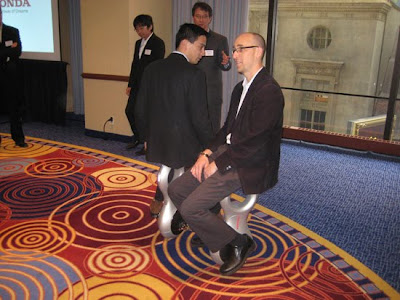
Honda Motor Co., Ltd. today unveiled the new UNI-CUB personal mobility device, designed for harmony with people. Featuring a compact design and comfortable saddle, UNI-CUB offers the same freedom of movement in all directions that a person enjoys while walking. Representing the evolution of the U3-X personal mobility device that Honda announced in 2009, UNI-CUB features Honda's proprietary balance control technology and the world's first omni-directional driving wheel system (Honda Omni Traction Drive System). These technologies allow the rider to control speed, move in any direction, turn and stop, all simply by shifting his or her weight. Since the rider can freely move forward, backward, side-to-side and diagonally, he or she can quickly and easily maneuver among other people.
Moreover, UNI-CUB's compact saddle-style packaging makes it easy for the rider's legs to reach the ground and maintains eye-level height with other pedestrians. This configuration promotes harmony between the rider and others, letting the rider travel freely and comfortably inside facilities and among moving people.
Starting in June 2012, Honda will jointly conduct demonstration testing of UNI-CUB with Japan's National Museum of Emerging Science and Innovation. In addition to testing the feasibility of using UNI-CUB indoors, this project will explore the practical applications of the device in a wide range of environments in Japan and other countries.
The balance control technology of UNI-CUB is part of the Honda Robotics family of technologies, which originates with Honda's research into humanoid robots, including the world-famous ASIMO.
Going forward, Honda will continue its proactive research and development of next-generation mobility technologies, aiming always to offer more and more people the joy and fun that comes from freedom of movement.
Key specifications of UNI-CUB

Size (L x W x H) 520 x 345 x 745 mm
Seat height
745 – 825 mm

Battery type

Lithium-ion battery
Maximum speed 6 km/h
Range 6 km
Application environment
Barrier-free indoor environments

Key features of UNI-CUB:
Maneuverability promotes compatibility with people in many environments:
1. Omni-directional freedom of movement similar to human walking
UNI-CUB has a two-wheel configuration with a minimal wheelbase. The front wheel features the Honda Omni Traction Drive System that Honda first announced in 2009. The rear wheel moves laterally to facilitate turning. By leveraging the different rotational speeds of the front and rear wheel treads during lateral movements, UNI-CUB can move forwards and backwards, side-to-side and diagonally and also turn in place, making possible quick, nimble movement.
2. Movement in harmony with other people
Honda's proprietary balance control technology makes it possible for the rider to freely control the wheels of the UNI-CUB, much as human beings maintain their balance. With a design that takes into consideration the rider's environment, this system allows the rider to maneuver while moving side by side with or holding hands with another person.
3. Compact size for moving and climbing gradients in barrier-free indoor environments
Thanks to UNI-CUB's compact saddle-style packaging, the rider and vehicle together are about the same width as a person when walking. Optimized wheel design and high-precision drive/balance control enhance UNI-CUB's ability to climb gradients in barrier-free indoor environments.

Ease of control promotes freedom of movement:
4. Weight shift control combined with touch panel control
When the rider is using weight shift control, UNI-CUB's incline sensor detects the direction in which the rider is leaning, allowing UNI-CUB to calculate the direction and speed intended by the rider. And touch panel control via smartphone and other devices is another convenient control option.

Source;
http://www.hondanews.com/channels/corporate-headlines/releases/-honda-announces-new-uni-cub-personal-mobility-device-designed-for-harmony-with-people

Honda Unveils All-new ASIMO with Significant Advancements

11/07/2011 - TOKYO, Japan
Honda Motor Co., Ltd. today unveiled an all-new ASIMO humanoid robot newly equipped with the world's first1 autonomous behavior control technology. With a further advance in autonomy, the all-new ASIMO can now continue moving without being controlled by an operator. Moreover, with significantly improved intelligence and the physical ability to adapt to situations, ASIMO took another step closer to practical use in an office or a public space where many people come and go.

1Honda internal research as of Nov. 8, 2011

Since the establishment of the company, Honda has continued to take on new challenges in the effort to create new products and advance technologies with the spirit of utilizing technology to help people. In the area of humanoid robot research, Honda has been developing and advancing the ASIMO humanoid robot to realize a dream to be useful for people and to help enrich people's daily lives.

Honda has a newly established collective name, Honda Robotics, to represent all of its robotics technologies and product applications created through its research and development of humanoid robots. While continuing the research and development of humanoid robots, Honda will also focus on applying robotics technologies to mass-produced products and putting product applications into practical use.

Based on this concept of Honda Robotics, Honda also introduced an experimental model of a task-performing robot arm that was developed while applying multi-joint simultaneous orbit control and posture control technologies amassed through the research and development of ASIMO. This robot arm can be remotely controlled to perform tasks in unstable places which are difficult for people to access.

All-new ASIMO
The all-new ASIMO is now advanced from an "automatic machine" to an "autonomous machine" with the decision-making capability to determine its behavior in concert with its surroundings such as movements of people. At the beginning of the development process, the following three factors were identified as necessary for a robot to perform as an autonomous machine, and the technologies required to realize these capabilities were developed;
1) high-level postural balancing capability which enables the robot to maintain its posture by putting out its leg in an instant,
2) external recognition capability which enables the robot to integrate information, such as movements of people around it, from multiple sensors and estimate the changes that are taking place, and
3) the capability to generate autonomous behavior which enables the robot to make predictions from gathered information and autonomously determine the next behavior without being controlled by an operator. With these capabilities, the all-new ASIMO takes another step closer to practical use in an environment where it coexists with people.

1. Advancement of intelligence capability
Honda has developed a new system that is a fundamental technology for advanced intelligence, which comprehensively evaluates inputs from multiple sensors that are equivalent to the visual, auditory, and tactile senses of a human being, then estimates the situation of the surrounding environment and determines the corresponding behavior of the robot. With this technology, ASIMO became capable of responding to the movement of people and the surrounding situations. For instance, ASIMO will stop its current action and change its behavior to accommodate the intention of the other party. Moreover, coordination between visual and auditory sensors enables ASIMO to simultaneously recognize a face and voice, enabling ASIMO to recognize the voices of multiple people who are speaking simultaneously, which is difficult even for a human being to accomplish.

Further, ASIMO is now capable of predicting the direction a person will walk within the next few seconds based on information from pre-set space sensors and quickly determining to take an alternate path to avoid a collision with the person if the estimated locations of the person and the ASIMO intersect.

2. Advancement of physical capability
The combination of strengthened legs, an expanded range of leg movement and a newly developed control technology that enables ASIMO to change landing positions in the middle of a motion has enabled ASIMO to walk, run, run backward, hop on one leg or on two legs continuously. As a result of acquiring the ability to make such agile motions, ASIMO has become capable of more flexibly adapting to changing external situations so that it can, as an example, walk over an uneven surface while maintaining a stable posture.

3. Improved task-performing capability
Honda has developed a highly functional compact multi-fingered hand, which has a tactile sensor and a force sensor imbedded on the palm and in each finger, respectively, and which acts to control each finger independently. Combined with the object recognition technology based on visual and tactile senses, this multi-fingered hand enables the all-new ASIMO to perform tasks with dexterity, such as picking up a glass bottle and twisting off the cap, or holding a soft paper cup to pour a liquid without squishing it. Moreover, ASIMO is now capable of making sign language expressions which require the complex movement of fingers.

Key specifications of the all-new ASIMO
1. Height
130 cm
2. Weight
48kg (decreased 6kg from previous model)
3. Operating degreesof freedom
Total: 57 degrees of freedom (increase of 23 degrees of freedom from previous model)
4. Running Speed
9km/hour (previous model: 6km/hour)

Establishing a collective name, Honda Robotics, to represent Honda's robotics technologies and product applications
Studying human beings to understand people and learn from people is the root of Honda's manufacturing. While positioning the humanoid robot research as one of the important pillars in the area of studying human beings, Honda has been working to realize various functions of a human being that is the ultimate mobility with intelligence.

Honda newly established a collective term, Honda Robotics, and the logo to represent Honda's robotics technologies and application products created through its research and development of humanoid robot represented by ASIMO.

In addition to the all-new ASIMO and the task-performing robot arm introduced today, the previously introduced the walking assist device with stride management system which supports walking for people with weakened leg muscles, the bodyweight support assist system which reduces the load on legs by supporting part of the bodyweight, and the U3-X, a compact one-wheel-drive mobility device that provides free movement in all directions, are examples of product applications resulting from the application of bipedal technology and balance control technology amassed through the research and development of ASIMO.

Striving to offer next-generation mobility products which expand the joy and fun of mobility, Honda will continue the robotics research that leads to ASIMO, walking assist devices, U3-X and other technologies. In addition, Honda will also work proactively toward putting such product applications into practical use.

Task-performing Robot Arm
Technologies developed for ASIMO were applied to an experimental model of a task-performing robot arm, which moves on a self-propelled base and was designed under the assumption of being utilized at disaster sites or other places too dangerous for people to work. Toward this end, the robot arm was made possible to be remotely controlled to approach the object and stably perform necessary tasks even in a narrow space with unstable footing and many obstacles.

The stability control technology used for ASIMO's walking and running was applied to stabilize the posture of the end of the arm even on an unstable surface so that the robot arm can exert the necessary power output to perform the task. Moreover, the application of other ASIMO technologies such as the compact layout structural designing technique and multi-joint simultaneous orbit control technology that simultaneously controls as many as 57 motors imbedded in the joints of the arms and legs has enabled the robot arm to avoid obstacles and approach an object even in a narrow space with obstacles such as a complicated layout of pipelines.

In the development process, the robot arm is designed to perform the task of opening and closing valves on pipelines; however, it will become capable of performing a variety of tasks by changing the end piece of the arm.

Key specifications of the task-performing robot arm
1. Length
1583 mm (arm length)
2. Width
338mm (base)
3. Depth
391mm (base)
4. Weight
29.5kg
5. Operating degreesof freedom
10 degrees of freedom (including the end piece of the arm)

Source;
http://www.hondanews.com/channels/corporate-headlines/releases/honda-unveils-all-new-asimo-with-significant-advancements

Honda's Asimo Can Now Copy Your Dance Moves

POSTED BY: Erico Guizzo / Fri, September 30, 2011
ASIMO, the Honda humanoid, one of the world's most loved robots, was showing off its dance moves this week at the 2011 IEEE International Conference on Intelligent Robots and Systems in San Francisco.

The robot was here to demonstrate some new tricks it's been learning from scientists at the Honda Research Institute in Mountain View, Calif.

Victor Ng-Thow-Hing, Behzad Dariush, and colleagues work with Asimo seeking to develop robotics technologies that can assist people, especially in terms of mobility.

In one demonstration, the scientists showed how Asimo can mimic a person's movements in real time. The researchers use Microsoft's Kinect 3D sensor to track selected points on a person's upper body, and their software uses an inverse kinematics approach to generate control commands to make Asimo move. The software prevents self collisions and excessive joint motions that might damage its system and is integrated with Asimo's whole-body controller in order to maintain balance. The researchers say that the ability of mimicking a person in real time could find applications in robot programming and interactive teleoperation, among other things.

In another demo, the scientists showed how they're using gestures to improve Asimo's communication skills. They're developing a gesture-generating system that takes any input text and analyzes its grammatical structure, timing, and choice of word phrases to automatically generate movements for the robot. To make the behavior more realistic, the scientists used a vision system to capture humans performing various gestures, and then they incorporated these natural movements into their gesture-generating system.

Here's a video showing these two demos:

Source (via www.autoblog.com);
http://spectrum.ieee.org/automaton/robotics/humanoids/asimo-can-copy-your-dance-moves?utm_source=feedburner&utm_medium=feed&utm_campaign=Feed%3A+IeeeSpectrum+%28IEEE+Spectrum%29

Honda denies nuclear mission for robot

There was a report that Honda was going to outfit ASIMO with a few upgrades to help out in the disaster in Japan;

http://gizmodo.com/5830373/hondas-most-adorable-robot-is-about-to-go-nuclear

TOKYO — Japan's Honda has denied a press report it is hoping to retool its humanoid robot ASIMO to enable it to join emergency work inside the crippled Fukushima Daiichi nuclear power plant.


The Japanese newspaper Asahi Shimbun said in its Friday evening edition that Honda was aiming to upgrade the robot's upper body functions so that it can move its arms as smoothly as a human being.


US Honda spokeswoman Lauren Ebner said the report was "speculation."


"Although Honda hopes that ASIMO will someday be a helper to people, at this point the robot is solely a research and design project," Ebner said in a statement to AFP.


No official at Honda's head office in Tokyo was available for comment on Friday.


The current ASIMO, introduced in 2000 and resembling a small astronaut, stands 130 centimetres (4 feet 3 inches) tall. The bipedal bot can walk, run, carry trays, push carts and shake hands with people.


Asahi said that to work in the debris-strewn nuclear plant, ASIMO would likely be modified and fitted with tyres or caterpillar tracks.


The Fukushima plant has been leaking radiation from its reactors since its cooling systems were knocked out by the March 11 earthquake and tsunami. At some hotspots radiation is high enough to be lethal to humans.


Robots have already been used inside the plant to take video footage, including the US-made PackBot and Japanese-made Quince crawler robots.


Source;

http://www.google.com/hostednews/afp/article/ALeqM5g7m9qLNugC96cUAu4BGNJPVA8Dxg?docId=CNG.1cc437d7d61fc59f3394a87a1a28abbb.171

ASIMO Humanoid Receives Honor as World’s Most Advanced Humanoid Robot

Honda’s ASIMO (Advanced Step in Innovative Mobility) humanoid robot has set a new world record and has been honored as the World’s Most Advanced Humanoid Robot.

The ASIMO humanoid is part of Honda’s R&D initiatives in robotics and human mobility fields. The robot was developed at Honda's R&D Wako Fundamental Technical Research Center before ten years.

All joints of ASIMO include 34° of Freedom, enabling the robot to effectively respond to the natural human motions. It can identify various objects as well as the landscape of its environment. It can understand easy verbal instructions, identify faces and evades mobile obstacles as it moves.

The company launched several applications in the iphone and smartphone (A ‘Run with Asimo’) enabling users to communicate with a virtual ASIMO robot on their mobile.

The Honda engineers worked for ten years to develop the latest version. The robot can now walk and run on all irregular surfaces. It can even climb staircases and stretch to grab objects.

The ultimate mission of Honda’ robotics department is to enable ASIMO to help humans for performing their daily tasks and to carry out risky operations.

Source;
http://www.azorobotics.com/details.asp?newsID=902

Honda makes short film on robots

I will use any excuse to post this picture....
Instead of cranking out a few more commercials, Honda is taking a different approach. It's making short films about some pretty interesting, and varied, topics.

The one about robots is especially well done. It's basic message: Robots are here to help us, says the company that brought you Asimo, pictured above. We have nothing to fear. There. If robots take over the world, blame Honda.

The goal of the films, a far longer format than any ad, was "telling the story we are already telling within the walls of Honda," said Barbara Ponce, Honda's U.S. ad chief. Doing it through short films works because "there wasn't enough time to tell the story and it wasn't breaking through in the 30-second spots."

Source;
http://content.usatoday.com/communities/driveon/post/2010/11/honda-makes-short-film-on-robots/1

Honda Conducts European Public Research to Perfect Human-Robot Interaction

Living with HUMANOID Robots

HONDA CONDUCTS EUROPEAN PUBLIC research to perfect
Human-Robot INTERACTION

A research project will be conducted this week in Linz, Austria, to discover what the ideal interaction between people and humanoid robots ought to be in the future, Honda R&D and Ars Electronica Futurelab announced today. The research, the first of its kind in Europe, will involve members of the public directly interacting with ASIMO, Honda's humanoid robot.

The findings from this and similar research around the world will be integrated into the functionality of future versions ASIMO. It will also help realise a humanoid robot that can interact effortlessly with people in a living environment and take on some the tasks that would help make people's lives easier.

For nearly a quarter of a century Honda has made significant progress towards this goal. The latest generation of this research is Honda's ASIMO, widely regarded as the most advanced humanoid robot. ASIMO, which stands for Advanced Step in Innovative MObility, features functionality including high-level mobility and an ability to give and receive objects.

Satoshi Shigemi, Large Project Leader of ASIMO development, Honda R&D Co., Ltd., said:

"This is an exciting collaboration for us with Ars Electronica Futurelab, which has a long history of investigating human-machine interaction and design. It is a significant milestone in our development of ASIMO and an important piece of human-robot interaction research to examine the diverse levels of robot acceptance and interaction around the world. We've already held research in Japan and in time we will conduct similar research in different cultures and different parts of the world."

He added: "The aim of this research is to better understand what the ideal interaction and communication between people and humanoid robots ought to be in the future. People need to be able to comfortably communicate with the robot so that it can react properly to their commands and carry out their wishes when assistance is needed."

The collaborative research with members of the public visiting the Ars Electronica Center will take place from the 2nd to 8th September 2010 during the Ars Electronica Festival in Linz, Austria. Leading experts from around the globe in the fields of robotics, futurology and design will gather at the Festival.

Source;
http://www.hondanews.eu/en/news/index.pmode/modul,detail,0,1579-DEFAULT,21,text,1/index.pmode

Robot Wars: Osaka Tower Robot Versus Honda Asimo

Japan's Tsutenkaku Robot, a rather unwieldy construction based on Osaka's Tsutenkaku Tower, was recently shown off in Tokyo's Akihabara district. During the robot's exhibition, the developers brought the robot over to a nearby store for a photo opportunity with Honda's Asimo robot.

Weighing in at around 66 pounds and 5 feet 7 inches tall, the robot's main function is to promote tourism to Osaka, thus its limited feature set can be excused as it hobbles around Japan Frankestein-like. You can see video of the Tsutenkaku Robot in action here.

Source;
http://dvice.com/archives/2010/04/robot-wars-osak.php

Hands On with Honda's U3-X Personal Mobility Prototype

Honda's remarkable U3-X personal mobility prototype is the device Segway inventor Dean Kamen should have introduced. Shaped like a figure 8, Honda's omni-directional, robotics-controlled U3-X is like an intelligent unicycle, where your own balancing skills are not required.

Unveiled last year at the Tokyo Motor Show, the U3-X has never been ridden in the U.S.—until now. I got a rare chance to try out the prototype at an invite-only event in Manhattan. Honda execs started the afternoon with a brief overview of the U3-X. The device, at roughly 25 inches high and six inches wide, is small enough to fit between your legs. Two small foot rests flip out from either side, and the top half of the device opens, butterfly-style, to provide a cushioned leather seat. The U3-X weight about 22 lbs and has a handle on top for easy carrying. However, since the U3-X balances itself (a trick learned from Honda's ASIMO robot), you can simply hold the handle and roll it along. Its lithium-ion battery holds an hour charge and features a rather unique omni-directional wheel system (called an Omni Traction Drive System) that can roll forward on the full-size wheel or sideways on dozens of little wheels that sit inside the larger wheel. Balancing is provided by accelerometers and sensors that detect the rider's center of gravity and make constant adjustments to keep the U3-X and rider in perfect balance. Riding is simply a matter of leaning, slightly, in the direction you want to go.

After the talk, we got a brief primer on exactly how to ride the U3-X: While facing away from the device, hold the seat with two hands and back onto the U3-X. At the same time, put one foot on one footrest. Sit down and then pick up the other foot. This worked for me exactly as described and within seconds I was gliding across the floor. Subtle movements of my upper back and shoulders sent to forward, back and side-to-side. To make, say, a hard right or left turn, I'd put one foot on the floor and gently turn. I rarely had to do this, though, because the U3-X responded to even my most subtle movements. The U3-X can travel up to three MPH, but even at this top speed, I never felt like I had to make a sudden movement to stop or avoid a collision. I just leaned back a bit in the opposite direction and the U3-X stopped. At one point, I rode in unison with another U3-X rider. I never feared falling and noticed that bumping into the other rider didn't send the U3-X or me into a tail spin.

I've ridden a Segway and, while it's an amazing device, it was never this simple or—more importantly—unobtrusive. A product like this that allow personal mobility to the able and, potentially, disabled, without needing special pathways, or sticking out like a store thumb, is something else altogether.

Honda wouldn't share the software platform or actual CPU intelligence inside the U3-X. That's not surprising for a prototype device. More distressing, though, is that the product, which took years develop has no "to-market" plan—or at least not one Honda would share. Honda execs would only say that it's still a prototype and they don't know when consumers will get their hands—or butts—on it.

Source;
http://www.pcmag.com/article2/0,2817,2362334,00.asp

P4: Honda’s Asimo humanoid gets a re-design after 13 year [Update: No, he doesn't]

Honda’s Asimo is probably the world’s most famous humanoid robot. The company today leaked the first technical details and pictures of the fourth version of Asimo, the P4. And the new and improved Asimo, which took 13 years for Honda to develop (P3 was unveiled in 1997), looks much more elegant and human astronaut-like than the previous models.

Standing 160cm tall, Asimo is probably only second in height to “tower robot” Tsutenkaku. P4 is as tall as P3, but Honda managed to reduce his weight from 130kg to 80kg. He now has 34 joints (two more joints in each hand than P3) and is said to be able to dance better than his predecessors (“dancing” was always one of Asimo’s special skills).

Update: Sorry readers, it looks as if P4 is just being publicly displayed in a museum in Japan, and Honda isn’t planning to manufacture the robot currently. We’ll tell you when they do.

Source;
http://www.crunchgear.com/2010/03/23/p4-honda’s-asimo-humanoid-gets-a-re-design-after-13-years/

Honda Technology Connects Brain with Robotics

"The circle is now complete. When I left you, I was but the learner; now *I* am the master."
A new device developed in Japan by Honda Motor Company can analyze thought patterns and actually relays them as wireless commands.

Straight out of a science fiction tale, now opening a car trunk or even controlling a home air-conditioner becomes merely a thought.

Honda’s robot is known as Asimo. Shaped like a human, it receives wireless commands via electric currents on a person’s scalp. Asimo can also decipher changes in cerebral blood flow whenever a person thinks about four movements; namely, moving the right hand, moving the left hand, running and eating.

According to Honda, a leader in the field of robotics, the technology is not quite ready for a live demonstration and is still in research stages for a number of reasons. Distractions in a person’s thinking could offset Asimo, and brain patterns differ greatly among individuals, which means advance study of at least two years is required in order for the technology to function. Also, the reading device needs to be smaller so it can be portable.

A recent video reveals a man wearing a helmet that is seated and thinking about moving his right hand. His thought is transmitted to the robot by cords attached to his head inside the helmet. It took a few seconds, but then Asimo, dutifully programmed to respond to brain signals, lifted its right arm.

Yasuhisa Arai, executive at Honda Research Institute had this to say regarding the project:
“I’m talking about dreams today. Practical uses are still way into the future. Our products are for people to use. It is important for us to understand human behavior. We think this is the ultimate in making machines move.”

Deciphering brain patterns represents an important breakthrough in medical research. All over the world, scientists are attempting to unlock the mysteries of the human brain, but Honda believes its research in the field is among the most advanced and least invasive anywhere.

Embedding the necessary sensors under the skin is a painless procedure that is easily tolerated. The Japanese government is encouraging this robotic research as it sees the industry as a path to growth.

Asimo is a Honda celebrity, appearing in television ads and at various public events. He fascinates all who view him, but as of yet, he cannot sign autographs. Hopefully that day will some soon.

Source;
http://www.ethiopianreview.com/news/8027

Honda’s very own Segway: the U3-X

Both Honda and Toyota seem to be quite interested in producing Segway-like personal mobility devices for human usage. Toyota has the i-REAL, and this latest gadget from Honda is called the U3-X. It’s still a concept for now, a compact experimental device that fits between the rider’s legs, to provide free movement in all directions just as in human walking – forward, backward, side-to-side, and diagonally.

Honda’s balance control technology – gained from the robotics research of Honda’s bi-pedal ASIMO robot – enables the rider to control the U3-X by leaning his or her upper body to shift body weight. The U3-X moves via a wheel that Honda calls the Honda Omni Traction Drive System, or HOT Drive System. The letter U stands for “unicycle” and “universal”.

It enables movement in all directions, including not only forward and backward, but also directly to the right and left and diagonally. Basically you sit on it like a stool, and lean around to move. The height of the device is designed to enable the user to be placed roughly the same eye level as other people. Top speed isn’t much, considering your upright position perhaps it’s for the better. You can travel at speeds of up to 6km/h. The U3-X itself weighs less than 10kg, can run for an hour with a full charge, and uses a lithium ion battery.

The U3-X will be one of Honda’s exhibits at the 41st Tokyo Motor Show 2009 that will happen towards the end of October 2009. You can probably expect the new Honda boss Takanobu Ito to ride out onto the stage on one of these to deliver his opening speech.

Source with Video and more pics;
http://paultan.org/2009/09/24/hondas-very-own-segway-the-u3-x/#more-16335

Blue Energy Begins Construction of New Plant

One more step closer to.....WORLD DOMINATION!!!!KYOTO, Japan, April 21, 2009 - Honda Research Institute Japan Co., Ltd. (HRI-JP), a subsidiary of Honda R&D Co., Ltd., Advanced Telecommunications Research Institute International (ATR) and Shimadzu Corporation have collaboratively developed the world’s first*1 Brain Machine Interface (BMI) technology that uses electroencephalography (EEG) and near-infrared spectroscopy (NIRS) along with newly developed information extraction technology to enable control of a robot by human thought alone. It does not require any physical movement such as pressing buttons. This technology will be further developed for the application to human-friendly products in the future by integrating it with intelligent technologies and/or robotic technologies.

During the human thought process, slight electrical current and blood flow change occur in the brain. The most important factor in the development of the BMI technology is the accuracy of measuring and analyzing these changes. The newly developed BMI technology uses EEG, which measures changes in electrical potential on the scalp, and NIRS, which measures changes in cerebral blood flow, with a newly developed information extraction technology which enables statistical processing of the complex information from these two types of sensors. As a result, it became possible to distinguish brain activities with high precision without any physical motion, but just human thought alone.

The BMI technology announced by HRI-JP and ATR in 2006 used a functional magnetic resonance imaging (fMRI) scanner to measure brain activities. The large size and powerful magnetic field generated by the fMRI scanner limited the locations and conditions where it can be used. As the newly developed measuring device uses EEG and NIRS sensors, it can be transported to and used in various locations.

<>
First, EEG and NIRS sensors are placed on the head of the user. Then, one of four pre-determined body part options*2 is provided to the user. The user imagines moving that body part without making any physical movement. Changes in both brain waves and cerebral blood flow triggered by the brain activity are measured simultaneously. The data obtained are analyzed on a real-time basis to distinguish what the user imagined. Upon receiving the result, Honda’s ASIMO humanoid robot makes corresponding movements such as raising its arm or leg. The world’s highest level*3 accuracy rate of more than 90% was achieved in the tests.

Since 2005, Honda and ATR have been conducting research and development of BMI technology exploring the potential of a new interface which connects people and machines. Honda is looking into the possibility of applying this technology to a people-friendly human interface through integration with other technologies such as artificial intelligence technologies and/or robotics technologies. In May 2006, Honda and ATR successfully developed a BMI technology which utilizes a fMRI scanner and achieved the first success in the world to control a robot hand by decoding brain activities without electrode array implants or special training of the user.

About BMI
While conventional machine-interface uses devices such as switches which need to be operated by a user’s hands or feet, BMI uses brain activity data measured by various devices and enables non-contact control of the machines (such as robots). Invasive BMI, which is widely studied by U.S. and European researchers, requires the surgical implant of electrode arrays, whereas non-invasive BMI uses sensors touching the user’s scalp.

Source;
http://world.honda.com/news/2009/c090421Blue-Energy/

Gizmodo; How It Feels To Walk With Honda's Cyborg Legs

Few geeks haven't dreamt of one day taking on cyborg enhancements—me included. And today I did, thanks to two of Honda's wearable Asimo-inspired Walk Assist devices. This is how it felt.

I strapped on Honda's fresh-from-the-labs Stride Management Assist and Bodyweight Support Assist rigs, and both devices made me feel totally unstoppable, albeit in a goofy sort of way. The whole time I felt the need to go do something great, like go on a cross-country jog or blast into outer space to join a robot colony.

I'm definitely not the target demographic for either device, which Honda's Fundamental Research Institute hopes will help mobilize and rehabilitate Japan's rapidly aging population or lessen the leg fatigue of factory workers who stand and crouch for hours on end. But of course, this didn't stop me from jumping at the opportunity to strap them on and stomp around; this is the first time Honda's prototypes have been presented on U.S. soil.

Stemming directly from Asimo research, Honda's learned so much about how bipeds walk that they can now produce devices that react to human motion in real time to support the motion of walking, using just a few simple sensors each. The magic is in the processing software which was refined with Asimo.

The first one I strapped on, the Bodyweight Support Assist (the one with the saddle) reduces the load on the user's legs to help with physically demanding activities. This one was definitely a bit more cumbersome to wear, but aside from riding up your crotch a bit (it doesn't exert upward pressure, much to Mahoney's relief), the experience is pretty cool. The system operates using just two tread sensors in the soles of the sweet built-in Velcro sneakers and two lift sensors in the legs which register the upward motion of your stride, as well as the orientation. There is zero delay, and you never feel like the device is controlling your movement. It reacted instantly to my motions and enhanced everything I did, like an exoskeleton.

Mundane activities like walking up the stairs and crouching down suddenly became fun and much easier—the saddle provides anywhere from 6.5 to 18 pounds of support when you lean back in it, which isn't enough to sit down on, obviously, but it's certainly noticeable and makes crouching easier. Personally, I had a little issue navigating the stairs and nearly fell backwards, as you can see in the video. Apparently my feet were too small for the sneaker sensors to pick up properly, making the whole device jerk my legs around more than was expected on the stairs. But even Asimo takes a tumble now and then, so wearing his legs, it was only natural that I had a stumble at some point. But when the shoes fit, the experience is absolutely natural.

Second was The Stride Management Assist, which straps on like a belaying harness and weighs practically nothing. It regulates the person's stride and walking pace, making walking much easier for the elderly or disabled while still building up their own muscles. The device was by no means discreet looking, but frolicking around in it felt very natural—just better, as my movements were enhanced almost immediately. The robo hip-huggers definitely perked up my posture and made me move around more confidently, giving gentle support to my legs during all parts of my stride. Walking up and down stairs, you can feel the complex processing involved, with more support given on the way up than on the way down.

Both devices have a sleek look, which Honda hopes to refine even further as they reduce the weight. Battery life for each is around two hours on a single charge, which will also get better as batteries get lighter. Even though Honda's tested both devices in real-world scenarious—the Stride Management Assist in a hospital, and the Bodyweight Support Assist in one of their factories in Saitama, there is no timeline for actual retail availability, but Honda does intend to come up with a finished product for sale eventually.

Which means most people will have to go on dreaming of the cyborg life, but hopefully not for much longer.

Source;
http://i.gizmodo.com/5212161/how-it-feels-to-walk-with-hondas-cyborg-legs

Honda, ATR and Shimadzu Jointly Develop Brain-Machine Interface Technology Enabling Control of a Robot by Human Thought Alone

Ah yes, those Honda Scientists are at it again....
TOKYO, Japan, March 31, 2009 - Honda Research Institute Japan Co., Ltd. (HRI-JP), a subsidiary of Honda R&D Co., Ltd., Advanced Telecommunications Research Institute International (ATR) and Shimadzu Corporation have collaboratively developed the world's first*1 Brain Machine Interface (BMI) technology that uses electroencephalography (EEG) and near-infrared spectroscopy (NIRS) along with newly developed information extraction technology to enable control of a robot by human thought alone. It does not require any physical movement such as pressing buttons. This technology will be further developed for the application to human-friendly products in the future by integrating it with intelligent technologies and/or robotic technologies.

During the human thought process, slight electrical current and blood flow change occur in the brain. The most important factor in the development of the BMI technology is the accuracy of measuring and analyzing these changes. The newly developed BMI technology uses EEG, which measures changes in electrical potential on the scalp, and NIRS, which measures changes in cerebral blood flow, with a newly developed information extraction technology which enables statistical processing of the complex information from these two types of sensors. As a result, it became possible to distinguish brain activities with high precision without any physical motion, but just human thought alone.
The BMI technology announced by HRI-JP and ATR in 2006 used a functional magnetic resonance imaging (fMRI) scanner to measure brain activities. The large size and powerful magnetic field generated by the fMRI scanner limited the locations and conditions where it can be used. As the newly developed measuring device uses EEG and NIRS sensors, it can be transported to and used in various locations.

Test procedures for experiments with the new BMI

First, EEG and NIRS sensors are placed on the head of the user. Then, one of four pre-determined body part options*2 is provided to the user. The user imagines moving that body part without making any physical movement. Changes in both brain waves and cerebral blood flow triggered by the brain activity are measured simultaneously. The data obtained are analyzed on a real-time basis to distinguish what the user imagined. Upon receiving the result, Honda's ASIMO humanoid robot makes corresponding movements such as raising its arm or leg. The world's highest level*3 accuracy rate of more than 90% was achieved in the tests.

Since 2005, Honda and ATR have been conducting research and development of BMI technology exploring the potential of a new interface which connects people and machines. Honda is looking into the possibility of applying this technology to a people-friendly human interface through integration with other technologies such as artificial intelligence technologies and/or robotics technologies. In May 2006, Honda and ATR successfully developed a BMI technology which utilizes a fMRI scanner and achieved the first success in the world to control a robot hand by decoding brain activities without electrode array implants or special training of the user.
About BMI

While conventional machine-interface uses devices such as switches which need to be operated by a user's hands or feet, BMI uses brain activity data measured by various devices and enables non-contact control of the machines (such as robots). Invasive BMI, which is widely studied by U.S. and European researchers, requires the surgical implant of electrode arrays, whereas non-invasive BMI uses sensors touching the user's scalp.

*1, 3 According to Honda and ATR in-house research.
*2 For this particular research experiment, the four options were left hand, right hand, tongue and feet. The user creates a mental image of moving the selected body part.
Source;

Honda robot spices up Insight launch in Europe

By Chang-Ran Kim, Asia autos correspondent

GENEVA (Reuters Life!) - Don't tell the boss, but Honda Motor Co may have managed to successfully replace its chief executive with a humanoid robot.

At least, that is, to show off the latest addition to Honda's car line-up at the Geneva auto show on Tuesday.

Like virtually all other carmakers, Honda is looking to save cash anywhere it can as plummeting vehicle sales hammer profits.

So instead of calling a press conference with the top brass attending, which is common practice at international motor shows, Japan's No.2 automaker employed its four-feet-tall robot Asimo to introduce the Insight hybrid, which will go on sale in Europe this month.

"I'm really interested in hybrid technology," the bubble-headed robot said in a boyish voice after being introduced by a Honda spokesman at the company's booth at the show.

Asimo, who normally resides in a studio in Brussels, is scheduled to do several shows a day when the Geneva auto show opens to the public later this week.

"It was cheaper than flying the CEO over from Tokyo for the show," said Shigeki Endo, a spokesman for Honda.

Another spokesman said both the Insight hybrid car and Asimo were "the result of the dream and hard work" of engineers at Honda, which is looking to make a business out of selling humanoid robots one day to assist the elderly or do simple work around the office, such as distributing mail.

During a 20-minute presentation for journalists Asimo fetched two green teas and stood diligently by the Insight on the stage as the spokesman chatted with an engineer about the merits of Honda's first low-cost hybrid car.

After some specifications were rattled off including the car's top speed of 189 km (117 miles) per hour, Asimo waved both hands in a plea for attention.

"I also run on batteries, and my top speed is impressive too," he said.

When Asimo was invited to perform, the robot walked to the front of the stage, loosened up his knees and ankles and dashed across the stage at 6 km/hour -- a record for his kind.

Source;
http://www.reuters.com/article/GCA-autos/idUSTRE5227QH20090303

Honda robot Asimo set to make appearance at science spectacular

THE world's most advanced humanoid robot is to make an appearance in the Capital later this year, as part of a 21st birthday programme for the Edinburgh International Science Festival.

Highlights of this year's programme, which was launched this morning, include a chance to take a first-hand look at the revolutionary ASIMO robot.

There will also be a spectacular exhibition examining the very edges of the universe, a sleepover at Edinburgh Zoo and a chance to get hands-on with the latest advances in renewable energy.

Launching the programme on the 200th anniversary of Charles Darwin's birth, festival director Simon Gage also announced a series of events celebrating the man and his revolutionary ideas.

Mr Gage said: "This is a spectacular programme packed with some of the best popular science events you'll find anywhere in the world.

"It's a sensational way to celebrate the 21st birthday of the first, and I believe best, science festival in the known universe.

"It is a festival that befits an inventive nation that continues to pioneer ways of making the world a better place."

In total, this year's festival will include 170 events in 26 venues over two weeks.

The most eye-catching element of the programme is the first visit to Scotland by ASIMO, which has been created by Honda over the last 22 years.

It is the only robot in the world that walks on two legs, runs, climbs up steps, dances, recognises people and speaks.

The City Art Centre will, for the first time, host part of the family programme – offering seven floors of hands-on experiments and activities.

For more on the article;
http://news.scotsman.com/scitech/Honda-robot-Asimo-set-to.4972822.jp

Giant Robot Attack!!!! 49ft ASIMO Float

If you thought Asimo falling down the stairs (aww, that's just not funny anymore! ;) )was funny, wait until this epic 49-foot-tall version of Honda's robot falls down during the Rose Parade, crushing dozens of bedazzled dancers.

Yes, Honda made a nearly 50-foot-tall version of its not-so-nimble robotic friend, and it'll be heading down the Rose Parade route on New Year's Day. Also, it will be wearing a big top hat, which is a nice touch.

Source;
http://gizmodo.com/5114514/49+foot+tall-honda-asimo-robot-to-terrorize-spectators-at-the-rose-parade

Honda Unveils Experimental Walking Assist Device With Bodyweight Support System

Better hope this doesn't malfunction in that position.....
Japan, November 7, 2008–Honda Motor Co., Ltd. unveiled its second experimental walking assist device that helps support bodyweight to reduce the load on the user's* legs while walking, going up and down stairs, and in a semi-crouching position. Honda will now begin testing the device in real-world conditions to evaluate its effectiveness.
The new walking assist device with the bodyweight support system reduces the load on leg muscles and joints (in the hip, knees, and ankles) by supporting a portion of the person's bodyweight. The device has a simple structure consisting of seat, frame, and shoes, and the user can put it on by simply wearing the shoes and lifting the seat into position. Moreover, a mechanism that directs the assisting force toward the user's center of gravity and the ability to control the assist force in concert with the movement of the legs – both unique Honda innovations – make it possible for the device to provide natural assistance in various postures and motions.
Honda began research of a walking assist device in 1999 with the goal to provide more people with the joy of mobility. Honda developed the knowledge required to develop the walking assist device from its thorough study of human walking represented by the research and development of Honda's advanced humanoid robot, ASIMO. This research has been conducted by the Fundamental Technology Research Center of Honda R&D Co., Ltd. in Wako, Saitama. To evaluate the effectiveness of the experimental model of the walking assist device with bodyweight support system, Honda will test the walking assist device at its Saitama Factory (in Sayama, Saitama) starting this month.
*This device is designed for people who are still capable of walking on their own.
For the rest of the news release;