Showing posts with label Honda Design Study. Show all posts

Honda Commits to Finding it's Way Back to Roots

By Chang-ran Kim And Ben Klayman, Reuters

The future of Honda Motor Co. may rest with a pair of contrarian Japanese car engineers working from a drab Tokyo suburb with a hotline to the boardroom. Their mission: just say no.

Honda's creative directors, Toshinobu Minami and Yoshinori Asahi, are out to kill any mediocre car designs rumbling down the pipeline. In short, they have been told to stop anything like the 2012 Civic, a cheapened redesign that prompted critics, consumers and rivals to wonder how Honda had so badly lost its way.

Inside Honda, in both Japan and the United States, that same question has also been asked with urgency.

Honda, many say, slipped into designing cars by committee in recent years and drifted away from the iconoclastic ambitions of its founder.

Honda had become boring.

"Somewhere along the way, we lost the ability to express ourselves more freely," Asahi said. "We have a lot of designers here, and when we ask ourselves, 'Which Honda car would we want to buy?' sometimes some of us draw a blank."

That's a startling admission at a company long praised for the quality and durability of its vehicles - a company that caught U.S. automakers flat-footed in the 1970s with inexpensive, fuel-efficient cars like the original Civic.

Touted four decades ago for its CVCC engine that boasted cleaner tailpipe emissions - as well as inspiring the Civic name - Honda has trailed with advances such as six-speed transmissions and direct fuel-injection systems.

In recent years, Honda's "car guys," the engineers that built the automotive upstart into a powerhouse, were overshadowed by the "bean counters," financial executives more willing to cut corners on vehicle content to shore up margins, insiders say.

That approach looks good on a spreadsheet, but it also carries the risk of a backlash. Consumers can turn on a debased version of a popular car and the resulting publicity can burn a brand - a lesson GM, Ford and Chrysler all learned the hard way in the slide to crisis in 2008.

Ironically, Detroit's willingness to settle for also-ran status in small-car quality created the opening for Honda in the 1970s and 1980s. Now, analysts and industry executives wonder whether Honda can rekindle the underdog ambition of founder Soichiro Honda.

Changes at Honda can't come soon enough after a terrible year. Slow to recover from the earthquake and tsunami in Japan a year ago, Honda's U.S. sales tumbled seven per cent in 2011. By contrast, Nissan bounced back with a 14 per cent sales gain to almost match Honda's market share. Meanwhile, Hyundai Motor Co. and its affiliate Kia Motors Corp. have overtaken Japanese automakers as the benchmark for value-for-money.

"Honda somehow managed to get very, very far away from their engineering discipline," AutoTrends Consulting president Joseph Phillippi said, adding it could take three years for Honda to show it has turned the corner in car development.

Honda's earnings remain supported by a strong finance arm and its leading motorcycle business. In addition, the automaker is taking steps to shift more production to North America to shore up profitability.

In another move that shows the importance Honda attaches to getting it right in the United States, the board last month promoted North America chief Tetsuo Iwamura to become the No. 2 global executive, the first time that job has been based outside Japan.

But behind the scenes, the battle for Honda's automotive soul is being played out in places like Asahi and Minami's sprawling third-floor studio in the Tokyo suburb of Wako. If the upscale Aoyama neighbourhood that houses Honda's headquarters can be likened to New York's Fifth Avenue, then Wako would be a dreary town in New Jersey.

Since September, when they were promoted to fix Honda's car designs, Asahi, 47, and Minami, 44, have been working from Wako with a mission to shake things up. Both worked in the early 1990s on the fourth-generation Accord, a bigger Honda that won praise for its simplicity and a near-indestructible fourcylinder engine.

Honda's creative duo now have a direct line to chief executive Takanobu Ito. Frustrated with the pace of decision-making at Honda, Ito has put himself in charge of Honda's car operations, splitting the core of the company into three units headed by engineers: the Acura brand, mid-sized vehicles and small cars.

Honda is rushing a redesigned Civic to market late this year, essentially a facelift to protect the image of a car that is key to both Honda's future and heritage.

Source;
http://www.calgaryherald.com/business/Honda+will+revamp+after+dent+from+Civic/6245829/story.html

Honda Pegasus Study Inspired by... Harley Earl's GM Firebird Concepts

Automotive designers find inspiration in all kinds of places. For independent designer Andrus Ciprian from Romania, it was Harley Earls' legendary GM Firebird concept cars of the 1950s. The thing is that he didn't use this inspiration on a GM product but on a futuristic Honda racing car design study that he named Pegasus.

The Romanian designer has dreamed up a small gas-turbine jet engine as the power source for the imaginary winged prototype, while other features include specially designed wheels that increase air-flow to the brakes. Full mage gallery after the break.

Source;
http://carscoop.blogspot.com/2010/07/honda-pegasus-study-inspired-by-harley.html

Honda Design Explain Changes to Production CRZ

For the first time in its history, Honda invited a select group of North American media to pay a visit to its design studio this week following the Tokyo Motor Show. While we didn't see any secret new cars today, we did sit down for a chat with Nobuki Ebisawa, general manager of global design for Honda. Among other things we discussed the design of the new CR-Z hybrid sport coupe.

Honda unveiled an updated concept version of the CR-Z at the show that is actually a very thinly veiled version of the production model that will debut at the Detroit Auto Show in January. The new concept remained on the show floor while the original 2007 concept was on display in the studio along with two quarter scale clay models. One model was of the original proposal from early 2007 while the other model was the 2009 concept. The original proposal model and the production car are both the work of Motoaki Minowa, while the actual concept that was built in 2007 was produced by Makoto Iwaki. Read on to learn more about the changes.

In many respects the production car is closer in detail to that 2007 Minowa model than to the 2007 full-size Iwaki concept, particularly in the character lines on the flanks that yield a bit of a cutout in the middle of the car.The Iwaki design has flatter sides.

There are other differences from both original designs to the production car. The sides of the greenhouse have been more vertical than inward sloping tumble home of the concepts. This was done to provide a more spacious feeling interior for occupants. Further aiding interior space is a higher roof. The other big change was the wheelbase which was shortened although we don't have exact dimensions.The result is a longer front overhang on the production car although the overall length of the production model is unchanged.

Ebisawa-san explained that this was done for several different reasons. The longer overhang provides more crush space to help with crash safety performance. It also allows more tapering of the front corners (as seen from above) which aids both pedestrian safety performance and air-flow for reduced aerodynamic drag. Another benefit that Ebisawa-san highlighted was improved, more nimble handling that results from the shorter axle span.

Ebisawa-san also answered our question about the grille shape of the CR-Z and the similar nose of the SkyDeck concept that also debuted in Tokyo. We asked if this design would become the new Honda standard. Ebisawa-san explained that unlike Acura, Honda won't be using a single face for its entire lineup. Instead it will have different looks for different families just as the light truck/SUVs already differ from cars in the US. The CR-Z style scoop grille will be reserved for sporty models.

Source;
http://www.autoblog.com/2009/10/23/honda-design-boss-discusses-changes-to-production-cr-z/

Honda FC Sport Concept Car to Make Canadian Debut

Hydrogen-powered Sports Car Concept Points to Future Direction

TORONTO, Feb. 2 /CNW/ - The Honda FC Sport design study model, ahydrogen-powered, three-seat sports car concept, will make its Canadian debuton February 11 to members of the press at the press preview of the 2009 Canadian International Auto Show in Toronto which opens to the public on Friday, February 13.

The FC Sport emphasizes the design flexibility and potential of Honda's VFlow fuel cell technology - already deployed in the Honda FCX Clarity sedan -and reconfigures it into a lightweight sports car design with an ultra-lowcenter of gravity, powerful electric motor performance and zero-emissions. Thedesign study concept is inspired by supercar levels of performance through lowweight and a high-performance, electrically driven fuel cell powertrain.

"The Honda FC Sport explores new ways to satisfy automotive performanceenthusiasts in a world beyond petroleum," said Jerry Chenkin, executive vicepresident of Honda Canada Inc. "People who enjoy sports cars will not beforgotten by Honda in a hydrogen-powered future." The high-output Honda fuel cell powertrain and a sleek, aerodynamic bodycontribute to the vehicle's performance potential. A modular approach to fuelcell component packaging and the electric drivetrain contribute to the FCSport's low center of gravity with the majority of vehicle mass distributedbetween the axles, creating the balanced weight distribution sought after insports cars.

The ideal placement of the Honda V-Flow fuel cell stack and relatedcomponents demonstrates the benefits of a platform-specific, hydrogen-poweredfuel cell powertrain. The FC Sport is configured to accommodate acustom-formed high-power fuel cell stack, located between the rear seats, anda battery pack placed low in the middle of the vehicle. The electric motorresides just forward of the rear axle. Two fuel storage tanks, visible fromabove, are located above the rear axle.

The optimal placement of fuel cell components for performance also allowsfor a relatively large passenger cabin by conventional supercar standards withenough space for three seating positions. The interior layout focusesprimarily on the driver with a racecar-like center driving position. Theenclosed canopy opens upward from the rear to allow for entry and exit. Tworear passenger seats flank the driver's left and right side.

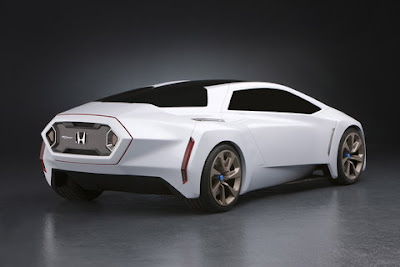
The sleek, low-profile body is designed to convey a high-technologyappearance with sculpting that combines angular shapes in the front of thevehicle that taper into geometric, hex forms in the rear. The rear hex formshouse cooling radiators for the fuel cell. Formula 1-style barge boards behindthe front wheels enhance high speed aerodynamics and convey the vehicle'sracing pedigree. The hydrogen storage tanks, visible from the rear deck,showcase the FC Sports fuel cell technology in much the same way that a "nakedbike" motorcycle showcases its engineering technology.

The glacier white body color conveys the FC Sport's clean environmentalaspirations while the dark wheels and deeply tinted glass provide a symboliccontrast befitting of the vehicle's unique combination of clean power and highperformance. Green construction techniques further contribute to a reducedcarbon footprint. An organic, bio-structure theme is carried through to thebody construction where exterior panels are intended to use plant-derivedbio-plastics.

The Advanced Design Studio of Honda R&D Americas in Pasadena, California,developed the FC Sport design study vehicle with the primary objective ofusing existing fuel cell technology as the basis for an ultimate Honda sportscar. Designer Jason Wilbur led the design efforts.

Honda Canada manufactures the Honda Civic and Civic Si sedan and coupe,and the Acura CSX sedan and MDX luxury utility vehicle at its two plants inAlliston, Ontario, and produces fuel-efficient 4-cylinder engines at its newengine plant adjacent to its Canadian manufacturing facilities. With 135manufacturing facilities in 28 countries worldwide, Honda attracts more than24 million customers annually.

Source;
http://www.newswire.ca/en/releases/archive/February2009/02/c4808.html

Here is my original post on the subject;
http://thehondaportal.blogspot.com/2008/11/2008-la-auto-show-honda-fc-sport.html

More Honda FC Sport Pic's

Here is my orig. post on the subject with more pic's and information;
http://thehondaportal.blogspot.com/2008/11/2008-la-auto-show-honda-fc-sport.html

2008 LA Auto Show; Honda FC Sport Hydrogen Car

Honda FC Sport Design Study Suggests Hydrogen Sports Car Future
Innovative fuel cell packaging demonstrates green performance potential

11/19/2008 - LOS ANGELES -
Honda today revealed the Honda FC Sport design study model, a hydrogen-powered, three-seat sports car concept, at the 2008 Los Angeles Auto Show.

The FC Sport emphasizes the design flexibility and potential of Honda's V Flow fuel cell technology - already deployed in the Honda FCX Clarity sedan - and reconfigures it into a lightweight sports car design with an ultra-low center of gravity, powerful electric motor performance and zero-emissions. The design study concept is inspired by supercar levels of performance through low weight and a high-performance, electrically driven fuel cell powertrain.

"The Honda FC Sport explores how to satisfy automotive performance enthusiasts in a world beyond petroleum," said Dan Bonawitz, vice president of American Honda Motor Co., Inc. "People who love sports cars will still have a reason to love in a hydrogen-powered future."

The high-output Honda fuel cell powertrain and a sleek, aerodynamic body contribute to the vehicle's performance potential. A modular approach to fuel cell component packaging and the electric drivetrain contribute to the FC Sport's low center of gravity with the majority of vehicle mass distributed between the axles, creating the balanced weight distribution sought after in sports cars.

The ideal placement of the Honda V-Flow fuel cell stack and related components demonstrates the benefits of a platform-specific, hydrogen-powered fuel cell powertrain. The FC Sport is configured to accommodate a custom-formed high-power fuel cell stack, located between the rear seats, and a battery pack placed low in the middle of the vehicle. The electric motor resides just forward of the rear axle. Two fuel storage tanks, visible from above, are located above the rear axle.

The optimal placement of fuel cell components for performance also allows for a relatively large passenger cabin by conventional supercar standards with enough space for three seating positions. The interior layout focuses primarily on the driver with a racecar-like center driving position. The enclosed canopy opens upward from the rear to allow for entry and exit. Two rear passenger seats flank the driver's left and right side.

The sleek, low-profile body is designed to convey a high-technology appearance with sculpting that combines angular shapes in the front of the vehicle that taper into geometric, hex forms in the rear. The rear hex forms house cooling radiators for the fuel cell. Formula 1-style barge boards behind the front wheels enhance high speed aerodynamics and convey the vehicle's racing pedigree. The hydrogen storage tanks, visible from the rear deck, showcase the FC Sports fuel cell technology in much the same way that a "naked bike" motorcycle showcases its engineering technology.

The glacier white body color conveys the FC Sport's clean environmental aspirations while the dark wheels and deeply tinted glass provide a symbolic contrast befitting of the vehicle's unique combination of clean power and high performance. Green construction techniques further contribute to a reduced carbon footprint. An organic, bio-structure theme is carried through to the body construction where exterior panels are intended to use plant-derived bio-plastics.

The Advanced Design Studio of Honda R&D Americas, in Pasadena, California, developed the FC Sport design study with the primary objective of using existing fuel cell technology as the basis for an ultimate Honda sports car. Designer Jason Wilbur led the design efforts.

Honda R&D Americas, Inc. began its operations in California in 1975 with local market research activities and has steadily grown its capabilities over the past 33 years to include all aspects of new vehicle design and development. Recent development efforts include trend-setting products such as the Honda Pilot, Ridgeline, Element, Civic Coupe and Civic Si.

In 2008, the company opened two new design centers in Southern California: the Acura Design Studio (Torrance), for the research and design of new Acura products; and the Advanced Design Studio (Pasadena), for the exploration and development of advanced design themes for both Honda and Acura.

The company operates 11 major R&D facilities in North America, including a full vehicle development center in Raymond, Ohio, and three design studios in Southern California. Honda R&D designers, engineers and support personnel are engaged in the development of Honda and Acura automobiles, powersports products, and power equipment for North America and global markets. The company's main centers of operation include the Los Angeles Center (Torrance, California), responsible for market research, concept development and styling design; the Ohio Center (Raymond, Ohio), responsible for complete product development, testing, and support of North American supplier and manufacturing operations; and a dynamic test facility in Cantil, California.

Source;
http://www.hondanews.com/categories/1097/releases/4879