Showing posts with label Honda Hybrid. Show all posts

Honda puts hybrid cars on hold (in Indonesia)

As Honda begins construction of a second factory in Indonesia on Monday, its executives say the giant Japanese carmaker has no immediate plans to produce hybrid cars in Indonesia even as the government pushes for fuel- and environmentally-friendly cars.

“It would be difficult to produce hybrid cars in Indonesia , as we need to invest in the technology first,” Honda Prospect Motor (HPM) marketing director Jonfis Fandy said at the ground-breaking ceremony for Honda’s newest plant in Karawang, east of Jakarta.

The Indonesian market was not ready for hybrid cars due to a lack of knowledge about the technology, he said, adding that work was needed to inform the public about how hybrid cars operated and how they could benefit from them.

For hybrid cars to truly contribute to Indonesia ’s energy conservation efforts, they had to be available in both the low and high ends of the market, he said. “How much [energy] can we realistically save if hybrid cars are only available for high-end users which make up 30 percent of the automobile market here?” he asked rhetorically.

Honda introduced the Honda Civic Hybrid in Indonesia in 2007 but pulled it off the market because of lack of interest. Honda is currently building a plant in Thailand to produce Jazz Hybrids and the first cars will roll out in 2013.

Industry Minister MS Hidayat said on Monday that he would call on all carmakers in Indonesia, including Toyota and Honda, to push them to start producing hybrid cars, detik.com reported. President Susilo Bambang Yudhoyono last month said the government planned to offer various incentives to carmakers to make them affordable.

Honda’s second factory in the Mitrakarawang Industrial Area has been earmarked to build the Brio at the lower end of Honda’s range. The plant will produce the hatchback version, which is already sold in India and Thailand, and the newer MPV model, which will be launched in 2014.

Honda’s operation in Indonesia is a joint venture between Honda Motor Co. of Japan and PT Prospect Motor of Indonesia. The original plant, opposite the new factory, produces Jazz, CR-V and Freed models. Once completed in 2014, the second plant will triple Honda’s production capacity in Indonesia to 180,000 cars per year from 60,000.

“Indonesia is an important market for Honda,” Takanobu Ito, the CEO of Honda Motor Co., said at the ground-breaking ceremony. “With a growing market and more conducive environment for economic growth, this country has a lot of potential.”

Ito said the Indonesian operation was one of Honda’s strongest both in terms of sales and production in the Asia-Oceania region and it topped sales among Southeast Asian markets last year.

Honda has chosen Indonesia as one of its production hubs in Asia, along with India and Thailand. It plans to use more materials from local suppliers, adding a further 45 local suppliers to its current 85.

The new factory will be built by construction company PT Takenaka Indonesia. (han)

Source;
http://www.thejakartapost.com/news/2012/06/05/honda-puts-hybrid-cars-hold.html

Honda Concept S and Concept C show Chinese style

I have to say that this closer look at the Concept S makes me appreciate it much more, and the Concept C is just gorgeous, I really hope that this is the direction of the next Honda Accord for North America!


Honda, in an effort to match Toyota’s triple concept outing in Beijing, premiered two concept vehicles developed for the Chinese market, called the Concept C and Concept S.

The names sound rather sedate upon first glance, but the C in this case stands for China and also Challenge and Cool, while the S translates into Stylish, Smart and Surprise, the company says.

Nothing too boring about the looks though, with the Concept C looking very much like a stretched and sleeked-out Accord on steroids – that dramatic front end won’t probably see the light of day in the production model, but much of the concept looks workable. Honda is set to develop the Concept C into a production model sometime next year.

Meanwhile, no mistaking the intent of the Concept S, a people mover in the mould of the Stream, but with more swoops and curves. Designed from the start as a hybrid offering, the Concept S will arrive in Chinese showrooms in 2013, produced and sold by Dongfeng Honda.

It won’t stop there – while the Concept S may have been developed with China as its primary market in mind, the vehicle is set to expand its presence by becoming a global offering in 2014.

Source;
http://paultan.org/2012/04/27/honda-concept-s-and-concept-c-show-chinese-style/

2012 Beijing Auto Showcases the Honda Concept S for China

Concept S
Concept S is a global concept model of a new-value passenger mover that was developed primarily for the Chinese market and will go on sale first in China. The "S" stands for "Stylish," "Smart" and "Surprise." Adopting a hybrid powertrain, this concept model realizes both the "fun of driving" and excellent environmental performance at the same time. A spacious cabin was realized by Honda's packaging technologies, which is one of the distinctive strengths of Honda. A mass-production model based on this Concept S is scheduled for introduction to the Chinese market through Dongfeng Honda Automobile Co., Ltd. next year, followed by a global release.

Source;
http://world.honda.com/news/2012/4120423Beijing-Motor-Show/index.html

2012 Honda Insight Preview


The 2012 Honda Insight gets a new look, some new features and (believe it or not!) even better fuel economy.

An increasingly crowded hybrid field now includes the Ford Fusion, the Kia Optima and, of course, the venerable Toyota Prius. All are pricier, except the new 2012 Toyota Prius c, which offers a nearly price-level competitor for the Insight. Honda's looking to at last gain some ground on the Prius in 2012 with numerous updates, most subtle on their own, but together adding up to a pretty comprehensive update.

Outside, a thin, blue accent bar has been introduced on the grille to denote its high-tech hybrid identity, while restyled bumpers contribute to a 2% increase in aerodynamics. New headlight and brake light internal reflectors, slightly wider tires and new 15-inch wheel covers round out exterior tweaks.

Inside, a reconfigured rear seat offers improved legroom and head room, and the gauge cluster gets a more technically sophisticated look. Cupholders are bigger, seat fabric is posher, and the cabin is quieter. A rearview camera is now available, packaged with an upgraded optional navigation system.

Honda's Integrated Motor Assist featuring a 1.3L i-VTEC 4-cylinder gas engine and 10-kW electric motor develops 98 combined hp at 5,800 rpm and 123 lb-ft of torque at 1,000-1,700 rpm; new friction-reducing measures and a CVT automatic transmission mean fuel economy improvements this year. Its Eco Assist System further enhances the efficiency of throttle control, CVT operation, idle-stop duration, air conditioning and cruise operation, and provides feedback on driving style via a 3D-ish background in the speedo: green for really efficient, blue for not-so-much.

Fuel economy is now rated at 4.7L/100km around town and 4.4L/100km on the highway.

One trim, the LX, is available starting at $21,990.

Source;
http://www.auto123.com/en/news/2012-honda-insight-preview-video?printable=1&artid=142452

Autoblog UK: First drive: Honda CR-Z MUGEN

Not the most flattering write up but they do it with flare.....

by Mark Nichol
Anyone that's ever played Gran Turismo will be well aware of MUGEN; the PlayStation racing game's bias towards all things Japanese is well known, and what with MUGEN being to Honda in Japan what AMG is to Mercedes, it has a special place in the game.

In the virtual world, MUGEN's in-game tuning upgrades could transform the most innocuous Japanese turdbox into a Ferrari-chasing hypercar. The natural assumption to a British gamer was that it was doing the same thing in real life, too.

When MUGEN Euro set up in Northampton in 2007, therefore, it did so with a level of credibility and mystique that extended beyond a handful of Japanese modding scene enthusiasts.

Its first fully-fledged model, 2010's £40,000 Civic Type-R MUGEN, furthered its cause. We loved it. It was (and is) the ultimate iteration of the car on which it's based, improving it in every way to create a Honda that's part family hatchback, part road-legal touring car.

This, the CR-Z MUGEN, is the difficult follow up.

The regular CR-Z is a fine car. The hybrid coupé isn't very quick, but it houses an economical petrol-electric hybrid system in an accomplished chassis, so it's fun to drive and returns 56.5mpg and 117g/km.

The CR-Z is all about balance. It's front-wheel drive, so it falls at the first hurdle in terms of being a 'pure' (rear-wheel drive) sports car, but it has lovely steering and pedal feel, enough low down punch from the electric motor to be lively, yet nowhere near enough to mess up the driven wheels in a haze of torque steer. In short, anyone can enjoy the CR-Z, and feel like a better driver for it.

Unfortunately, MUGEN - in stark contrast to its efforts with the Civic Type-R - has come along and spoiled it.

It's not a car entirely without merit - in fact, parts of it are awesome - but at times it feels like an unfinished low-budget DIY modding project. The carbon fibre lined doors of our test car, for example, had to be virtually kicked to close properly. That wouldn't happen in an AMG.

To turn the 122bhp CR-Z into the manic machine you see above, MUGEN has stripped the 1.5-litre petrol engine and rebuilt it using better parts. The torque-enhancing 14bhp electric motor stays strapped on - but a supercharger is added to the mix, endowing the car with a hot hatch-matching 197bhp.

In addition, the chassis and bodywork are lightened, partly by using carbon fibre; the dampers are replaced with five-way adjustable items; the wheels are exchanged for forged lightweight ones with sticky tyres; the brakes are upgraded; and the track is widened.

And as you can see, it also has a body kit looks like it's been designed by someone with an extensive collection of tracksuit bottoms.

The result is an altogether more serious CR-Z with a 0-62mph sprint time down from ten seconds to around six and a half.

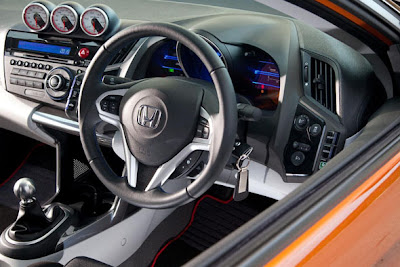
On the road it all starts off in exciting fashion. The Recaro bucket seats strap you in tightly, and the trio of bolt-on dashboard gauges suggest this is one mean machine.

Put your foot down and the supercharger inhales audibly, which is good. Problem is, there's very little associated acceleration; the MUGEN just doesn't feel that quick.

It becomes quickly apparent that there's been an epic and over-complicated technological struggle in order to eke out too much power from an ordinarily modest petrol engine. It's sort of like entering the Grand National with a donkey wearing a small jet pack.

Driving the MUGEN slowly isn't that much fun either - it's positively uncomfortable, in fact. A stiff clutch and over-sensitive throttle combination that makes smooth take-offs difficult, and after a while the combination of a small, noisy cabin and very tight seats make the whole thing feel fairly claustrophobic.

But there is credibility in MUGEN's work. It's capable of astonishing cornering speed, especially for a front-wheel drive car, and its steering rack is sublime, with more than a hint of Porsche in terms of its directness and unencumbered feedback. And the short shift gear lever is, as usual for a Honda-derived 'box, a delight to move through the gate.

But ultimately, laying down the £23,000 or so it will take to put one of these on your drive is like paying a dentist to make your teeth more yellow. It costs £19,000 for a CR-Z Sport, and £25,000 for a Toyota GT 86. Case closed.

If only MUGEN had been given carte blanche to rip out the CR-Z's hybrid drivetrain and put in a nice, simple, high-revving petrol engine...

Source;
http://uk.autoblog.com/2012/03/15/first-drive-honda-cr-z-mugen/

Honda Sells 800,000 Hybrids

As of the last few days of 2011, Honda has sold 800,000 units of hybrid vehicles across the world. This took them 12 years and 2 months, from the moment the first Insight was delivered in Japan back in November 1999.

In recent times, Honda has released the second generation Insight to challenge but not defeat the Prius back in 2009, and the complete hybrid range now includes six vehicles in total.

In 2011, the Japanese automaker sold 200,000 units, an increase of 30 percent over the previous year. And it’s the domestic market of Japan where Honda’s hybrids are in the highest demand, as 45% of all Hondas sold there we gas-electric in December.

We’d also care to mention that Honda is committed to development of fuel-cell vehicles as well, being among the leaders in the field.

Source;
http://www.autoevolution.com/news/honda-sells-800000-hybrids-41971.html

The 42nd Tokyo Motor Show 2011 Speech of Takanobu Ito President and Chief Executive Officer

Honda captured the "triple crown" that is the Contractor, Rider and Team Championships in this year's MotoGP. I would like to take this opportunity to express our appreciation for the support and enthusiasm of Honda fans around the world.Motorsports is at the origin of Honda and is part of our DNA. After watching the MotoGP races all year, I wanted to experience for myself the overwhelming acceleration of the actual MotoGP machine which took our riders to the podium. So I went to test ride it, and I felt so thrilled and excited by the riding performance of this machine.

Since its establishment, Honda has been committed to the development of personal mobility products which realize the joy and freedom of mobility. What we mean by the joy of mobility obviously includes the joy of operating the vehicle on our own. But it also includes the joy of discovering all kinds of new dreams and inspiring experiences and getting excited by new thrills that can be realized only through personal mobility.
On the other hand, in order to realize a "sustainable society where people can enjoy life", the reduction of CO2 emissions will be one of the most important challenges. In order for Honda to continue delivering environmentally-responsible, exciting and thrilling products, ever since I was appointed as the president of the company I have been prompting systems and capabilities which enable us to develop "edgy products" just like pushpins. By edgy products I mean products which have environmental and safety performance as the solid base, but also a sharp point that creates a distinctive "edge".

Today, I will introduce some models that symbolize this direction which were realized with our electromotive technologies. First, is an EV version of a super sports bike, the RC-E. RC-E was designed after the image of Honda's classic racing machine, the RC series, pursuing the joy of riding.
Next, we are exhibiting the world premiere of our small sports EV Concept model, the EV-STER. The EV-STER is a completely new next-generation EV sports model Honda is proposing. With this model, we embodied the joy of driving to the maximum extent. Starting from here at the Tokyo Motor Show, we will sequentially introduce multiple new models including a high-performance sports model which is currently under development toward market introduction in the near future.

As for EVs, we are currently conducting demonstration testing with the Fit EV in Japan, the U.S. and China. The Fit EV is scheduled to go on sale in Japan and the U.S. in summer of 2012. With the Fit EV, we achieved the world's top-class, most highly efficient electricity consumption rate. Further, while it is an EV, you can still experience sporty acceleration unique to Honda.
Now, let me introduce Honda's unique concept models of motorcycle and automobile electric mobility.
The MICRO COMMUTER CONCEPT, a four-wheel EV commuter, and the MOTOR COMPO, a two-wheel EV commuter, were created for mobility in a metropolitan area. These models are developed with new ideas and through collaboration between our motorcycle and automobile R&D centers.Honda will continue proposing the potential of a wide range of electromotive mobility products including the AC-X mid-to-long range plug-in hybrid and the FCX Clarity electric fuel cell vehicle.

In addition to the development of electromotive mobility products, Honda also has been focusing on the creation of clean energy using a solar photovoltaic system and a cogeneration system independently developed by Honda.
As of today, Honda is the industry leader in installing solar power generation systems to our factories and offices in Japan. Next year, we will be installing a mega solar power generation system to our Yorii Plant, which will be the largest solar power system to be installed to an automobile production plant. Furthermore, we will accelerate our effort to install solar power systems to our dealership locations as well.Based on these initiatives we will strive to achieve the "Triple Zero" - which means "zero" CO2 emissions well-to-wheel (from the point of creating electricity until it is used to power the vehicle) through our own renewable energy technologies; "zero" energy risk through our energy management technologies; and "zero" waste through our effort to reduce, reuse and recycle, the 3Rs.
Under this "Triple Zero" concept, Honda will address climate change and energy/resource issues with our own technologies and business activities. With these efforts, Honda envisions a future with "zero environmental burden society".

For such a future, the most important challenge we need to address right now is the improvement of the efficiency of gasoline and diesel-powered internal combustion engines.Under the name "EARTH DREAMS TECHNOLOGY," Honda has created a new next-generation engine and transmission series, which we will apply to our products to realize both "fun" and "environmental" values at a high level.
This EARTH DREAMS TECHNOLOGY will be applied first to the N BOX, a new mini-vehicle model we are announcing today, and then we will gradually expand the applications. By combining it not only with gasoline engines, but also with diesel engines, and the new CVT series, we will strive to be number one in fuel economy in each category within the next 3 years.Accelerating these initiatives, Honda will set a goal to reduce future CO2 emissions from our motorcycles, automobiles and power products sold around the world by 30% compared to the level of the year 2000. And we will strive to attain this goal by the year 2020.

Now, I would like to talk about the mini-vehicle business in Japan.Honda originally entered the automobile business with mini-vehicles. We made a fundamental review of our origin, that is to say mini-vehicles, and will largely renew our product lineup. I would like you to have high expectations toward the N BOX and the N Concept Series. We put our huge passion into the small body of those vehicles.

Finally, I would like to introduce our all-new ASIMO humanoid robot which is now equipped with the world's first autonomous behavior control technologies.
With improved physical capability and autonomy, this all-new ASIMO was further advanced so that it can now continue moving without being controlled by an operator.
In addition to further improvement of the physical capability of its legs, we advanced the capability of ASIMO's fingers so that each finger now moves independently. These changes were made so that ASIMO can coexist with and be useful for people.
We are utilizing the technologies we have amassed through ASIMO and humanoid robotics research for our mobility products such as motorcycles and automobiles.
In addition, we will apply such technologies to other devices such as the task-performing robot arm which performs tasks in places where people cannot access and the walking-assist device which supports walking for people with weakened leg muscles. We will continue our R&D activities to put those technologies into practical use so that we can offer more technologies that are useful for people.

The motivation behind our ASIMO research and, the development of mobility products in the areas of motorcycles, automobiles and power products is our passion to create products that are useful to people and that utilize technologies to make people happy. That is Honda's philosophy as a manufacturing company which has remained unchanged since the establishment of the company.
Honda will remain true to its origin - manufacturing for people - and continue creating "edgy products" that move people's hearts, so please keep your expectations high!


Source;
http://www.hondanews.info/news/en/corporate/c111130aeng

Honda Announces Revolutionary Next-generation "Earth Dreams Technology" -New plan calls for top-of-industry fuel efficiency in every vehicle class wit

TOKYO, Japan, November 30, 2011 - Honda Motor Co., Ltd. today announced the outline for a revolutionary next-generation technology for automobiles called "Earth Dreams Technology."

"Earth Dreams Technology" is a next generation set of technological advancements which greatly enhance both driving performance and fuel efficiency at a high level, using as its base advanced environmental technologies to pursue the joy of driving unique to Honda. It is a series of measures in which efficiency of internal combustion components including engine, and transmission, as well as electric-powered motor technology, is further improved.

Through its implementation first in the mini-vehicle N BOX and gradually onto other vehicle models, Honda aims to achieve top-of-industry fuel efficiency for every category within three years, while simultaneously setting a timeline of 2020 to reduce by 30% CO2 emissions for all products sold worldwide, relative to emission figures for 2000.


Inspiration of the "Earth Dreams Technology" name:
"Earth Dreams Technology" is an expression for a set of technologies which takes into account both our need to protect the environment and our desire to provide a joy of driving.


Key features of "Earth Dreams Technology"
1. A gasoline engine which realizes top level driving performance and fuel efficiency.
2. A compact diesel engine which realizes the world's lightest body*1, top-of-class*1 acceleration performance and fuel efficiency.
3. CVT which combines at a high level the fun of driving and fuel efficiency.
4. A two-motor hybrid system which realizes top-of-industry efficiency*1.
5. A high-efficiency, high output electric SH-AWD hybrid system which combines superior driving and environmental performance.
6. A Compact, high efficiency electric powertrain for EVs.


Summary of key features
1. Gasoline engine which achieves top-of-industry driving performance and fuel efficiency
・By enhancing Honda's original VTEC (Variable Valve Timing and Lift Electronic Control System) technology to thoroughly improve thermal efficiency and minimize friction, a combination of high output and fuel efficiency was achieved. Further, a new engine series employing a new structure for higher expandability was developed.
・By gradually renewing the engine starting with the mini-vehicle N BOX, Honda aims to utilize this technology to achieve top-of-industry output and fuel efficiency in every vehicle class within three years.
・A wide range of engine classes including the 660cc, 1.3L, 1.5L, 1.8L, 2.0L, 2.4L, and 3.5L classes will feature the technology.


[660cc class engine]
・Employs DOHC and VTC (Variable Timing Control) to improve intake efficiency. Further, the compact combustion chamber realizes high thermal efficiency.
・By shortening the bore pitch compared to the present engine models and reducing the thickness of the cylinder block and camshaft, engine weight is reduced by 15%*2 and fuel efficiency is improved by 10%*2.


[1.3 to 1.5L class engine]
・Employs VTC, direct injection technology and the Atkinson cycle using the DOHC, VTEC technologies as the base.
・Extensive friction reduction measures are implemented.


[1.8 to 2.0L class engine]
・Employs direct injection technology and the Atkinson cycle using the DOHC, VTEC technologies as the base. Further, implementation of VTC and high-capacity EGR (Exhaust Gas Recirculation) to both the intake and exhaust ports realizes significantly reduced friction.
・For the 2.0L class hybrid vehicle engines, use of an electric water pump eliminates the need for a belt in the auxiliary device and contributes to a reduction in friction. The VTC system allows fuel-efficient driving in various driving styles.


[2.4L class engine]
・Based on the DOHC and VTEC technologies, it employs VTC and direct injection technology and implements extensive friction reduction measures.
・Standalone engine features 5%*2 improvements in fuel efficiency and output as well as a 10%*2 improvement in maximum torque compared to the previous engine.


[3.5L class engine]
・Employs new valve train mechanisms and direct injection technology in the SOHC, VTEC, VMC systems to improve by over 10%*2 of fuel efficiency and 5%*2 of output, relative to the present standalone engine model.

2. A compact diesel engine which realizes the world's lightest body*1, top-of-class*1 acceleration performance and fuel efficiency.
・Through optimizing engine rigidity and combustion pressure, an aluminum open deck for the cylinder block was enabled in this top-of-industry lightweight*1 1.6L class diesel engine.
・By downsizing from the present 2.2L engine and extensively reducing mechanical friction in each section, a friction level equivalent to present gasoline engine models was achieved.
・Optimized thermal management system thanks to improvements in the cooling system reduces CO2 output by over 15%*2.
・Employment of a compact, high-efficiency turbocharger and weight reduction in the reciprocating sliding section realizes a sporty and nimble ride.

3. CVT which combines at a high level the fun of driving and fuel efficiency.
・Three CVT structures for mini, compact, and mid-size vehicle classes are newly developed to be adopted for a variety of engine models.
・Reinforced belt is used to realize a structure for which a wide ratio range can be set.
・Implementation of analysis technology over the contact behavior between the belt and pulley, and a high-precision hydraulic control system allows for continual optimization of hydraulic pressure to the pulley under a variety of driving conditions, contributing to improved fuel efficiency.
・Use of an electronic oil pump to realize an idle stop system with high response contributes significantly to improved usability and fuel efficiency.
・"G-Design Shift", a new coordinated control system for shift transmission, throttle, and hydraulic control responds quickly to driver demands and realizes an exhilarating, sporty drive with superior acceleration.
・In the mini-vehicle class, a control mechanism and innovations in axle placement to reduce the engine size lengthwise, while a reduction in parts by simplifying the transmission casing structure helps realize a lightweight and compact body.
・For the compact and mid-size classes, in addition to the reductions in size and weight, transmission efficiency was greatly improved by expanding the ratio range to achieve fuel efficiency improvements of 5%*2 and 10%*2 compared to the conventional CVT and comparable

5 ATs, respectively.

4. A two-motor hybrid system which realizes top-of-industry efficiency*1.
・A two-motor hybrid system featuring top-of-industry efficiency*1 enhancing driving performance and reduced CO2 emissions has been newly developed.
・Special lithium-ion battery and charger is employed to enable mounting on plug-in hybrid vehicles.
・Mid-sized vehicles equipped with this system are scheduled to begin production, starting with the plug-in hybrid model in 2012 and the hybrid model in 2013.
・Three driving modes allowing for top-of-industry efficiency*1 for various driving environments were developed; an "EV driving mode" for urban environments, a "hybrid driving mode" using electricity generated by the motor, and a "engine-connected driving mode" where the engine and tires are mechanically connected during high-speed cruising.
・Combination with a high-output 120kW motor allows for superior environmental performance and driving enjoyment.

5. A high-efficiency, high output electric SH-AWD hybrid system which combines superior driving and environmental performance.
・A new hybrid system, electric SH-AWD, was developed for large-sized vehicles. By combining a 3.5L, V6 engine with this hybrid system, acceleration equivalent to V8 engines, as well as fuel efficiency equal or superior to in-line 4-cylinder engines were realized.
・An electric 4WD system with independent 20kW+ motors on both sides for the rear wheels combines a 7-speed dual clutch transmission system with a built-in 30kW+ high-efficiency motor with the engine.
・By mounting a high-performance lithium-ion battery and optimally controlling the front and rear motors, a new hybrid system with high fuel efficiency and output was realized.
・By mounting two independent motors in the rear and employing a newly developed bilateral torque adjustable control system, incredibly tight cornering just like driving "on-the-rail" is realized. With this mechanism, Honda strives to provide a stable ride for various driving environments.

6. A compact, high efficiency electric powertrain for EVs.
・Thanks to the high efficiency coaxial motor, low-friction gearbox and electric servo brake system, the system realizes the highest electrical consumption capability in the world*1, meeting the required AC consumption rate of 29kWh/100mile(116MPGe) as set forth by the United States.
・A traveling distance of 123 miles*3 (LA-4mode: unadjusted) or 210km*3 (JC08 mode) was achieved thanks to the mounting of a high capacity lithium-ion battery.
・When using the 240V U.S. electric source, a full charge takes less than 3 hours. (From the time a low-charge signal is lit till full charge)
・By offering three driving modes (SPORT, NORMAL, ECON), the driver can freely select from a number of options to meet the needs of various driving styles such as power-saving or sporty drive.

*1 Honda internal research (as of November 30, 2011)
*2 Compared to Honda products
*3 Honda calculations

Source;

Upgraded 2012 Honda Insight Hybrid Offers New High-Tech Look, Improved Fuel Economy and More Features

10/17/2011 - TORRANCE, Calif.
A significantly updated 2012 Insight hybrid debuts today with new exterior styling, an enhanced interior, additional features on select models and an EPA fuel economy-rating1 improvement of 1 mpg. The Insight’s city/highway/combined EPA fuel economy rating1 of 41/44/42 mpg, up from 40/43/41 on the prior model, continues to offer the highest EPA fuel economy rating of any new vehicle currently available with a Manufacturer’s Suggested Retail Price (MSRP) starting under $20,000.

The aerodynamically styled, five-passenger, five-door dedicated hybrid vehicle receives extensive changes inside and out for 2012. Exterior changes include a more distinctive grille design that introduces a thin, blue accent bar representative of the Insight’s high-tech hybrid identity. Restyled front and rear bumpers, along with changes under the vehicle, contribute to a 2-percent increase in aerodynamic performance. New designs for the headlight and brake light internal reflectors further complete the refreshed look. Insight and Insight LX models have new 15-inch wheel covers and the Insight EX has newly styled 15-inch alloy wheels. Slightly wider 185/60R15 tires, up from 175/65R15 tires on the prior model, contribute to confident driving performance.

The Insight’s interior refinements for 2012 include a reconfigured rear seat area for better leg and head room; a redesigned gauge cluster background with a more technically sophisticated appearance; reshaped center-console beverage holders that accommodate larger drinks; and a more supportive front armrest (Insight LX and EX).

The Insight LX has new, more premium seat fabric, while the Insight EX is upholstered with a combination of synthetic leather (new) and premium fabric. Rear-seat headroom improves by 0.6 inches with changes to the rear headliner shape and deeper sculpting of the rear seat cushion to improve rear passenger comfort. Rearward visibility improves with a more compactly mounted rear-wiper motor housing and a thinner rear spoiler that creates a larger viewing area out the lower back window. The Insight becomes quieter for 2012 with increased thickness to the vehicle’s existing noise-insulation materials and additional insulation panels in the cargo area.
Available on Insight EX models, the Honda Satellite-Linked Navigation System™ with voice recognition2 receives several notable upgrades including the addition of a rearview camera. The system provides routing and guidance to individual addresses and more than 7-million points of interest within the continental United States. A 16-GB flash memory system replaces the 4.7-GB DVD-based system used on the prior model. The new system offers faster route calculation and includes FM traffic, a subscription-free service that alerts drivers to traffic conditions.

The Insight is powered by an Integrated Motor Assist™ (IMA™) system comprised of a 1.3-liter i‑VTEC® gasoline 4-cylinder engine and a 10-kilowatt electric motor. The combination develops 98 horsepower at 5800 rpm and 123 lb-ft. of torque at 1000-1700 rpm. For 2012, friction-reducing measures in the engine and the Continuously Variable Transmission (CVT) contribute to the new model’s increased fuel economy. A 10.6-gallon fuel tank provides an estimated maximum driving range exceeding 400 miles.

The Insight features the Eco Assist™ System, an innovation that can enhance efficient vehicle operation while providing feedback related to individual driving styles. Eco Assist can help drivers improve fuel efficiency, both by altering vehicle functionality and providing driver feedback, with fuel economy dependent on their given set of driving conditions. Pressing the ECON button can further enhance the efficiency of multiple vehicle systems: throttle control, CVT operation, idle-stop duration, air conditioning and cruise-control operation (if equipped). Eco Assist also provides feedback about driving style via a 3D-like background within the speedometer. The background changes colors from green to blue to reflect how efficiently or inefficiently the driver is accelerating or braking (green is more efficient).

Aerodynamic refinements for 2012 include changes to the shape of the engine bay underbody cover and the addition of air diffusers under the rear bumper to smooth airflow exiting behind the vehicle. The strakes ahead of the front wheels have been extended by 0.4 inches to better direct air around the wider front tires.

Standard safety features on all Insight models include dual-stage, multiple-threshold front airbags; front-side airbags with a passenger-side Occupant Position Detection System (OPDS); side-curtain airbag system; anti-lock brakes with electronic brake distribution (EBD); driver’s and front-passenger’s active head restraints; and a front body structure designed to mitigate pedestrian injuries. The Insight also features Honda’s Advanced Compatibility Engineering™ (ACE™) body structure, which provides improved occupant protection and crash compatibility between vehicles of different sizes and ride heights in frontal crashes.

The 2012 Insight is offered in three distinct models. The value-oriented base model, simply designated as "Insight," is well equipped with a 160-watt, two-speaker audio system, automatic climate control, power windows, remote entry and more.

The Insight LX adds a four-speaker audio system, USB audio interface, armrest console, floor mats and a security system. New for 2012, the LX has map lights and steering wheel audio controls.

The Insight EX adds alloy wheels, steering wheel-mounted paddle shifters, an audio system with six speakers, heated side mirrors with integrated turn signals and much more. For 2012, the EX gains Bluetooth® HandsFreeLink®3, automatic headlights and a leather-wrapped steering wheel and shift knob. The Insight EX is available with the Honda Satellite-Linked Navigation System with voice recognition and rearview camera.

New exterior colors include Frosted Silver Metallic and Truffle Pearl, which replace Clear Sky Blue and Crimson Pearl.

Insight accolades include J.D. Power and Associates "Highest Ranked Compact Car in Initial Quality in a Tie" in their 2011 Initial Quality Study SM (IQS) (the Insight tied with the Civic). The IQS names the highest performers within the first 90 days of vehicle ownership. And for the past three consecutive years, the Insight was named a Top 10 Green Car by Kelley Blue Book's kbb.com4. The Insight was also named one of the "Greenest Vehicles of 2011" by the American Council for an Energy Efficient Economy (ACEEE).

Honda is a leader in developing cleaner, more fuel-efficient vehicle technologies, including the original Honda Insight, introduced as America’s first mass-produced hybrid car in December 1999. Honda is also a leader in the development of advanced alternatives to gasoline, including the zero-emission, hydrogen-powered FCX Clarity fuel-cell electric car, the world’s most-advanced production fuel cell automobile.

Honda’s diverse lineup of environmental vehicles also includes the Civic Natural Gas sedan, the only retail CNG passenger vehicle currently available from any automaker in the U.S., and three distinct gasoline-electric hybrid models: Civic Hybrid, CR-Z sport hybrid and Insight hybrid.

Honda was named America's "Greenest Automaker" for the fifth consecutive time by the Union of Concerned Scientists (UCS) in late 2010. The award is earned by the company with the lowest combined score of its smog-forming and greenhouse gas emissions (primarily CO2) in its U.S. automobile fleet. Honda has led the UCS rankings of overall vehicle environmental performance since the first UCS study in 2000, marking a decade of Honda leadership in reduced vehicle emissions. Honda earned the recognition with an industry-best score based on model year 2008 data, the latest available for analysis.

Insight Manufacturer’s Suggested Retail Price*Insight: $18,350Insight LX: $20,125Insight EX: $21,815Insight EX with Navigation: $23,540* MSRP excluding tax, license, registration, $770 destination charge and options. Dealer prices may vary.

Connect with Honda:
Honda Media Newsroom (for journalists): www.hondanews.com
Honda Insight (for consumers): http://automobiles.honda.com/insight-hybrid/
Honda Insight on Facebook: www.facebook.com/hondainsight
Honda on YouTube: www.youtube.com/honda
Honda on Flickr: www.flickr.com/hondanews
Honda on Twitter: www.twitter.com/honda

1 Based on 2012 EPA mileage estimates. Use for comparison purposes only. Do not compare to models before 2008. Your actual mileage will vary depending on how you drive and maintain your vehicle.

2 The Honda Satellite-Linked Navigation System™ is available on Insight EX models in the United States, except Alaska. See your Honda dealer for details. Certain functions that rely on a satellite signal will not work correctly in Hawaii and Alaska. These functions include, but are not limited to, automatic clock updates and time zone adjustments.

3 The Bluetooth® word mark and logos are owned by the Bluetooth SIG, Inc., and any use of such marks by Honda Motor Co., Ltd., is under license.

4 For more information about the 2011 Top 10 Green Cars from Kelley Blue Book's kbb.com, visit www.kbb.com. Kelley Blue Book is a registered trademark of Kelley Blue Book Co., Inc.

Source;
http://www.hondanews.com/channels/corporate-headlines/releases/upgraded-2012-honda-insight-hybrid-offers-new-high-tech-look-improved-fuel-economy-and-more-features

Honda Insight with 1.5 liter IMA system to debut soon?

Check out the Honda Insight section on Honda Japan’s website and you’ll be greeted by the teaser image above, which seems to indicate that an Insight with a larger 1.5 liter i-VTEC IMA engine will be available soon. So far, most Honda hybrids including the Honda Insight sold here in Malaysia use the 1.3 liter system, while the 1.5 liter system is reserved for the sporty Honda CR-Z.

A larger more powerful system in the Insight would certainly be welcome for those looking for a little more fun in their green motoring, but do not want to go for the 3-door body of the CR-Z. With the hybrid tax exemptions just recently extended by the Malaysian government, perhaps Honda Malaysia can introduce this 1.5 liter variant of the Honda Insight as well? I’m sure there’s a market!

Source;
http://paultan.org/2011/10/11/honda-insight-with-1-5-liter-ima-system-to-debut-soon/

Carscoop: Euro Mugen building custom High Performance CR-Z Hybrid

One of the biggest problems most see with Honda’s CR-Z hybrid sport hatch is the lack of a performance version. That may change soon enough as Mugen’s European division is readying a “highly-tuned” version of the CR-Z that it claims will deliver “Type R-like” performance. The faster and more powerful CR-Z Mugen prototype is being developed as a joint project between Honda UK and Mugen Euro, and it will make its world debut at the Goodwood Festival of Speed this July.

“This will be one quick hybrid,” said Martin Moll, Head of Marketing for Honda UK. “With more torque, more power and MUGEN’s experience of working with Honda cars, we’re expecting great things. It promises to show how hybrid cars can be even more exciting to drive.”

Honda said that the CR-Z MUGEN prototype will feature modifications to both the 1.5-litre i-VTEC petrol engine and the Honda IMA system to boost power and torque, adding that these changes may also result in greater mpg and lower CO2 emissions during some conditions. Final power, torque and fuel economy figures are not yet known.

Other performance upgrades will include bespoke brakes and a tuned suspension while Mugen will also make use of lightweight components such as a carbon fibre bonnet and forged alloys to lower the overall mass.

Furthermore, Mugen will treat the CR-Z with a new body kit that includes new front and rear bumpers as well as a rear wing and diffuser to improve aerodynamics.

“We wanted to extend the performance of the CR-Z,” says Hiro Toyoda of MUGEN Euro. “It is already a fun car to drive, with an excellent chassis, but we thought that with more power and enhanced torque delivery it could be even more exciting. However, as with all MUGEN projects, we have stayed true to the Honda design and philosophy, and the electric motor is still a vital ingredient to boost performance and economy.”

Even though at this stage, the CR-Z MUGEN is being crafted as a one-off prototype with no plans for a production version, we’ll remind you that’s what Honda said when it introduced the 240HP Civic Type R Mugen in 2009 which ended up in a limited production for Europe.

Source;
http://carscoop.blogspot.com/2011/03/mugen-euro-building-high-performance.html

Honda has Prius in sight

HONDA is embarking on a four-car hybrid program with a range of new petrol/electric models scheduled for launch here before the end of 2012. They started this week with the five-door Insight and continue next year with the CRZ hybrid sports coupe, Jazz hybrid and then the new generation Civic hybrid some time in 2012.

All will feature a similar parallel hybrid powertrain based around a 1.3 or 1.5-litre single cam, petrol four-cylinder engine with variable valve timing coupled to an electric motor for what Honda calls integrated motor assist.

Essentially Honda hybrids run on their petrol engine with assistance when accelerating from an electric motor fed by a battery pack and electric control unit between the rear wheels.

Honda Insight is a direct competitor for Toyota’s slightly larger Prius which has a 1.8-litre petrol engine hooked up to an electric motor. The Prius has 100kW whereas the Insight has 72kW.

It drives the front wheels via a constantly variable transmission and uses regenerative braking and deceleration to charge the battery pack which, in the Insight’s case, is optimized for size and weight tipping the scales at a mere 38kg complete with the electronic control module. Honda says Insight is 37 per cent more economical than a conventional petrol-powered car of similar size generating considerably less emissions rated at 109g/km of carbon dioxide. Insight gets 4.6 litres/100km fuel consumption Honda’s most frugal vehicle.

It’s designed for smooth aerodynamics outside and convenience inside with a family Honda look to the controls based around a convex dash and Civic type wheel.

Seats for five are provided inside with a good size load space expandable after folding the rear seats. The spare is a space saver.

Honda fits Insight with an economy assist system that “coaches” the driver to drive economically through the use of a multi-coloured speedo and a “reward” system. The car can also be set-up for maximum fuel efficiency and low emissions.

Used carefully, up to 20 per cent fuel savings are possible.

Apart from the hybrid powertrain Insight is fairly conventional underneath with a strut front suspension, simple torsion beam rear and electric power steering. The chassis is optimized for strength and crash protection. Insight’s nickel metal hydride battery is designed to last 15 years or 240,000km and a replacement, if needed, costs $1850.

Two models are available; the VTi at $29,990 and the VTi-L at $33,990.

The base model is well equipped, and so is the high grade version which gains auto wipers, 16-inch alloys, fog lights, satellite navigation, rear view camera and other goodies.

Both have a five-star Australasian new car assessment program crash rating and are manufactured in Japan.

On the road, Insight is a bit like driving your average 1.6-litre hatch except that is has start/stop at idle and hardly makes the fuel gauge move. Dynamics are quite sporty so the drive experience is rewarding with reasonable acceleration.

It’s comfortable over a longish time and makes minimal noise or vibration.

Though it’s noble to be “green”, we think Insight buyers are going to appreciate the car’s fuel economy above all else and the fact that it’s many thousands of dollars less than Toyota Prius.

Source;
http://sydney-central.whereilive.com.au/lifestyle/story/honda-has-prius-in-sight/

Honda Insight Gets Tweaked Stop-Start System, Revised MPG Numbers

All this is confirmed for the UK markets, not sure why it wouldn't come here in North America....
Honda has made some improvements to the stop-start system on their Insight hybrid car, allowing drivers to keep the engine off for up to 3 times as long as previous years.

Insights before 2011 could keep the engine stopped for up to 30 seconds, but new improvements for this coming model year allow for the engine to be stopped for as long as 90 seconds. The initial figure was based on a “worst case scenario” of extreme humidity, a car full of passengers and poor weather, but Honda has now revised the rating.

The 90 second engine-off feature will help improve mileage in town by a noticeable amount.

Unfortunately, we’re not sure just how significant the improvement will be, as no official figures have been released yet.

Source;
http://www.autoguide.com/auto-news/2010/10/honda-insight-gets-tweaked-stop-start-system-revised-mpg-numbers.html

Honda takes green commitment to RP

Honda has undertaken worldwide efforts in protecting the environment and Honda Cars Philippines, Inc. (HCPI) carries the same green commitment.

In marking its 20th year of operations in the country this October, HCPI is celebrating 20 years of providing fun-to-drive and environment friendly vehicles.

Voltaire Gonzales, Vehicle Sales and Corporate Communications Head of HCPI, said there are over 239,200 Honda patrons in the country today.

HCPI recently staged a four-day exhibition during the 3rd Philippine international Motor Show held at the World Trade Center to highlight is commitment to preserve the environment. The exhibit theme was "Blue Skies for our Children."

Honda has taken conservation measures as early as 1960s. In 1966, Honda Motor Co., Ltd. Founder, Soichiro Honda once said, "Leave blue skies for our children." This has been Honda’s longstanding commitment for more than four decades now.

The display put up Honda’s ecologically sound technologies that remain true to its promise. It featured the latest in Honda’s roster of cars: the Honda City, Jazz, Civic, CR-V and Accord.
All powered by the ingenious i-VTEC engine, Honda vehicles make the most out of every drop of fuel by adjusting valve timing and valve opening combination to pump in fuel as needed only.

Apart from fuel efficiency, Honda vehicles are also engineered to release less harmful emissions.

Honda is the only local manufacturer that reaches EURO 4 levels for all its model line-up, even if Philippine regulations only mandate EURO 2 compliance. EURO 4 standards translate to approximately 56 percent reduction in harmful emissions as compared to EURO 2 standards.
To date, almost 82,000 Honda units with EURO 4 levels have already been sold and ply Philippine roads.

Lessons learned from the CVCC (Compound Vortex Controlled Combustion) engine technology, the first engine to meet the almost then impossible emission standards of the 1970 US Clean Air Act, have paved the way in the development of Honda’s new products and technologies which set the standard in mobility and environmental conservation.

In improving fuel efficiency and reducing carbon footprint, Honda recognizes hybrid as the most practical technology at the moment. Honda’s original Insight introduced in 1999 was the first gasoline-electric car sold in the US.

Using Integrated Motor Assist (IMA) technology, the gasoline engine serves as the main power source of the vehicle while the electric motor provides additional power as needed. Thereafter, other gasoline-electric powered models soon emerged like the Civic Hybrid and Accord Hybrid.

Last year, Honda introduced the all-new Insight. Boasting excellent fuel economy at an affordable price, the Insight is designed to pass on hybrid technology to the mass market. A year after, the CR-Z model was launched in Japan.

Source;
http://www.malaya.com.ph/08312010/auto2.html

RUMOUR ALERT: Honda Abandons the sale of Honda Civic and Insight hybrid

Hmmm....No doubt about it, Hybrid sales are slow, I just attributed it to low (are we really desensitized to $1/litre now?!?) gas prices, I don't think that Honda would go to such a drastic measure, but I've been wrong before....Not surprisingly one day or another. With sales exceeding 175 copies since the beginning of the year in Quebec, the hybrid Insight became a burden instead of a source of pride for Honda. Is it too much like the Toyota Prius, its rear seats bit inviting or I do not know what other avatar, but one thing is certain, Honda intends to significantly slow the commercialization of its hybrid cars in the Canadian market. This includes not only the Insight, recently renovated, but the Civic Hybrid.

At first, according to a dealer who prefers to remain anonymous, Honda had decided to remove completely the sale of the Insight and Civic Hybrid, leaving only the new model this year, the CR-Z coupe only hybrid. Such an approach had been an admission of failure on the part of Honda, so that both cars to disappear benefit from a stay that will allow consumers to order. That's what we told the director of public relations for Honda Canada for Quebec, Nadia Mereb. "Our dealers do not keep any of these models (Insight and Civic hybrid) in stock and the customer who wants to buy one should place an order and wait for the car be delivered to him," was echoed by Ms. Mereb.

It is a blow to all those who work to spread products less damaging to the environment and is also proof that Quebecers are shy to adopt greener solutions. Some say that the wrongs come from Honda which has not found the right recipe to woo customers with these two hybrid cars.

It is expected that this new raised much debate in the areas concerned.

Source;
http://monvolant.cyberpresse.ca/dossiers/dossier-auto-ecolo/201008/20/01-4308342-honda-delaisse-la-vente-des-civic-et-insight-hybrides.php?utm_categorieinterne=trafficdrivers&utm_contenuinterne=cyberpresse_B2_automobile_508450_accueil_POS1

Honda Civic Going 100-Percent Hybrid, In Japan

Reuters and Wall Street Journal are reporting that Honda is phasing out the gas-powered Civic for the Japanese market, and will only sell the hybrid version.

Honda will roll out an all-new Civic worldwide in late 2011.

As we reported a few days ago, Honda is boosting investment in hybrid technology, based on the belief that conventional hybrid technology can provide fuel economy and CO2 benefits more cost effectively than plug-in cars or clean diesel models.

The Wall Street Journal writer Paul Ausick speculated, “US buyers may also see the day, sooner rather than later, when only a hybrid Civic is available.” Yet, U.S. sales of the Honda Civic Hybrid in the first half of 2010 are down by almost 75 percent. Meanwhile, in Japan, hybrids remain hot sellers. Toyota Prius has been the top-selling vehicle in Japan for the past 14 months.

The move to only sell Civic Hybrids in Japan represents the first time a conventional gas-powered vehicle would turn into a hybrid-only model. Honda currently offers the Honda Insight, and will soon introduce the Honda CR-Z coupe. Both cars were designed from the beginning as hybrid-only models.

Some industry observers believe that tighter emissions laws will require hybrids to become a widespread mainstream auto technology. In 2008, Bob Lutz, G.M.’s legendary product guru, said "Ultimately by 2020 we figure that 80 percent of vehicles will require some sort of hybridization," because of tougher fuel-economy standards.

Source;
http://www.hybridcars.com/news/honda-civic-going-100-percent-hybrid-japan-28250.html

Honda to focus on hybrids, drop microcar plant-paper-UPDATE 1

* Planned green car factory may start ops in 2013-Nikkei

* Honda to stop developing commercial minivehicles-Nikkei

* Honda to announce medium-term strategy next week

* Honda shares down 0.9 pct, in line with market (Adds background, company comment)

TOKYO, July 15 (Reuters) - Honda Motor Co, Japan's No.2 automaker, will drop plans to build a new minivehicle factory and focus on its green vehicles business, the Nikkei business daily reported on Thursday.

Soon after the global financial crisis hit in 2008, Honda had announced plans to delay construction of the Yorii factory, north of Tokyo, and a plant for 660cc minivehicles at subsidiary Yachiyo Industry Co, both originally scheduled to start production in 2010.

Honda had initially planned to build clean-diesel and other fuel-saving vehicles at the Yorii factory, but has since abandoned the development of clean diesel engines, planning instead to come up with a new hybrid system to boost fuel economy on its bigger vehicles.

A Honda spokeswoman declined to confirm the report.

The Nikkei said the Yorii factory would likely begin production in 2013, in line with Honda's latest plan to start in or after 2012.

The paper also said Honda would review its strategy on minivehicles, with a market limited to Japan. Honda, which had earmarked about 50 billion yen ($565 million) to build the minivehicle plant in western Japan, plans to stop developing commercial-use minivehicles to narrow its product line, the paper said.

Honda Chief Executive Takanobu Ito, who took his post about a year ago, has said he wanted to accelerate the roll-out of hybrid cars as environmental regulations tighten around the world. He is scheduled to brief on Honda's medium-term strategy at a news conference next Tuesday.

Source;
http://www.forexyard.com/en/news/Honda-to-focus-on-hybrids-drop-microcar-plant-paper-2010-07-15T001915Z-UPDATE-1

"In our view, the key to winning this race is not declaring a winner until the technology has actually run the race."

John Mendel
Executive Vice President
American Honda Motor Co., Inc.
American Honda’s Executive Vice President of Sales John Mendel, along with other business leaders and academics, gathered at The Ohio State University May 3 to discuss ways of reducing gasoline in transportation in a three-day conference called: Moving Ahead 2010. Following are his excerpted remarks.

It’s great to be in Columbus... a real hometown for Honda. Our first U.S. manufacturing operations were established here 30-plus years ago … and we have a major R&D center that creates many of the products we build here.

Both our manufacturing and R&D operations have a strong relationship with our host, Ohio State University. We have partnered with OSU in advanced research … we employ their graduates …and our associates root fanatically for the Buckeyes. So, we’re very happy that this important new event is kicking off here.

And this is a critically important event. The realization of more efficient and sustainable forms of mobility is key to the future of our planet … and to the future of personal transportation for millions of people around the world.

It’s also key to the future of the auto industry. I’ve been a part of the industry for more than 30 years now. And I think I can say that for all automakers … the ability to develop advanced environmental technologies is no longer just a means to gain competitive advantage. The truth is that any manufacturer without these technologies will not long survive. And you can look at the mergers and joint technology ventures in our industry over the past year as proof of this new reality.

This pursuit of sustainable transportation solutions amounts to something of a new race for our business, with many promising technologies vying for the lead and various companies racing to bring these technologies to market.

But in our view this shouldn’t be the kind of race where different companies or technologies are pitted against one another. Rather, we should race with each other toward a common goal … of creating technology that provides the world with greater mobility … while dramatically reducing CO2 emissions and creating a more sustainable energy future for generations to come.

"The effort to promote the virtues of one technology should not result in the demonizing of another" In our view … the key to winning this race is not declaring a winner until the technology has actually run the race. That’s a critical distinction, because the race for a cleaner and more sustainable future is a marathon, not a sprint. It will be decades before any new technology can be called the all-out winner. And while there are a lot of opinions … and even more desires … no one can say with certainty today which technology or combination of technologies will be first to the finish line. The effort to promote the virtues of one technology should not result in the demonizing of another. … or in policymakers laying all of their chips on the technology du jour … rather than promoting fair and open competition among all the players and all promising technologies.

This is a crucial point. Because rushing to select a winner could lead us in the wrong direction … resulting in the loss not only of time and substantial investment of development resources … but, more importantly, the trust of our customers and society.

Regulators and legislators at both the federal and state levels should adopt this perspective. To put the country on a course toward a single technology without fully understanding the implications … including whether consumers will buy it … will put us behind in achieving our objectives. And in the long run will be very costly to boot.

Rather, the critical role of policymakers should be to tell industry what goals must be met … a performance standard if you will … and leave it to the industry to figure out how to get there. To do that, we will vigorously pursue a variety of viable technologies for the near-, mid- and long-term to determine which approaches best meet the multiple challenges of air quality … climate change … and energy sustainability.

Certainly, there is a lot riding on the ability of the auto industry to create a new technology pathway. But it would be wrong to believe that the right path to the future of the automobile rests solely with the automakers. Indeed, real progress can not be achieved without the efforts of energy companies, governments and NGOs. And all of us must keep our focus on the customer.

Automakers can’t just build technologically advanced automobiles. We must make automobiles fully functioning … so people want to buy them … and affordable … so people can buy them.

Government can have tremendous influence on this outcome through regulations and energy policies that foster a marketplace that will remain open to a fair competition among the various technologies. This will allow the marketplace to do its job as the ultimate judge of who wins and who loses.

As a case in point, a little more than ten years since Honda introduced America’s first hybrid vehicle, there are some 26 distinct hybrid models on the market … but they still represent just around 2 percent of the total market. And even this level of penetration has benefited from generous incentives from the government and industry.

The reality is that the price of gasoline is the single greatest influence on the sales of more fuel-efficient vehicles including hybrids. If we can’t convince people to move to a hybrid … which is as fully-functioning and as easy to refuel as an internal combustion engine vehicle … we have to seriously consider what will get them to accept battery electric and plug-in hybrid vehicles with their myriad limitations including cost, driving range, and re-fueling or recharging issues.

"We must ultimately replace petroleum as the fuel that powers personal transportation." What we do know … is that we must ultimately replace petroleum as the fuel that powers personal transportation. But accomplishing this challenge requires that we focus on two critical needs … a reduction of petroleum use and a reduction of greenhouse gas emissions. These are related goals in many cases because burning less gasoline reduces CO2 emissions. But the size of that reduction depends on which alternative is adopted and how it is deployed.

Looking at the technology race … will this mean hybrids … plug-in hybrids … biofuel … battery electric vehicles … fuel cell electric vehicles? The answer is … well … “yes.” Because we need to manage short, mid- and long-range demands of society in balance with the evolution of all these technologies. And the reality is that each technology has unique challenges somewhere along that timeline. And even long term solutions require step-by-step progress that must begin today.

So, developing multiple pathways makes more sense than trying to pick tomorrow’s winner today. And by the way, there may well be more than one winner. For instance, we might find that small battery electric vehicles work for commuting … with a fuel cell electric vehicle a better solution for heavier vehicles or for longer trips.

Surely, the internal combustion engine will continue to play a role in personal transportation ... and can be made more efficient. Additionally, bio-fuels represent a great potential alternative to gasoline. But it has to be the right biofuel. The key to the success of biofuels is that we should be able to simply “drop it in” to the existing fleet using the existing infrastructure.

But the drive for bio-ethanol derived from food stocks was a case where prematurely picking a winner may not have made a big contribution to the reduction of greenhouse gas emissions. And while I realize that it was good business for our nation’s farmers, it actually created a host of unintended problems … and undermined credibility with consumers.

Honda is now working on so-called second-generation biofuels – which means the sustainable production of alcohol-based fuels from plant waste material, instead of edible plants. The potential for algae-derived bio-gasoline is also promising because it would offer the additional merit of not needing to change-over cars to run on ethanol…and avoids new infrastructure costs. But these technologies are a long way from mass production.

One of the best alternative fuel opportunities in our grasp today is natural gas. I don’t suggest this to promote the fact that Honda is the only automaker mass-producing a natural gas vehicle … the Civic GX. Natural gas is an inexpensive, clean burning and abundant domestic fuel. The Civic GX is the cleanest vehicle powered by an internal combustion engine that the EPA has ever certified for everyday use. And natural gas results in 25 percent lower CO2 emissions than gasoline.

However, without a convenient and affordable refueling infrastructure natural gas cannot succeed. It’s an important lesson. When it comes to an alternative fuel … no matter how good the technology … no automaker can go down the path alone.

For the near-term, expanded use of hybrid technology represents the best direction to reduce petroleum use … because hybrids leverage both existing internal combustion engine technology and our existing petroleum refueling infrastructure … and represent a bridge to the next generation of electromotive technologies.

But even with hybrids, cost and affordability must continue to be addressed. As I said earlier, there is a strong correlation between hybrid sales and the price of gasoline which demonstrates that consumers are looking closely at the cost benefit ratio … and many still don’t see the overall benefit.

"Honda's strategy is focused on affordability" That’s why Honda’s strategy is focused on affordability, with the goal to make hybrid technology available and appealing to more people.

We have created a family of hybrid models that meet a variety of needs and interests … high fuel economy … a fun-to-drive sporty coupe … and a mainstream family sedan … with additional plans to introduce hybrid technology to our luxury Acura brand lineup in the coming years.

Looking ahead, what will advance and extend the contribution of hybrid vehicles is the introduction of lithium ion battery technology. But improvements in both the performance and cost of batteries are required. Toward this end, Honda has invested in a joint venture to accelerate our ability to introduce lithium ion batteries in future hybrids.

Plug-in hybrids are also being looked to with increasing interest. Certainly, plug-ins would contribute positively to energy sustainability and energy security concerns. But in some areas plug-ins are actually worse than regular hybrids in reducing CO2 emissions.

Also, the larger battery required for a plug-in hybrid vehicle increases the vehicle weight and cost, reducing overall efficiency, while raising additional concerns about battery durability and cost. These issues diminish the payback for a smaller-sized plug-in hybrid vehicle. I don’t mean to suggest that Honda doesn’t believe in plug-ins … with our focus on original technology, we obviously have a few things in the kitchen. But any near-term alternative energy technology we green light for production must offer promise in reducing CO2 emissions and be affordable and practical for the customer.

Of course, there is renewed excitement about battery electric vehicles. And Honda understands electromotive technologies as well as anyone. Starting in 1997, we leased some 340 Honda EV Plus electric vehicles to customers … primarily in California. We developed the EV Plus from scratch as an electric car and it was the first to use non-lead acid batteries.

Looking at real world electric range … which includes the EPA’s 30 percent downward adjustment … our 1997 EV Plus had superior or at least comparable driving range to most of the models now coming “to market.” Fifteen years later, even with the advent of lithium ion batteries, the cost of the battery remains extremely high … as much as half the cost of the vehicle. So, despite legitimate advancements … the technology and the infrastructure remain significant hurdles to high-volume market appeal.

Battery electric vehicles contribute to energy security and the reduced use of petroleum … but like plug-ins they’re not the best solution to reducing greenhouse gas emissions until there are fundamental changes in the nation’s grid. This is a concern shared in other regions of the world. A top executive with a Chinese automaker said just last week that with China deriving 83 percent of its electricity from coal that now is “not the right time to promote pure electric vehicles” in that country.

"Honda is conducting research on a short-distance battery electric vehicle as a 'city commuter car'" There remains hope for the future … and that’s why Honda is conducting research on a short-distance battery electric vehicle as a "city commuter car" – which we see as the practical limit of the technology at the present time. We're now studying the U.S. market with a view to introducing this electric commuter car in the future.

But we continue to believe that a fuel cell electric vehicle is the ultimate solution to reduce CO2 emissions … and meet the real world needs and expectations of consumers. A fuel cell car is a full electric vehicle. But rather than use electricity from the grid, it generates electricity on board.

Among all electromotive technology options fuel cell electric vehicles are about as close to identical to the functionality of existing gasoline-powered automobiles as you can get. As a practical daily driver, the Honda FCX Clarity is a fuel cell electric vehicle with 240 miles driving range … nearly triple that of today’s EVs. And compared to the slow recharging requirements of a battery electric vehicle, the fuel cell electric car can be refilled with hydrogen in minutes. Clarity is also a spacious and comfortable mid-size sedan that has surprised the people who have driven it … including our 15 lease customers in California now driving it on a daily basis.

Importantly, even using natural gas to produce the hydrogen, the Clarity achieves a 62 percent reduction in CO2 emissions. And a 40% reduction versus a battery electric vehicle that uses electricity from the U.S average power grid. For the long-term, we are working on producing hydrogen from renewable sources. One such interesting approach is Honda’s long-term investment to develop a next-generation prototype solar hydrogen station … now operating at our Los Angeles R&D center. This compact system was designed with the idea of daily home refueling of a fuel cell electric vehicle.

Certainly, as with other alternative fuel technologies, fuel cell electric vehicles have challenges to overcome … including a refueling infrastructure and cost reduction. But the full functionality of the vehicle and the potential of a solar hydrogen station are the reasons we view the fuel cell electric vehicle as the ultimate alternative to petroleum … and the best path to reduce CO2 emissions in the long run.

But as I said at the outset … when it comes to alternative fuels, no automaker can be successful without support from energy companies, policymakers and consumers. For fuel cell electric vehicles, there was the promise of a hydrogen highway in California … as well as federal support for fuel cell technology. But this seems to be in constant peril … whether due to the difficult economy or as some new technology comes along. There must be consistent and sustained policy in the near term … to realize the tremendous benefits that fuel cell electric vehicles offer for the long term.

"Policymakers must play an expansive role by defining the goals but not the specific technologies." Policymakers must play an expansive role, not a limiting role … by defining the goals … but not the specific technologies. Government can also contribute through effective energy policies that support both near and longer-tem solutions, and working in partnership with all the key players … while avoiding the temptation to pre-determine the winners and losers before the race has been run.

You know … I realize there is a lot of skepticism about the will and skill of the traditional auto industry to make a real contribution to the reduction of greenhouse gas emissions … and to wean America and the world from its dependence on petroleum. After all, we have earned a reputation … as an industry … as being anti anything the government wanted us to do. Years ago, this actually prompted a quote from our founder Mr. Honda that I will paraphrase for you … he said “when the government passes new regulations, some companies hire 50 more lawyers while Honda hires 50 more engineers.”

I know that the industry CAN lead. Air quality advances over the last 40 years have been nothing short of astounding. And I’m proud to say that Honda led the way … or as some have said … showed the way in meeting virtually every low emission vehicle standard established by the federal government and the state of California.

I’m talking about a thousand-fold reduction in hydrocarbon emissions that the entire industry has now achieved … to the point where we have gasoline internal combustion engines that can achieve credit as Partial Zero Emission Vehicles.

I cannot make the case that this success is an indication of what we can do on every issue … but I think it demonstrates what can be accomplished when the industry and policy makers focus on a key objective. And that’s what we must do now.

The challenges we now face are different … but by entering into a race with each other. by focusing on the same finish line … and by making certain our technology solutions meet the needs of our customers … I know we can advance personal mobility … and protect our planet. And that will make winners out of us all.

Thank you for your attention. And enjoy the rest of the conference.

Source;
http://www.hondanews.com/categories/1346/releases/5459

2010 Honda Civic Hybrid

Yes, there will be a 2010 Honda Civic Hybrid and No, there won't be any changes.

Source;
Honda Canada

Honda Boss: Next Insight Will Beat Prius MPG


Takanobu Ito, Honda’s president, said last week that the company has grown “complacent,” and specifically pointed to its poor performance with hybrids as a key sign of the problem. To correct the situation, Ito is pushing his engineers to have the next-generation Honda Insight beat the Toyota Prius’s fuel economy numbers—and to deliver it as soon as possible.

"I'm not satisfied," Ito told Automotive News. In the first quarter of 2010, Honda’s share of the US market fell to 10.1 percent—from 10.5 percent a year earlier.

In concept, the Honda Insight was intended to compete as a more affordable alternative to Toyota Prius. But the price of the Insight, typically in the low $20,000s, is not the much cheaper than a Prius—and the fuel economy is considerably lower. The Prius gets 51 mpg in the city and 48 on the highway, compared with the Insight's 40/43. The copycat shape of the Insight added to the negative comparison with the Toyota Prius, which has outsold the Insight by about 5 to 1.

In addition to trying to beat the mileage of the Prius, Ito wants to roll out a new two-motor hybrid technical design—one motor employed to increase engine power and another to solely charge the battery. The new system is also likely to switch to lithium ion batteries from the nickel metal hydride technology currently in use. Honda will apply its new hybrid approach to a minivan and in Acura models. A rework of Honda's hybrid system could potentially create a technology pathway to plug-in hybrids.

More Lessons to be Learned
Honda’s new and improved hybrids are not expected until about 2012. Meanwhile, the company will introduce the Honda CR-Z hybrid coupe this summer. Unfortunately, the small hybrid could be another case of neither-here-nor-there, at least according to Graham at Fifth Gear, the British television show. The CR-Z looks sporty enough, but at 122 horsepower, it's “not blessed with red-blooded speed,” said Graham. At the same time, the fuel economy averaging at 37 mpg is only “reasonable” and “doesn’t sound that good next to a Prius.”

Yet, Honda engineers and designers should take heed to Fifth Gear’s positive feedback on features that could be applied to future hybrids. Graham calls the interior “mad and brilliant,” and praises the availability of a six-speed manual gearbox—a first for hybrids. Given the CR-Z’s moderate level of high-speed handling and cool interactive dashboard features, the reviewer said, “You can’t accuse it of being dull.” Pricing in the US for the CR-Z has not yet been announced.

Source;
http://www.hybridcars.com/news/honda-boss-next-generation-insight-will-beat-prius-mpg-27839.html