Showing posts with label Honda Aviation. Show all posts

Honda Jet's strange looking aircraft aces first flight

The upstart ailine manufacturer is moving ahead with a product and a plan that sounds oddly familiar

Fans of Mad Men know that when Sterling Cooper Draper Pryce started their new advertising agency the thing they wanted most was an airline. Had they not insulted, and then kicked out, Honda (at that time a motorized bike company) due to Roger’s WWII Pacific Theater rage, they would now have one. Yes, Honda is an airline manufacturer. What began formally at Honda in 2006 after 20 years of research and development on the side, has now come to the point where Honda has four aircraft for testing.

See if this sounds familiar. Honda’s product will be:
- Smaller than its competition
- More fuel efficient than other similar products
- Quieter than the current products in the market
- Uses "outside the box the thinking" with regard to engines
- No threat to anyone, just quietly making a small non-threatening little product…

By all measures Honda is following its playbook from the motorcycle, automotive and residential power products success to enter the airplane business.

This is Honda’s third flying aircraft, as one is used for ground based testing. Previous flights tested the performance envelope, flying to 43,000 feet and achieving a speed of 420 KTAS (knots True Airspeed – just think miles per hour). This flight seems to have been more a test of the aircraft in a regional jet scenario. The pilots flew to 11,500 feet and kept the speed in the cruising speed range for about 74 minutes (the time it takes to fly from Boston to New York perhaps?). Stefan Johansson, pilot-in-command was quoted as saying “The stick shift is probably the best in the world. When the engine switches cam lobes at about 5,000 RPM, and the V-TEC system kicks in, this baby really scoots.” (No of course he didn’t say that!) However, Michimasa Fujino, President and CEO of Honda Aircraft Company did say in a press statement "The first flight of F3 shows the steady advancement on our course toward delivering to our customers an aircraft that offers not only superior performance, efficiency and comfort, but also superior quality,"

If history is any guide, it will not be long before business people taking regional flights become used to seeing the yellow planes with the engines mounted up and back from the wings.

Source;
http://www.torquenews.com/1083/honda-jets-third-aircraft-aces-first-fligh

Honda out to shake up market with 1st jet next year

* Honda sees minimum 25% share of small business jet market
* HondaJet aims to be the Civic of small business jets -exec
* HondaJet to up ante on Cessna, Embraer
* Sees demand for small jets growing as users downsize -exec
* Wants to enter Brazil, China earlier than planned

By Chang-Ran Kim
TOKYO, Jan 30 (Reuters) - Honda Motor Co expects to grab at least a quarter of the world market for small business jets soon after delivering its first aircraft next year, achieving the company's long-standing goal of taking to the skies, an executive said.

Honda, Japan's No.3 car maker and the world's biggest manufacturer of motorcycles and engines, is in the final stages of getting its $4.5 million HondaJet certified. It aims to ramp up the pace of production to 80 a year in the first half of 2013.

Honda received more than 100 orders for the seven-seater jet in three days when it began taking orders in 2006, promising a quieter engine, 20 percent better fuel economy over competing models and operational costs of two-thirds or less.

It has not disclosed an updated number of orders, but Michimasa Fujino, a Honda executive and CEO of its North Carolina-based subsidiary, Honda Aircraft Company, said it held a backlog of about three years from orders taken through its nine dealerships in North America and Europe.

"I'm very optimistic about our prospects," Fujino, who initiated Honda's foray into aviation research in 1986, told a small group of reporters at the automaker's Tokyo headquarters on Monday.

"We're doing with HondaJet what the Civic did to American cars from the 1960s. Our competitors are still producing with technology from the 1990s," he said, referring to Textron Inc's Cessna and Brazil's Embraer SA, which now dominate the 200-a-year small business jet market.

The Civic, known for its reliability, durability and mileage, has consistently been among the United States' best-selling cars since its launch in 1973, forcing industry giants such as General Motors Co to follow suit with cars to meet the country's tighter emissions regulations.

Honda's ambition of making jets traces back to its iconic founder, Soichiro Honda. The HondaJet will make Honda the only car maker in the world to build its own aircraft.

Its engine is made by a joint venture between Honda and General Electric Co.

Honda Aircraft is aiming to turn a profit by 2018, Fujino said.

BRAZIL, CHINA CLAMOURING FOR JETS
The business jet industry is expecting a rebound in sales this year after the global economic crisis hammered sales over the past three years.

While the small business jet market has traditionally been limited to North America and Europe so far, Fujino said he was fielding about a call a week from China, both from prospective buyers and eager dealers, while interest was also greater than he anticipated in Brazil, India and the Middle East.

"Right now we want to focus on delivering on the orders that we have, but I'd like to enter Brazil and China earlier than we'd initially planned," he said, declining to specify a timeframe. New demand from emerging markets could expand the global small-jet market to about 300 a year, he said.

Fujino said he was also seeing more interest in the smallest end of the market as medium-sized jet users look to downsize to get more for their fuel, much like the trend in the car industry.
"Most of our customers are owners of small- and medium-sized businesses, and many are looking to get the most out of the jets that they need," he said.

With operational costs of about $1,000-$1,200 an hour, HondaJet could make travelling in a group of five or six cheaper and more efficient than flying commercially between small cities, he said. Competitors offer at best $1,800 by comparison, he added.

Honda Aircraft will add 300-350 factory staff to bring its total workforce to around 1,000 in the first half of 2013, Fujino said.

Source;
http://www.reuters.com/article/2012/01/30/honda-jet-idUSL4E8CU1TM20120130

HondaJet Likely To Be First Of A Family

By George C. LarsonGreensboro, N.C.


As Honda Aircraft begins its sixth year, it is advancing cautiously but relentlessly toward the 2012 scheduled certification of its $4.5 million HA-420 HondaJet.


One pacing item for the airplane’s overall approval is its turbofan engine, the HF-120. A product of GE Honda Aero Engines, the powerplant, equipped with a full authority digital engine control (Fadec), first ran in 2009 and became available for testing on a conformal aircraft for the first time in 2010. Its developers report “steady progress” and expect to receive FAA certification of the 2,095-lb.-thrust engine by year-end.


Although the aircraft program has been delayed by more than a year, the Honda organization appears to be unhurried—paced, no doubt, by the precipitous drop in the global economy and subsequent fall-off in light-jet sales. Meanwhile, it continues to be guarded about the precise health of the order book, which has stood at “over 100” for years now.


The company says aircraft testing has proceeded on schedule, and the conformal aircraft, which first flew in December 2010, recently surpassed its specified 420-kt. true airspeed with a flight to 425 kt. Five aircraft are to be involved in the certification trials.


In an industry familiar with failed startups, a visit to Honda Aircraft’s Greensboro, N.C., headquarters at Piedmont Triad International Airport makes clear very quickly that one of the world’s largest automakers is in the aircraft business for the long haul. The tidy campus, and the offices and workspaces contained therein, are austere and functional, in keeping with the company’s culture. But the amount of investment in evidence and 263,000-sq.-ft. production facility leaves no doubt that Honda is looking beyond this first light jet and toward follow-on products.


CEO Mishimasa Fujino only hints at that scenario, saying, “We cannot sustain a company with one product.” Future models might not feature the HondaJet’s unique engine-over-wing design, he has said, but would likely incorporate concepts that are equally innovative.


The company could have reduced the amount of its bet by outsourcing much of the testing and research on both its original proof-of-concept aircraft and the production conforming models in FAA certification testing now. But Honda decided to do it all in-house, and has not scrimped in the process.


One employee estimates the total investment in buildings and equipment at roughly $100 million, but that seems low. On campus are complete full-scale structural test rigs equipped with dozens of computer-controlled actuators, an advanced system-integration test facility that “flies” a virtually complete airplane as represented by its principal systems, and a fully staffed telemetry facility that can capture 2,500 data streams.


This is not to say that Honda is not availing itself of numerous suppliers from all over the world.

The plant as configured now is planned around assembly of finished components, not ab initio manufacture. Just one example: Hampson Aerospace of Grand Prairie, Texas, a subsidiary of a parent company in the U.K., will provide completed empennage assemblies. And more: GKN Aerospace, a composites fabricator in Tallassee, Ala., supplies fuselage components. Avcorp, a subcontractor in British Columbia, will supply parts of the wing. Garmin’s G3000 avionics will light up the panel.


Aircraft will follow two parallel paths and emerge from the now completed final assembly facility, empty for the moment, then undergo systems installation, completion and painting at Greensboro.


Fujino expresses satisfaction with the Carolina workers, citing “good quality” and “a strong work ethic.”


The workforce is young—tablet notebooks are everywhere—with some notable experienced heads such as Mark Ard, vice president of engineering and a former Gulfstream executive, in key management slots. Fujino notes that just four years ago the company had 40 employees; now the figure is 600-700, with another 200-300 expected in 2012 when production gets under way in earnest.


The light jet’s legend started as Fujino’s vision and a cursory sketch in 1997. The unconventional engine arrangement employing overwing mounting is said to save room in the fuselage for a total of 66 cu. ft. of baggage (9 cu. ft. in a forward compartment and 57 aft of the cabin; it’s not accessible in flight). The combination of drag-reducing natural laminar flow over the wing’s advanced airfoil and the unusually shaped bulbous nose are what Honda says provides up to 30% gains in efficiency over the competition. Efficiency may sell on paper, but Honda appears to be placing more of its marketing bet on cabin appeal. To that end, the Greensboro facility has a complete and well-equipped design studio.


Fujino says the single-pilot-certified version is marketed primarily to individuals and corporations rather than to fleet buyers, but the company portrays a 2+6 seating arrangement as well. The HondaJet faces stiff competition, particularly from Embraer’s Phenom 100 and the M2, Cessna’s new successor to the Citation CJ1+.


Photo Credit: George C. Larson/AWST
GEORGE LARSON/AVIATION WEEK


Source;

HondaJet production nears


GREENSBORO — The recently completed production plant at Honda Aircraft Co. sits empty except for several yellow holding carts and some blue work desks.

Before long, this 6-acre-plus building — one part of a $100 million investment — will teem with activity as several hundred workers begin building the company’s $4.5 million HondaJet.

Honda officials said the company should begin delivering the light business jets in the later half of next year, right after it secures Federal Aviation Administration certification.

“Mass production will start early next year,” Michimasa Fujino, Honda Aircraft’s president and chief executive officer, said after a tour of the company’s operation at Piedmont Triad International Airport. “It’s difficult to define when.”

It will require another 250 to 300 employees, boosting the company’s workforce on Ballinger Road to nearly 1,000.

“It changes every day,” Fujino said of the employment level, which now totals 650.

Still, they perfectly match the high-tech manufacturing jobs that local economic development officials want to attract to the area as it moves from more traditional manufacturing associated with textiles, tobacco and furniture.

“This is exactly the outcome we hoped for when we landed the Honda project here,” said Dan Lynch, president of the Greensboro Economic Development Alliance. “The project continues to grow. These are the types of jobs we have been talking about creating.”

After Tuesday’s tour, Fujino hinted that the company would not stop with HondaJet but refused to say what might follow or when.

“It’s too early to tell,” the 50-year-old engineer said. “Honda cannot sustain business by one model. Aerospace has to grow.”

That’s clear from a rare, behind-the-scenes look at Honda Aircraft.

On Tuesday, the company invited more than 40 business and aviation reporters from the U.S., Europe and Mexico to see the state-of-the art business.

“Generally speaking,” Fujino said, “Honda does not show its facilities.”

Visitors toured the company’s delivery room, where customers from around the world will pick up their jets; various testing areas; the design studio; and the telemetry room, where engineers follow the plane’s test flights.

In late December, they monitored the maiden flight of the first production-quality HondaJet.
The company made a production of the event, bringing in film crews in a chase plane and a helicopter to record the flight. Company employees stood in the cold to watch it all and cheer the pilots as they returned from the successful flight.

“It was right before Christmas,” said Stephen Keeney, the company’s senior manager of corporate affairs. “It was the best Christmas present any of us could have had.”
The flight proved that Honda could design, build and prepare a jet for FAA testing.

Tuesday’s visitors saw a video of the event, which Fujino called “a big milestone.”

The day’s activities gave officials a chance to use the airplane for show-and-tell.

Al Lawless, chief flight test engineer, talked about how easily the plane could hit 420 knots.

“We had a little extra,” Lawless said of the speed test. “Our airplane is a rocket.”

Warren Gould, chief test pilot and manager of flight operations, talked about how well the jet handled.

“We really believe the airplane is going to be a pilot favorite,” Gould said. “We have a lot of the best parts of a lot of airplanes.”

By the time the tour reached Jim Hranica, an official in the production building, he didn’t have much to show.

“We don’t have too much going on right now,” Hranica said. “We’re getting this area set up for production.”

Source;
http://www.news-record.com/content/2011/07/12/article/hondajet_production_nears

HondaJet Flies at 489 MPH

It's been not such a long while since Japanese manufacturer Honda presented its newest attempt the take over the corporate skies above, and the Japanese announced today that they have already completed the speed tests of Honda's newest creation. After being cleared for flight for the first time by the FAA last December, the model was put through all its paces this week, the most important of which being the speed. According to the data supplied by Honda, the jet managed to top at a speed of 489 mph, with the number being achieved at 30,000 ft above sea level. "We are extremely pleased with the strong performance of the FAA-conforming HondaJet early in the flight test program," said Michimasa Fujino, Honda Aircraft CEO. "Our flight tests indicate the aircraft is handling and performing as expected, with excellent control harmony and stability.” The exact details of the soon to be new jet in the sky are still kept under wraps but, as it usually happens in this segment of the aviation industry, is not necessarily the power that counts the most, but comfort. And by the looks of it, Honda cut no corners there. “The HondaJet's unique over-the-wing engine mount configuration and natural laminar-flow leading edge and fuselage nose designs significantly reduce drag and greatly contribute to such outstanding performance. In addition, the HondaJet's HF120 engines are exhibiting carefree handling of thrust and are supporting top-level performance and efficiency," added Fujino. The model will enter the market in 2012. Until then, Honda is increasing the efforts to bring the Greensboro production facility in shape to accommodate the new model. Source; http://www.autoevolution.com/news/hondajet-flies-at-489-mph-33498.html

New Honda Jet Makes First Flight

Honda Motor Co. says the first FAA-conforming version of the small business jet it has been working on for years made its first flight. The plane, called the HondaJet, flew from the company’s Honda Aircraft Co. operation at Piedmont Triad International Airport in Greensboro, N.C.

While an earlier version called a proof-of-concept aircraft has logged more than 500 hours of flight testing, flying the version built to Federal Aviation Administration rules is what really counts toward bringing the plane to market.

Honda’s project is part of a renewed and growing intersection between automobiles and aviation that is occurring around personal- and business-transport. Honda touts the same qualities for the plane, such as “dynamic performance” and efficiency, as it does for its cars. The company has said it is essentially applying lessons learned in auto manufacturing to the aircraft business.
Cirrus Aircraft, a longtime maker of small single-engine propeller-driven planes is developing a small jet designed for personal use that it has described as a minivan with wings. Terrafugia, a small aircraft start-up in Woburn, Mass., plans to start selling a flying car called the Transition late next year.

Honda says it will build five FAA-conforming jets for testing before ramping up production in 2012. The company says it has more than 100 orders for the light business jets, which have a top speed around 483 mph and a ceiling of 43,000 feet. Honda plans to deliver the first one in the third quarter of 2012.

Source;
http://blogs.wsj.com/drivers-seat/2010/12/22/new-honda-jet-makes-first-flight/

HondaJet Program Update Released at 2010 NBAA

- Ground function testing underway on first conforming flight test aircraft
- Static stress testing in progress on second conforming aircraft
- Third conforming flight test aircraft in production
- Production cockpit and cabin released

Honda Aircraft Company, Inc., today released at the annual National Business Aviation Association (NBAA) convention an update to its HondaJet advanced light jet program, including the announcement of ground testing underway on its first conforming flight test aircraft and static structural stress testing in progress on its second conforming aircraft. Also announced was the commencement of assembly of its third conforming flight test aircraft.

With the installation of electrical, hydraulic, mechanical and environmental control systems, the first conforming flight test aircraft has entered the ground testing stage in preparation for first flight. Systems tests already completed on the conforming aircraft include, among others: oxygen, fuel tank and vapor cycle systems tests; landing gear deployment tests; steering and brake tests; flight control tests; power distribution tests; core navigation functions (VOR/ILS/GPS) tests; primary air data and attitude/heading sensor tests; and integrated avionic system functional tests. Additional tests completed at supplier facilities include: DC motor pump extreme environmental condition tests; hydraulic and electrical component tests; landing gear actuator vibration tests; landing gear drop tests; and crew and cabin seat crash tests.

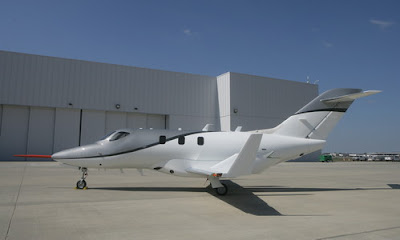
Exterior treatment of the first conforming flight test aircraft also is complete with the application of a new HondaJet paint scheme. Featuring a metallic silver-over-white profile combined with a distinctive sweeping fuselage stripe in dark metallic gray, the aircraft sports a bisecting white and dark metallic gray combination stripe extending from its nose over the upper fuselage, further enhancing the HondaJet's unique image of dynamic performance.

Assembly of the second conforming aircraft - to be used for static structural stress testing - was completed in July. Following control surfaces FAA testing, including rudder and elevator tests, static structural stress tests of the entire aircraft have commenced and included: 100% limit-load wing tests; 100% limit-load horizontal stabilizer tests; wing stiffness tests; landing gear load tests; pylon stiffness tests; and fuselage pressure tests. Static structural stress testing has been undertaken at Honda Aircraft Company's R&D facility on its Greensboro, North Carolina, campus.

"In addition to the more than 500 flight hours we have accumulated on the proof of concept HondaJet, the successful completion of this robust range of static structural stress tests on the conforming aircraft significantly reinforces the advantages of the HondaJet's advanced design," said Michimasa Fujino, Honda Aircraft Company's President and CEO.

All static structural stress tests are conducted utilizing Honda's advanced structural test system. The system incorporates 61 hydraulic actuators and a 2,600-channel data acquisition system within a structural test fixture designed exclusively for HondaJet testing. The entire aircraft can be tested simultaneously to prove static and fatigue strength under various flight- and ground-load conditions. Testing will continue on static test aircraft as the HondaJet program moves through the certification process. The fourth conforming aircraft will be used for fatigue testing scheduled for 2012.

Honda is now focused on assembly of the third conforming aircraft to be used for flight testing of mechanical systems. The fuselage and empennage for this aircraft have been completed, while the wing assembly nears completion. Final assembly of this aircraft is scheduled to begin soon at Honda's R&D facility on its Greensboro campus.

Testing of aircraft systems on conforming flight test aircraft are supported through the implementation of Honda's industry-leading Advanced Systems Integration Test Facility (ASITF). Honda's ASITF confirms before first flight the integration of the aircraft's electrical, avionics, mechanical and flight control systems, including stall warning protection systems (SWPS) and rudder bias systems (RBS). The HondaJet ASITF incorporates a fully representative primary flight control system with a high-fidelity control-loading system.

The HondaJet ASITF also incorporates actual aircraft systems hardware and software, installed in a spatially-representative manner and interconnected with actual aircraft electrical harnesses. Additional simulation capabilities have been integrated to provide real-time simulation of navigation RF data, including GPS.

"Honda's Advanced Systems Integration Test Facility is a powerful tool that will support the most efficient development and certification process possible for the HondaJet. By effectively identifying any developmental issues at the earliest possible stages of the process, our ASITF system will support an accelerated program momentum and, ultimately, help us create the best possible aircraft," said Fujino.

At this year's NBAA, Honda released HondaJet production cockpit and cabin designs featuring production parts, reflecting the quality of materials, colors and finishes to be available in delivery aircraft. The HondaJet's cockpit design has been updated to reflect the maturity of Honda's human factors engineering efforts and flight test evaluations.

Concurrent with the ongoing assembly of flight test aircraft, construction of the HondaJet production facility on the company's Greensboro campus is quickly nearing completion. The 250,000 ft2 production facility is now in the final phase of construction, with interior build-out well underway. The facility is scheduled for completion in early 2011, at which time pre-production preparations and training of production staff will begin. Upon completion, the production facility's two state-of-the-art painting facilities will be utilized to support finishing of additional conforming aircraft, thereby supplementing the painting capacity of Honda's R&D facility on campus. In addition, the HondaJet production facility will incorporate Flight Safety International Level-D, full-motion flight simulators for training of all HondaJet pilots and crew.

Also at this year's NBAA, Honda will conduct demonstrations of its advanced humanoid robot ASIMO to showcase the company's commitment to enhancing and expanding human mobility for the benefit of society. In addition to the design and development of automobiles, motorcycles and power equipment products, Honda's innovative research and development efforts during the past decade have yielded such diverse outcomes as humanoid robotics, walking assist devices, HondaJet, fuel cell electric vehicle technology, thin film solar cells, increased rice crop yields and functional nano-materials.

Based on its belief in the value of technology to address the needs of society, Honda's mission is to develop products that anticipate and satisfy the evolving needs of its customers while meeting society's demand for cleaner, safer, more efficient and sustainable means of transportation and human mobility.

About HondaJetHonda Aircraft Company, Inc., a wholly owned subsidiary of Honda Motor Company, Ltd., began sales of the advanced and innovative HondaJet in October 2006 in the U.S. and has amassed orders for well over 100 aircraft. Scheduled for first delivery in the third quarter of 2012, the $4.5 million HondaJet is Honda's first-ever commercial aircraft and lives up to the company's reputation for dynamic performance together with superior efficiency. The HondaJet proof-of-concept aircraft has accumulated more than 500 flight test hours and attained both a top speed of 420 knots (483 mph) and a maximum altitude of 43,000 ft. in flight testing.

The HondaJet incorporates many innovative technological advances in aviation design, including a unique over-the-wing engine-mount configuration that dramatically improves aircraft performance and fuel efficiency by significantly reducing aerodynamic drag in flight. This innovative approach to airframe design also lowers ground-detected noise when overhead and allows for a more spacious cabin and greater cargo capacity. The HondaJet is powered by two highly fuel-efficient GE Honda HF120 turbofan jet engines.

The production HondaJet flight deck features a Honda-customized Garmin® G3000 next-generation all-glass avionics system incorporating a class-leading layout with three 14-inch landscape-format displays and dual touch-screen controllers for overall avionics control and flight plan entries. The HondaJet Avionics Suite is the most advanced glass flight deck available in any light business jet and provides state-of-the-art integrated avionics functionality featuring split screen MFD capability, satellite weather, graphical synoptics, digital audio, and optional Synthetic Vision.

Learn more about HondaJet at www.hondajet.com.

Source;
http://www.hondanews.com/channels/corporate-headlines/releases/hondajet-program-update-released-at-2010-nbaa

Honda Aircraft completes tests on HondaJet

Awesome....

Honda Aircraft Co., the company building HondaJet, said this week it has completed key tests on its HondaJet aircraft at its factory in Greensboro, North Carolina.

HondaJet plans to build a $9 million sales and maintenance hangar at Albany International airport. Construction of the Albany hangar—initially scheduled to open this year—was delayed by the recession. HondaJet will provide sales and maintenance services for Honda Aircraft Co.

The Albany HondaJet hangar would open around the time the first HondaJet is scheduled to hit the market in 2012, airport spokesman Doug Myers said. The operation is expected to create 25 to 30 local high-paying jobs.

HondaJet will own the building and has a 25-year lease with the Albany airport that includes a first-year leasing rate of $65,393. New York state will pay $500,000 toward the project.

HondaJet’s recent tests, combined with structural testing planned for this summer and a first “conforming” flight test scheduled for later this year, should lead to Federal Aviation Administration certification of the private five- to six-person airplane, Honda Aircraft CEO Michimasa Fujino said during this week’s 2010 EAA AirVenture conference in Wisconsin.

“With this significant milestone achieved, we are now focused on the integration of avionics and other electrical systems in anticipation of first flight later this year,” Fujino said.

While a prototype of the HondaJet light aircraft has been flying since 2003, the conforming craft must meet FAA requirements for flight certification.

Honda aircraft also said it is nearing completion of the superstructure of the 250,000-square-foot production facility on its campus near Piedmont Triad International Airport, in Greensboro, with installation of electrical and plumbing systems next on the agenda. That facility should be completed early next year.

About 450 people work at the Greensboro HondaJet facility now, with about 600 total employees expected when full production begins.

The Albany HondaJet hangar will be built between the Million Air terminal, where HondaJet has set up temporary operations, and the vacant Eclipse Aviation hangar.

The Eclipse hangar at the Albany airport has been vacant since the Albuquerque, New Mexico company filed for bankruptcy November 2008. It is being marketed by the Albany office of NAI Platform, a global real estate company.

Myers said NAI Platform has shown the hangar a number of times since Eclipse was released from its lease in September 2009.

Source;
http://albany.bizjournals.com/albany/stories/2010/07/26/daily44.html