Showing posts with label Car and Driver Review. Show all posts

Car and Driver; In Depth with the 2012 Honda CRV


Compact crossovers are a little like toothbrushes. They perform a necessary function, but they’re rarely exciting. Everybody needs a toothbrush, though, and toothbrush manufacturers want to outsell their competitors, so we have wear-indicating bristles, flexible split heads, integrated tongue-and-cheek scrapers, and the like.


Accordingly, much of Honda’s technical presentation on the new CR-V focused on the next-gen mini-ute’s new features, including standard stuff like two info screens, a rearview camera, Bluetooth, and a function that reads incoming text messages from paired phones—assuming said phone is from a short list of BlackBerrys or a Droid X, as those are the only devices with which the CR-V can currently communicate. Meanwhile, lesser points like the powertrain and the basic construction of the chassis were only mentioned in passing. Makes sense: Once Colgate nails down the perfect handle cross-section, head shape, and bristle feel, it’s probably going to keep making that same toothbrush. Honda was pretty happy with the outgoing CR-V—and its sales numbers indicated that buyers were, too—so the new CR-V is a lot like the old one.


Hello, Again. You Should Have Brought a Friend. Maybe a Turbo.


The spec-sheet familiarity begins with the only available engine. It’s the same dual-overhead-cam 2.4-liter inline-four, but it now boasts a 5.4-percent reduction in internal friction and a more efficient alternator. These slight changes increase output to 185 hp and 163 lb-ft, bumps of five and two. It’s worth noting that the power peak occurs at 7000 rpm, and the automatic transmission shifts about 300 or so rpm before that. Unless you’re going to lock your CR-V in first around town, don’t expect to feel those extra fillies. You won’t hear them quite as much as before, either, although Honda still has the most pleasing soundtrack in the tiny-truck business. It’s louder than we would expect most crossover buyers to want, but it obviously isn’t deterring many—the CR-V is the perennial bestseller in its segment.


Behind that only slightly updated engine is an only slightly updated transmission. Against a market that is swelling with six-speed automatics—not to mention the nine-speed ZF unit on its way for front-drive applications—Honda is sticking with the CR-V’s fiver. Lower-friction internals and lower-viscosity transmission fluid boost efficiency, and a wider ratio spread nudges the CR-V’s fuel-economy ratings up. Front-drivers see their mileage increase from 21/28 city/highway to 23/31; all-wheel-drive models go from 21/27 to 22/30.

The Snow Falls and Molasses Wins


The downside is that the CR-V remains among the slowest in its class. The Honda’s ratios make it feel even slower than its predecessor—in first gear, redline resides north of 40 mph; in second, it’s hiding in the 80-mph range—but when we got the new CR-V to the test track, it actually clicked off the 0-to-60 run in two fewer tenths, or 8.5 seconds. We’ve recently logged about half a dozen complaints about the ratio spread in Chrysler’s rear-drive five-speed—we would like Honda to note that this unit is imminently being replaced with an eight-cogger—because of its ludicrous gearing.


Although few people floor it off the line during their morning commute (more people should try it; they’d be amazed how much more time they have in a day if they don’t drive like they’re dead or waiting to be), there are real-world drawbacks to dog-slow crossovers. Run up on a surprisingly slow truck on the freeway, and you’d better have a long opening behind you in the left lane. When you pop out to pass and give the CR-V the boot, it’s going to need a lot of time to get up to speed. Accelerating from 50 to 70 mph takes 5.6 seconds, while the combined time for 30–50 and 50–70 runs is more than 10 seconds. Should you floor it at much more than 60 mph, the trans only drops into third, stranding you around 3500 rpm. At that speed, it feels like you only need two digits to quantify the 2.4-liter’s torque output. Drivers behind you are likely to display two digits of their own. For even greater sluggishness, Honda fits all 2012 CR-Vs with an “econ” button that dulls throttle response and widens the acceptable window of variation for the cruise and climate controls.


In response to criticism for sticking with the five-speed, Honda’s answer was along the lines of, “Our five is damn good. The customers wanted efficiency gains—we gave them efficiency gains.” We appreciate the philosophy of extracting greater efficiencies from existing hardware before creating all-new systems, but clinging to the five-speed seems kind of lazy.


The critical chassis measurements—wheelbase, front and rear track—are identical to the previous CR-V’s, so you’d be forgiven for thinking that the new car’s underpinnings also land in the “same old, same old” column. Nay, says Honda: 65 percent of the basic structure is new. Part of that 65 percent is additional bracing around the back of the body. It further solidifies what already felt like one of the firmest shells in its class and contributes to what Honda claims is a 40-percent increase in the balance between responsiveness and stability. Claiming exact-percentage increases in unquantifiables doesn’t make much sense to us. Then again, neither does the fact that such a sporty-feeling chassis can be the favorite in a segment whose buyers certainly don’t prioritize athletic feel. But the CR-V is agile and firm, and the ride only gets unsettled on pavement that seems engineered to unsettle a vehicle. The steering is a bit slower than the outgoing CR-V’s, and although some added heft makes it feel more certain on-center, there’s otherwise less communication than before. We doubt many buyers will care. Neither will they notice that the electronically controlled all-wheel-drive system is quicker in its operation, more efficient, and lighter than the old hydraulic setup.


Feels Bigger Inside
Overall length is down by one inch, and height drops by 1.4 inch for front-wheel-drive models and one inch on all-wheel-drive versions. That robs front-row occupants of about an inch of headroom; legroom stays the same up front and is reduced by 0.2 inch in the rear. But the 2012 CR-V is a good deal wider up around the front windows than its predecessor, which lends it a much more spacious feel. The back seat of the outgoing vehicle could be adjusted fore-and-aft and offered four different seat-back angles; the new one has no fore-and-aft adjustment and only two seatback angles. Even so, we found it much easier to get comfortable in the back of the new car than in its predecessor. More sound-deadening material throughout the cabin makes this generation much quieter than the last CR-V.


Just as important to the CR-V’s target customer is the folding rear seat. Seats up, you’ll find 37.2 cubic feet of cargo space, up from 35.7. Maximum volume drops exactly two cubes, though, to 70.9. From the rear doors, the seats fold in two steps—flip the bottom cushion forward and then drop the back cushion on top of it—but levers on either side of the cargo area drop each seat in one smooth action.


Other features of the new CR-V are less impressive. Neither of the infotainment system’s two screens presents its assigned information clearly, and the controls for both are obtuse. If this Gen-Y author couldn’t immediately figure out how to navigate a USB-connected iPod, you’ve got trouble. And Honda apparently believes that high-tech features should have ColecoVision graphics.


For better or worse, Honda is proud that those features are standard on all CR-Vs, starting with the base LX trim. Moving to the EX adds a sunroof, nicer seat cloth, an intermittent setting for the windshield wipers—for which we imagine every LX buyer would gladly trade one of the two information screens—a security system, and body-color door handles and mirror housings. The CR-V EX-L piles onto that leather upholstery, a 10-way power driver’s seat, heated front seats, automatic climate control, an upgraded audio system with XM satellite radio, and a few interior trim pieces. Above EX-L, buyers have to make a tough decision: Do you want to get to your destination or travel in peace? Nav and a rear-seat entertainment system are available, but not together. The Oral-B ProfessionalCare SmartSeries 5000, on the other hand, has a timer to remind you to brush for two whole minutes and an in-handle display to provide feedback on the user’s brushing habits.

Honda hasn’t announced pricing yet, but figure on the ladder remaining similar to what it was in 2011, with the LX around $23,000, the EX near $25,000, and the EX-L commanding about $28,000, all with front-wheel drive. Add in navigation or the rear-seat entertainment system, and you’ll probably surpass $30,000.


The 2012 CR-V pleases on paper and remains a refreshingly competent entry in a dull segment. We’re amazed and heartened that a vehicle that feels so sporty relative to its competitors can consistently outsell all of them. But the new CR-V also delivers a few subtle insults—the poor integration of some of the technologies and Honda’s refusal to fit a six-speed transmission or more powerful engine among them. We still find it fundamentally satisfying, but a toothbrush should never offend.


Source;

2012 Honda Civic Si Coupe - Road Test

Now Playing: Upsized and downrevved for the enthusiast of tomorrow.
BY JOHN PHILLIPS, PHOTOGRAPHY BY ROY RITCHIE May 2011

For the past six years, we’ve felt a little like Estragon and Vladimir in Waiting for Godot. So many hours have been lost debating whether the previous-gen Honda Civic Si produced enough power to hold its head above water in the pocket-rocket pond. Eventually, this existential controversy morphed into a kind of recreation, with Si devotees screeching fiery epithets from the bleachers. Well, finally, Generation Nine is upon us. “We’re saved!” shouted Beckett’s protagonists whenever they suspected Godot might momentarily appear.

Here’s a sad fact: Godot never showed. And whether the Si is “saved” likewise remains unclear.

Let us review recent history.

Our first encounter with the previous Si came late in calendar year 2005, when we pitted it against a Volkswagen GTI. The Honda lost. In 2009, we inserted an Si into a seven-car comparo, where it finished fifth, gasping and sweating. We weren’t surprised. The Si’s engine—2.0 liters, 197 horsepower, 139 pound-feet of torque—relegated it to least-powerful status in the whole segment. It certainly didn’t possess the grits to fend off, say, a 263-hp Mazdaspeed 3 Grand Touring or a 265-hp Subaru Impreza WRX. What’s more, accessing the Si’s horses has always required the spinning of the crank and cams to a fine fare-thee-well. The VTEC didn’t swap cam profiles until 6000 rpm, and it was thereafter vital to rely on every single rev right up to the colossal eight-grand cutoff.

Of course, Si purists—and trust us, they are legion—smugly insisted that the little howler-monkey engine comprised much of the car’s charm. Yet in the same breath, they’d also confess the coppery taste of  humiliation whenever a WRX achieved 60 mph 2.0 seconds in front of them, fast becoming a gnat on the horizon.

Now comes Honda’s solution for the ninth-gen Si, a solution both simple and a little surprising, given the rumors of a turbo. Out goes the 2.0-liter engine, in comes the naturally aspirated 2.4-liter unit that sees simultaneous duty in the Acura TSX. The result is an unnoticeable 4-hp gain, but torque is up 22 percent—peaking at 4400 rpm instead of 6100 rpm—and that’s a difference you can feel. While they were at it, the engineers paired the engine to the TSX’s delightful six-speed transaxle. But is that enough?

Well, sort of. At the track, the Si nailed 60 mph in 6.3 seconds versus the previous 6.7, and it proved a half-second quicker in our 5-to-60-mph rolling start. Turn off  the traction control, and you can now shred rubber for 15 feet, followed by a Rottweiler bark as you bang into second. An improvement, for sure, but it’s still shy of the accelerative thrust of five turbocharged competitors, including the Speed 3, the WRX, and even the GTI, which has a similarly meager 200 horses but can nonetheless summon 60 mph in 6.1 seconds.

On the other hand, the larger engine ushers in welcome perks. The mechanical thrash of the previous powerplant, for instance, is now largely MIA, and gear noise is likewise reduced, with all three of our sound-level tests confirming the fact. (Still, road-borne noise and tread roar remain issues that Honda must address.) Equally important, the number of shifts required for ’round-town cruising seems subjectively halved. In traffic, the Si is perfectly content relying on first, third, and fifth. And by eschewing a turbo, the Si’s mileage—now up to an observed 26 mpg—is best described as a charming achievement.

Yes, yes, 900 top-end revs have been lost. But the car now pulls with at least vague enthusiasm just after step-off. In fact, our only serious beef with the new engine is its considerable overrun when the throttle is suddenly dropped. Among other things, that makes for very little initial engine braking, and the revs sometimes take a couple of seconds to return to idle. Most drivers won’t complain, but it’s a behavior that lends the drivetrain a titch of laziness that has historically been anathema to Honda-think.

As with the previous-gen Si, this is among the most-neutral-handling front-drivers on the planet. Around our 15-mile public-road loop in southern Ohio, we could provoke only the most minor of nibbling understeer—and that was at speeds approaching Fear Factor Nine—with the rear tires faithfully following whatever paths had been established by the fronts. No rotation, no drifts, no drama. Body motions were exquisitely controlled, with the ride revealing the stiff springs and dampers only over high-frequency imperfections, primarily expansion joints and broken pavement.

At around-town speeds, the Si’s steering tends to feel artificial, as if it were the outcome of some sort of electrical/mechanical calculus that never precisely balanced. At least it’s light. As speed rises, fortunately, it firms up nicely and also becomes livelier. There’s no bump steer, no nervousness, and interstate tracking is peerless. The brakes are fade-free, and the pedal is firm and informative.

Moreover, the light, fluid shifter—as good as any that Honda has ever produced—allows the driver to summon alternate rev ranges with the flick of two fingers, abetted by a new lightweight clutch with simply seamless takeup. Faced with slow hairpins, the limited-slip differential carefully apportions power so that the inside front wheel never scrabbles. The thinly cushioned seats hold you firmly in place, and the dead pedal is perfectly sited. With lateral grip rising from 0.87 g to 0.90 g, the Si just dances and sings in the hills. This 2864-pound coupe is perfectly balanced, agile, poised, ever willing, a car that is easy to drive. Real fast comes real quickly.

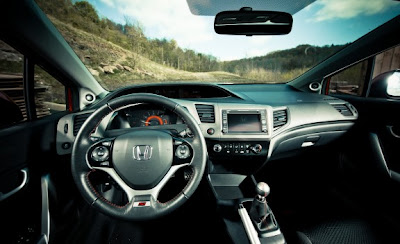
The only obvious failure here is the unimproved interior. There are crass plastic trim bits on the steering wheel and around the HVAC controls. The Civic’s trademark minivan-sized windshield leans over a mini­van-sized dash, a vast plain of cut-lines, textures, and colors. The bunk-bed layout for the IP is okay, but the garish LCD gauges are right out of a RadioShack in Akron. The mouse-fur headliner suffers from the mange, and there’s a lumpy, wrinkled collar of felt that surrounds the steering column, shouting to one and all, “Yessir, that’s right, I actually am the cheapest bit of flotsam in the universe!” Note to Honda: Check out the Ford Focus’s interior.

The new Si—manual six-speed only—comes in both sedan and coupe forms. The coupe starts at $22,955, the sedan opens at $23,155, and both top out at $24,655. The only options are navigation, XM radio, and (exclusive to the coupe) summer tires—17-inch Michelin Pilot Exalto PE2s, as fitted on our test car. (Fun driving tip: Demand that your spouse call you “Pilot Exalto.”) If you’ve got a calculator handy, you’ll perhaps already know that a starter Si coupe is more than $1500 cheaper than either a GTI or a Speed 3.

This latest Si is more sophisticated than its forebear, although it has been somewhat cruelly left to play David to the turbocharged Goliaths. As of now, it offers a better ride, produces less noise, and is faster in both a straight line and through the most diabolical off-camber, double-apex turns that Ohio’s deranged civil engineers could conjure. It is surely less raw than its predecessor, a trait that many Si purists—including our own revered Tony Quiroga and Dan Pund—lament. Until they commit to a three-day, 800-mile road trip, two-thirds of which skates over frost-heaved interstates. No longer is the Si a one-trick pony. At speed it’s a serial killer, yet during commutes and city errands it’s a near-soothing mental-health counselor with practicality and a price that make it easy to justify.

And with that, as always, please feel free to express your unalloyed hatred.

Source;
http://www.caranddriver.com/reviews/car/11q2/2012_honda_civic_si_coupe-road_test

Car and Driver: 2010 Acura TSX V6 Review

How does a big V-6 affect one of our longtime favorite sports sedans?
BY STEVE SILER, PHOTOGRAPHY BY MORGAN SEGAL AND THE MANUFACTURER June 2009


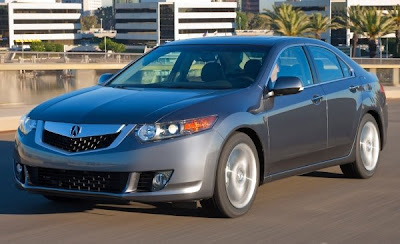
Around here, we are all big fans of the Acura TSX—the lean, frisky, three-time-10Best-winning, first-generation version, anyway. With respect to the larger, more substantial second-gen 2009 TSX introduced just last year, our camp is split. Some of us believe that even despite the car’s newer and larger (but just 130-pound-heavier) body, the high-revving 201-hp, 2.4-liter four-cylinder carried over is still a great match, offering an excellent blend of power and prudence, especially with the available six-speed manual. The rest believe that along with the newfound size and substance, Acura should have added a heap of horsepower—and rear- or all-wheel drive.

In regards to the former group, nothing has changed on the four-cylinder TSX for 2010: it’s still the happy, front-drive, near-luxe sedan it’s always been. For the power-hungry bunch, the 2010 TSX V-6 will alleviate the horsepower deficit when it goes on sale in July. By slipping in the same, 3.5-liter V-6 from the base TL—tuned in the TSX to 280 hp and 254 lb-ft of torque—Acura turns its smallest four-door into a very quick sports sedan, even if it comes only with a paddle-shifted, five-speed automatic transmission.


Specifications
VEHICLE TYPE: front-engine, front-wheel-drive, 5-passenger, 4-door sedan
BASE PRICE: $35,660
ENGINE TYPE: SOHC 24-valve V-6, aluminum block and heads, port fuel injection
Displacement: 212 cu in, 3471ccPower (SAE net): 280 bhp @ 6200 rpmTorque (SAE net): 254 lb-ft @ 5000 rpm
TRANSMISSION: 5-speed automatic with manumatic shifting
DIMENSIONS:Wheelbase: 106.4 in Length: 185.6 in Width: 72.4 in Height: 56.7 in Curb weight (C/D est): 3650 lb
PERFORMANCE (C/D EST): Zero to 60 mph: 6.0 sec Standing ¼-mile: 14.6 sec
FUEL ECONOMY: EPA city/highway driving: 18/27 mpg


How quick is it? Well, we’ll have to wait until we track test it to say for certain. Acura says it is capable of hitting 60 mph in seven seconds. But considering we hit 60 in 6.7 seconds with the last manual-equipped four-cylinder TSX we tested, we’re sure Acura is waaaaaay off with that silly estimate. Stay tuned.


Keep Your Hands on the Wheel

But alas, as the saying goes, with power comes responsibility. And in this case, the driver must be responsible for managing the V-6 model’s extra thrust—and 200-plus pounds of additional beef, most of which takes up residence over the front wheels. With its 62/38-percent front-to-rear weight distribution, this is a recipe for eminent understeer. And sure enough, our preview drive on some of the most challenging mountain roads through Malibu, California—with almost no runoff room and very few guardrails—provided us with more than a few intestine-twisting moments. We came to realize that the V-6 model truly isn’t as tossable as the four-cylinder, despite Acura’s fitment of flared-spoke 18-inch wheels (one inch larger than those on the four-banger) and firmer front shocks. Torque steer, however, is very well managed considering how much power is being dumped upon the front axle. After all, the front tires have to steer, too.

The brakes were also worked up a bit, with a new master cylinder, brake booster, and uprated rear brake pads. The pedal, however, still exhibited some slop in the first inch or so of travel, and that only got worse during our admittedly harsh flogging. We also saw considerable fade. In every other respect, however, the TSX is unchanged. The only exterior alterations involve the aforementioned wheels, a slightly revised front fascia and the V-6 badge on the trunk. Inside, other than a new active noise-cancellation system, there is no difference whatsoever. And that’s just fine with us: the comfortable, spacious and exceedingly well equipped interior is one of the TSX’s strongest suits, especially dressed in a dark color and equipped with the Tech package and its solar-sensing climate-control system, 10-speaker ELS surround-sound stereo, and navigation with real-time traffic reporting.

Steep Price for Power
Well, there is one more difference: price. At $35,660, the TSX V-6 will cost a monstrous $5,540 more than the $30,120 2010 TSX four-cylinder that’s available now. That’s right, two extra cylinders will run a guy nearly $2,800 each. That’s especially notable given that the TSX has proven that it can do its job just fine with the four it was born with, to say nothing of that engine’s clear fuel economy advantage (21 city/30 highway mpg versus 18/27).
Hmmm. So how much is all that power—and understeer—really worth to ya?


Source;
http://www.caranddriver.com/reviews/hot_lists/high_performance/honda_acura_central/2010_acura_tsx_v6_first_drive_review