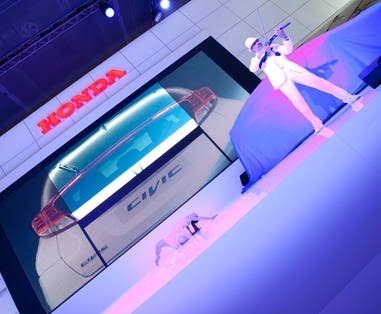
Showing posts with label Next Gen Honda Civic. Show all posts

2013 Honda Civic launches in Thailand (are you the refreshed Civic for NA?)

Hmmm, it's no secret that the 2013 Honda Civic will be getting a minor model refresh, I wonder if this is what it's going to look like....
We simply love the current Honda Civic even though it has been virtually unchanged for the last six years. As expected, there is a new model coming now and as we showed you last year, it is much similar to the Civic that is being sold in the US market – albeit with minor design changes for the ASEAN countries.

Earlier this week, the all-new Civic was launched in Thailand and provides an insight into the model that will be launched in India. For the Thailand market, the Civic gets two engine options – 1.8-litre and 2.0-litre i-VTEC petrol mills. There is still no word about the diesel powerplant though. Surprisingly, the paddle shifters that were so popular with the automatic variants of the Civic are now available only on the 2.0-litre version and not on the 1.8 automatic.

The interiors too have been updated and get new features like telephone connectivity, in-dash navigation system, push-button starter and reversing camera. The design of the interiors is an evolution of the two-tier design that you see in the current Civic. The steering wheel has a new design though and is a big departure from the current design which is now common to the Civic, City and Brio. The highlight of the interiors is the ECON switch and the Intelligent Multi-Information Display (i-MID). The new Civic also gets projector headlamps now with HID lamps and auto-leveling feature.

Honda has a total of five variants for the new Civic, out of which four are powered by the 1.8-litre mill. The pricing starts at THB 773,000 (Rs 13.4 lakh approx.) and goes all the way up to THB 1,124,000 (Rs 19.5 lakh approx) for the top of line 2.0EL variant. The top end version is also sportier of the lot with black leather interiors, paddle shifters and the more powerful engine.

Source;
http://www.oncars.in/Car-News-Detail/2013-Honda-Civic-launched-in-Thailand/2382

Honda President Commits to “Distinctive” and “Sporty” Vehicles

After having taken quite a beating with reviews of the new Civic, Honda has been on the offensive, promising updates while announcing its new “Earth Dreams Technology” plan to reestablish itself as a fuel economy leader. With the debut of the EV-STER electric sports car concept and confirmation that a new NSX is on the horizon, company president Takanobu Ito is now going a step further, while explaining the faults of the past.

In an interview with the The Nikkei, he explains Honda’s old product planning method. “We divided the world into six regions, and Honda’s regional operations were each responsible for their respective regions. Whenever we planned a product for the global market, our thinking was that we needed to listen to each regional supervisor.”

The result, says Ito, was a lowest-common-denominator approach to building a car, watering down all the characteristics of a vehicle to the greatest mass-market appeal. The problem admits Ito is that, “When you harmonize all the different opinions, you end up with a safe, boring car.”
Under the old method of doing business, the vehicle development team was essentially taking the designed-by-committee idea and building a car around it.

Ito says that since he took over in April of last year, changed the system. “I had three corporate officers each supervise luxury, midsize and small vehicles,” he said. “Putting more authority in their hands, I asked them to create more competitive autos and to speed up coordination with product planning and regional operations. I set up a structure that would allow them to take the lead in realizing the wishes of the development team. The fruits of these moves will begin to appear in the market next fiscal year.”

Exactly what those fruits are, says Ito, will be cars that are environmentally friendly and safe, but also ones that are “highly distinctive”. Honda, after all, has a long history of unique vehicles from the NSX, S2000, CRX and del Sol. But perhaps most importantly, he says, “This strategy will be represented by our effort to make vehicles more sporty.”

The first true example of this plan will be evident when Honda unveils the next-generation NSX at the Detroit Auto Show next week.

Source;
http://www.autoguide.com/auto-news/2012/01/honda-president-commits-to-distinctive-and-sporty-vehicles.html

Report: Honda Will Revise Sales Forecasts Up While It Revises Civic

By Ben Timmons
Honda’s not taking its recent Civic-related setbacks quietly, and it certainly isn’t giving up in the face of natural disasters, supply problems, and cheap plastics: the company is shooting to increase sales by 24 percent next year.

Automotive News reports that Tetsuo Iwamura, the President and CEO of American Honda, is predicting a 24 percent increase next year in sales, as the company works to upgrade and fix its 2012 Civic coupe and sedan. If Honda can pull off both of these ideas well, it would spell a great 2012 for a company that struggled through 2011. Its Civic sedan is down 13 percent thanks to inventory problems and quality problems, and the whole nameplate is off 5.3 percent year-to-date.

Keep in mind, also, that Honda was one of the hardest-hit Japanese automakers in last March’s Great East Japan Earthquake, and it continued to suffer during the Thai floods later this year. Sales of Honda’s hybrids, which are either produced in Japan or rely on Japanese parts, were down 53 percent in November 2011 from the same period in 2010.

Still, Honda hopes that its product portfolio will carry it to victory next year, as it pushes the one-two punch of natural disasters further and further in the rearview mirror. It is looking to replenish dwindling inventories of the Civic as it readies the update, and along with the all-new CR-V, sell roughly 1.25 million Hondas in 2012.

It’s a lofty goal, but we’ll see just how attainable it is in the coming months.

Source;
http://rumors.automobilemag.com/report-honda-will-revise-sales-forecasts-up-while-it-revises-civic-96285.html

Updated 2013 Honda Civic Coming Late Next Year, Company Says it Expects to Improve Sales

With less than two weeks to go before the year’s end, we can safely say that one of the biggest disappointments of 2011 was the ninth generation of Honda’s U.S.-market Civic. Launched in April as a 2012 year model, the new Civic was criticized for its drop in quality and was even removed from Consumer Reports’ “Recommended” list.

Honda Motor CEO Takanobu Ito took personal responsibility for the new Civic's poor performance. And now, the company's executives confirm earlier reports that Honda is rushing back to the drawing board much earlier than originally anticipated.

Honda U.S. executive vice president of sales John Mendel may claim that “building a good car isn’t good enough for us, we have to build a great car”, but we suspect that the 13 percent drop in sales to 200,690 units in 2011, is probably the reason why the Civic is getting ready for a redesign only a year after launch.

Tetsuo Iwamura, Honda’s top North American executive, told Bloomberg News that the 2013MY Civic will go on sale by late next year and that it will be “upgraded”. That was to be expected, as the Civic is Honda’s second best-selling car in the U.S. after the Accord.

Iwamura admitted that “the gap between the Civic and the competitors has been narrowed”, adding that “we have to make it wider”. Thus, he revealed that the Japanese carmaker will improve the styling, driving dynamics and comfort of the 2013 MY Civic.

The performance of such a critical model only added insult to injury for Honda, as the March earthquake that hit Japan seriously diminished its inventory and resulted in a 5.3 percent drop in the company's U.S. sales through November.

Despite this year’s performance, Japan’s third biggest carmaker has set quite a high target for next year: it wants its U.S. sales to increase from about 1 million units in 2011 to 1.25 million, and its luxury brand Acura to improve its record even more, from 126,000 to 180,000 deliveries.

“It looks like quite a high jump, but because of the availability problem we had a really low year in 2011”, Iwamura told Bloomberg. “That is the reason why growth looks huge, but for us, it’s a natural growth.”

Source;
http://www.carscoop.blogspot.com/2011/12/updated-2013-honda-civic-coming-late.html

Honda: Let's try that again

HONDA is working flat-out on improvements to its all-new Civic after a lacklustre start to the car's life.
The latest model of the Japanese compact has been criticised for its lack of innovation and quality. For the first time, it has been struck from the list of recommended models in the influential Consumer Guide in the US.
The new Civic sedan arrives here towards the middle of next year, with the five-door hatch to follow, as global head of Honda, Takanobu Ito, promises significant upgrades to counter the criticism.
"We will continue to make improvements on a daily basis," Ito says.
He takes responsibility for the car's shortcomings and admits Honda underestimated its opposition, as well as the level of improvement needed over the outgoing model.
"I believe that the ultimate responsibility for the Civic rests with me," Ito says.
"Right now we are trying to work out the best actions possible in response.
"We might have underestimated the competition to a certain extent."In Honda's defence, Ito says he believes the previous-generation Civic was well ahead of its rivals and that might have led to decisions that did not push hard enough on the new car.
"The previous Civic was something of a major surprise to the world, it was extremely advanced, and therefore the concept for this current Civic was trying to carry over the concept.
"We look at the history of the Civic model. We are constantly aiming towards more advanced features and carrying out development of the new Civic."
He admits Honda has been stung by the poor reception for the car.
"In this situation it is true that we lacked the capability to understand beforehand that such reactions might have come about. We should have studied these things more carefully."
He believes Honda's effort with the previous Civic also spurred rivals to develop the cars that are now making things tough for the maker and the model.

Source;
http://www.adelaidenow.com.au/ipad/honda-lets-try-that-again/story-fn9y0ah4-1226217398926

First Drive: 2012 Honda Civic European-Spec

It's Different, but Is It Better?November 07, 2011 / By Paul Horrell
The new Ford Focus and Honda Civic went on sale at roughly the same time, aiming at roughly the same buyers -- but the two were designed with entirely different global philosophies. Thanks to One Ford, the Focus is largely interchangeable in Europe, Asia, and the U.S. Honda, meanwhile, has continued the split-design policy started with the previous-gen Civic. As such, the European model has very little in common with the one sold in the States and elsewhere.

For starters, the European Civic is a hatchback, not a sedan. It has entirely different exterior sheetmetal, rear suspension, and interior. It even has different front frame rails to make space for Europe's bulky 2.2-liter diesel engine.

Because it hasn't gotten into bed with any other car company, Honda is now in the second tier, size-wise. This separation of platforms must therefore count as a scarily expensive decision. Is it worth it?

Certainly the Euro-Civic has a unique selling proposition. As with the Jazz/Fit, the fuel tank is under the front seats. The rear suspension uses a simple, compact torsion beam layout rather than double wishbones, giving the Civic remarkable versatility. There's nothing but fresh air under the rear seats, so you can flip the cushions up against the backrest like in a movie theater, giving a wide floor-to-roof cave that can easily fit a bicycle upright. Even with rear passengers, the trunk is super-deep.

But let's face it, if cargo space is that important, there are plenty of other options, like one of the micro-minivans that are all over the roads in Europe. If the rest of the Civic doesn't have enough engaging characteristics, flip-up rear cushions aren't going to save it.

Cosmetically, this brand-new Euro Civic is an update of the car it replaces. It develops the same styling form, a sort of one-box that tends to the pyramid-shaped, but it's slightly lower than last time, and has a wave-like crease along the sides plus a black goatee at the front.

On the powertrain side, Honda hasn't done enough. Although the automaker used to be regarded as one of the world's most progressive engine-makers, these days it looks out of step with the European market. European buyers are busily downsizing, and gasoline engines in this category tend to be torque-rich direct-injection turbos such as the Ford Ecoboost or Mini 1.6s, or even a 1.2 and 1.4 from Volkswagen. Honda is sticking with port-injected 1.4 and 1.8 VTECs. The 1.4 makes a scant 94 lb-ft. Meh.

At the same time, Honda's diesel is the opposite: It's too big and powerful. Europe's compact car diesels are usually around 1.6 or 1.8 liters in size. Honda's is 2.2-liters, making it an expensive engine for the market. Still, Honda has at least found ways to eke out the fuel consumption -- the reason diesels proliferate. For this size of car, it now balances performance and economy in an attractive fashion. Economy is a bit better than average, and performance is much better than average.

It's not just engine improvements that make these economy gains. Honda obsessed on aerodynamics, both in the body shape and the details. There's an active shutter arrangement for the radiator grille, so that at speed when cooling air isn't needed in quantity, the grille shuts off for smoother airflow over the car. The tail has several small spoilers and fillets to clean air detachment and cut turbulence. More gain came from an idle-stop system. And weight hasn't risen, despite better equipment.

Yes, this is a good engine to use, with a wide spread of torque and decent refinement. Use the sweet six-speed stick sensibly and the rated acceleration (0-62 mph in 8.5 seconds) translates through the major-league torque into muscular passing and corner-exit acceleration.

The previous Civic was set up with a jittery ride and sharp steering. Fun, but tiring on a long trip. It didn't suit the buyers - families, commuters, and business travelers who spend a lot of time on highways. So Honda used the model change to uprate the NVH isolation. It went back to the source with, among other measures, new fluid-filled bushings for the rear suspension. Even more significant, the springs have been softened off. The Euro Civic now has a decently pliant and quiet ride, a contrast to the criticisms leveled at the U.S. version.

Of course, this means extra body lean, but in general the motions when cornering feel well-controlled. The real downer is a new EPS system, which is soggy and lacks road feel through curves. The simplicity of the rear suspension probably doesn't help. Still, the steering does have good straight-line stability and easy placement in urban driving. And it saves fuel versus the old hydraulic system. See where Honda's priorities are?

Honda did consider moving the European and American Civics closer together with this generation, but as the project went along they drifted apart again. There's a lot to like about the Euro car, and its character seems very different from the U.S. one. But both of them seem, in different ways, to have needed a bit more money spent on them. Maybe a single world-car program would have been the way to do it.

Source;
http://www.motortrend.com/roadtests/sedans/1111_2012_honda_civic_european_spec_first_drive/printer_friendly.html

SEMA Preview: Fox Marketing Working on Monster 2012 Honda Civic Coupe with More than 500HP

Even though we are still wrapping up the goods from the 64th International Auto Show in Frankfurt, we are keeping an eye on upcoming automotive events such as the 2011 Specialty Equipment Marketing Association, more commonly referred to as SEMA, that will take place in Las Vegas from November 1 to 4.

One of the project cars currently being developed for the largest aftermarket gathering in the world is a highly modified 2012 Honda Civic Si Coupe from Fox Marketing.

The crew over at Fox is preparing an outrageous tune that will see the Japanese carmaker's latest Civic Coupe gaining a turbocharged engine producing north of 500-horsepower.

The car will also feature an upgraded chassis and extensive exterior modifications.

You can get a sneak preview of what Fox Marketing is working on in the gallery below.

Source;
http://carscoop.blogspot.com/2011/09/sema-preview-fox-marketing-working-on.html?utm_source=feedburner&utm_medium=feed&utm_campaign=Feed%3A+Carscoop+%28CARSCOOP%29

Honda Motor President and CEO, Takanobu Ito reveals New Civic at Frankfurt Motor Show

-New Civic makes public debut
-Designed for, tested and uniquely produced in Europe
-Newly developed smaller diesel added to Civic range in 2012
-New generation of low emission engines for Europe
-30% CO2 reduction target for all product areas by 2020

Good morning, Ladies and Gentlemen, I am very pleased to join you today at the Frankfurt Motor Show.
50 years ago, Honda's first European company was established in Germany in 1961. Since then, our mission has always been to satisfy European customers with unique and innovative products.
Our journey still continues today. We are making progress with a range of clean and sustainable, yet fun-to-drive mobility technologies. We continue to develop our Hybrid, Battery Electric, Plug-in, and Fuel Cell products alongside energy generation technologies such as Solar Cell and Cogeneration.
Since 1972 when we became the World's 1st auto maker to meet strict US emissions regulations with CVCC technology, Honda has been committed to reducing our environmental footprint.
Our New Environmental Mark symbolizes our passion to provide sustainable mobility for future generations and to deliver ‘blue skies for our children'.
To measure and demonstrate this commitment, we announced in June that we aim to deliver a 30% CO2 reduction on all product areas by 2020.
The New Civic is the first step towards achieving this new target. The 1.8 litre petrol engine delivers a 10% CO2 reduction. The 2.2 litre diesel engine reduces CO2 emissions by nearly 20%, whilst further enhancing performance.
By the end of 2012, we will add a newly developed smaller diesel engine to the Civic range. Designed specifically for the European market, the new engine will further reduce CO2 emissions. Starting with this new smaller diesel, Honda will introduce a new generation of low emission engines, renewing all of our automobile engines in Europe.
From the First Civic to this 9th generation Civic, we have always challenged ourselves to give Civic a new value. The New Civic offers a striking sporty design and class-leading utility created by Honda's unique centre-tank layout, whilst now offering even more improved fuel economy, handling and comfort.
The New Civic is designed for European customers. We tested this car on European roads more than any other Honda car in our history. It is dynamic and stable. It is fun and comfortable with no compromise made to achieve these improvements.
New Civic is not just an evolution, it is a revolutionary evolution. We have jumped 2 generations ahead of our current model.
The new Civic will be uniquely produced in Europe, and sales will start in early 2012.
Ladies and Gentlemen, THIS IS... THE NEW CIVIC, and with this New Civic, Honda's strong regeneration in Europe begins.
Thank you for your attention.

Source;
http://www.hondanews.eu/en/news/index.pmode/modul,detail,0,1977-DEFAULT,21,text,1/index.pmode

The New Honda Civic (Euro)

Honda will launch the new Civic at the IAA Frankfurt Motor Show in September. Developed specifically for the European market, the Civic will be offered exclusively as a five-door hatchback and will compete in the C-segment. It will reach European showrooms in early 2012.


In the build-up to the reveal of the new Civic, Honda is releasing a series of short form films detailing its development. The third of these films focuses on noise and refinement.


NEW HONDA CIVIC: class-leading refinement


One of the focuses of the development team for the new Civic was optimising the interior refinement. The engineers worked intensively to hone every detail of the design, build and aerodynamics. The results add to a car that is relaxing to drive on all roads and in all conditions.


The engineers have spent a lot of time testing the car in Europe, tuning the new Civic to suit the distinctive road conditions. The team used Honda's anechoic chamber in its R&D Facility in Swindon, England, to fine-tune the cabin insulation. One of the results of this research was to modify the design and construction of the roof lining, and how it interacts with the bodywork.


The new Civic's aerodynamic efficiency also plays a key role in maximising its refinement. Several members of the development team have Formula One experience, which they used to deliver a car that combines a low coefficient of drag with excellent high-speed stability. Hours of meticulous work in the Honda wind tunnel has improved performance, reduced fuel consumption and resulted in an exceptionally quiet interior.


"We did not improve the noise and refinement of the new Civic through just one technique," says Kazuo Sunaoshi, Development Leader - Chassis. "It was the accumulation of lots of little details. My big challenge was to match the noise and vibration levels of our European competitors. I am proud to say that we have achieved our goals."


Find out more by watching the new ‘noise and refinement' film release. The film is hosted on an interactive media player where all the films will be shown and automatically updated. You can easily download films and images or even embed the whole player in your site http://multivu.com/players/English/51356-honda-motor-europe/


Source;


For First Time In Years, Civic Isn’t ‘Recommended’

Whoa! I didn't think I'd ever see the day.... I got to say I'm not sure what to think, on one hand I do agree with consumer reports on the quality of materials taking a step back, but the noisy choppy ride I couldn't disagree with more, especially having done a comparison ride and drive between all the major competitors listed in the top 12 and knowing how each drives.

CR's also says that the rear seat room is a positive, well, I am no giant but I have noticed that there is less head room in the rear compared to the previous model. Hmm.

I think Honda is a victim of their own success, there is no doubt that the competition has gotten better, it's very hard to have a 'revolutionary' new bodystyle everytime but I do feel they made some improvements; safer (10% more high tensile steel), better fuel economy (with or without Eco mode), and more features (bluetooth is standard, new multi-informational display, USB is more standard, power seat in a Civic EX-L, and I could go on).

At the end of the day it is going to come down to what the consumer says and if early indications are anything, at least here in Canada, we can't get enough of them. I expect a revision to this rating some time, might not be until their May 2012 issue, but I expect something.
A popular consumer magazine known for its automotive road tests says it can no longer recommend the Honda Civic compact sedan. The Civic, which has been a top finisher in comparisons with rivals in the small-car segment for decades, finished second from the bottom in a 12-car shoot-out in Consumer Reports.

The magazine’s announcement, which coincides with distribution of its latest issue, marks “the first time in recent memory” that the Civic has not received its stamp of approval, a magazine spokesman says.

Summing up the Civic’s performance in its small-sedan evaluation, Consumer Reports says, “The Civic, long one of our top-scoring small cars, has slid backward with its latest redesign and no longer scores high enough in our testing for us to recommend it. The new Civic dropped a whopping 17 points — from a very good 78 to a mediocre 61 on our 100-point scale.”

The statement continues: “Compared with its predecessor, the 2012 Civic has lower interior quality and suffers from a choppy ride, long stopping distances, and pronounced road noise. Vague steering impairs its agility and robs it of its fun-to-drive feel.”

Among the positives, the magazine says, are the car’s rear-seat room and fuel economy of 30 mpg overall .

Honda released the following statement:
“In a broad sense, we disagree with Consumer Reports’ findings. Without question, the small sedan segment is more competitive than ever. In virtually every way, the completely redesigned 2012 Civic is a step forward. The new Civic excels in areas that matter to small-car customers, including fuel efficiency, safety, and reliability. Among the Civic’s greatest competitive strengths, is a smooth and efficient powertrain that, in Consumer Reports testing returned, “… an impressive 30 mpg overall on regular fuel and 47 mpg on the highway.” Also noted in Consumer Reports findings, the Civic excels in the area of safety, with a long list of important features standard on all trim levels, and a class-leading ‘Top Safety Pick’ rating from IIHS. Lastly, the Civic has a stellar reliability history with Consumer Reports, and we are confident that the new Civic will be a reliability leader as well.”

Here is the finishing order in the Consumer Reports test:
1. Hyundai Elantra GLS
2. Nissan Sentra SL
3. Subaru Impreza 2.5i
4. Toyota Corolla LE
5. Kia Forte EX
6. Mazda Mazda3 Touring
7. Chevrolet Cruze 1LT
8. Ford Focus SE
9. Chevrolet Cruze LS
10. Mitsubishi Lancer ES
11. Honda Civic LX
12. Volkswagen Jetta SE

Source;
http://blogs.wsj.com/drivers-seat/2011/08/01/for-first-time-in-years-civic-isnt-recomended/

2012 Honda Civic Si Takes On New Role As IZOD IndyCar Series Safety Car

TORRANCE, Calif. (July 6, 2011) – The all-new, ninth-generation 2012 Honda Civic Si Coupe will take on new duties as a Safety Car for the IZOD IndyCar Series, beginning on the weekend of the Honda Indy Toronto, July 8-10.

Already a hit with race fans through the Civic Racing Style Sweepstakes, the 201-horsepower Honda Civic Si Coupe was recently transformed by Honda Performance Development (HPD), Honda’s racing subsidiary north of Los Angeles, into an official IZOD IndyCar Series Safety Car.

Modifications to the already high-performance stock Civic Si include Sparco seats and four-point racing harnesses; an HPD high-performance brake system, with four-piston calipers, competition rotors, racing pads, and stainless brake lines; a Honda Genuine Accessory aerodynamic body kit, consisting of front, side and rear under spoilers; and Firestone Firehawk 225/40 R18 tires mounted on Enkei alloy wheels.

An exclusive graphics theme completes the conversion from a showroom Civic Si Coupe to an IZOD IndyCar Series Safety Car. The Safety Car will be driven during IZOD IndyCar Series events by three-time Indianapolis 500 champion Johnny Rutherford.

“The high-performance new Honda Civic Si is the perfect match for the IndyCar Safety Car fleet,” said John Mendel, American Honda executive vice president, auto sales. “With its larger and more powerful 2.4-liter engine and enhancements provided by HPD, it is ready to lead the IZOD IndyCar Series field at the Honda Indy Toronto and beyond.”

Unveiled in April at the New York International Auto Show, the 2012 Honda Civic features more streamlined and expressive “mono-form” exterior styling, wrapped around a spacious cabin with more style and convenience. Available new technology features include an intelligent, Multi- Information Display (i-MID), USB audio interface, Bluetooth® HandsFree Link® and a satellite-linked Navigation System with voice recognition and FM traffic.

American Honda Motor Co., Inc., was founded in 1959 as the U.S. sales and marketing subsidiary of Honda Motor Co., Ltd. Honda currently produces automobiles, motorcycles, all-terrain vehicles, lawn mowers and engines at its nine major U.S. manufacturing operations, using domestic and globally sourced parts.Honda Performance Development (HPD) is the Honda racing company within North America. Founded in 1993, and located in Santa Clarita, Calif., HPD is the technical operations center for high-performance Honda racing cars and engines. HPD is the single engine supplier to the IndyCar Series and competes in prototype sports-car racing under the HPD banner in the American Le Mans and European Le Mans Series. In addition to its grassroots motorsports support programs, HPD offers race engine products from karting to pinnacle.
From Honda / HPD

Source;
http://insidetracknews.blogspot.com/2011/07/2012-honda-civic-si-takes-on-new-role.html

Burlapp Fine; 2012 Euro Honda Civic?

Not too sure what to think about this one, the front doesn't go with the body in my opinion....
Source;
http://www.burlappcars.com/2011/06/2012-euro-honda-civic.html

Inside Line: IL Track Tested: 2012 Honda Civic Si Coupe

No, your eyes aren't playing tricks on you. This is not the last gen, but rather the all-new 2012 Honda Civic Si.

For 2012 Honda expanded the stroke and bore of the old 2.0 so now the Civic Si displaces 2.4 liters and produces 201 horsepower at 7,000 rpm and 170 pound-feet of torque at "only" 4,300 rpm. That's 22 percent more torque than the outgoing car, arriving nearly 2,000 rpm sooner.

We walked away from a first drive of the 2012 Honda Civic Si pleased with the additional torque, and the handling was exactly what we expected from the Si. But that was on a Honda-prepped autocross course under careful supervision.

Now that we've got one on home turf, it's time to see what the 2012 Honda Civic Si will do in our performance tests...

Vehicle: 2012 Honda Civic SI Coupe
Date Tested: 5-3-2011
Driver: Chris Walton

Specifications:
Drive Type: Transverse, front-engine, front-wheel drive
Transmission Type: Six-speed manual
Displacement (cc/cu-in): 2,354
Redline (rpm): 7,100
Horsepower (hp @ rpm): 201 @ 7,000
Torque (lb-ft @ rpm): 170 @ 4,300
Steering System: Electric-assist rack-and-pinion power steering
Suspension Type (front): Independent MacPherson struts, coil springs, stabilizer barSuspension Type (rear): Independent multilink, coil springs, lateral links, stabilizer bar
Tire Size (front): 215/45ZR17 (91W)
Tire Size (rear): 215/45ZR17 (91W)
Tire Brand: Michelin Tire Model: Pilot Exalto PE2
Tire Type: Summer performance
Wheel size: 17-by-7 inches front and rear
Wheel material (front/rear): Cast aluminum
As tested Curb Weight (lb): 2,845

Test Results:
Acceleration
0-30 (sec): 2.6 (2.9 with T/C on)
0-45 (sec): 4.6 (4.8 with T/C on)
0-60 (sec): 6.9 (7.1 with T/C on)
0-60 with 1-ft Rollout (sec): 6.6 (6.9 with T/C on)
0-75 (sec): 10.1 (10.2 with T/C on)
1/4-Mile (sec @ mph): 15.1 @ 93.1 (15.3 @ 93.1 with T/C on)

Braking
30-0 (ft): 29
60-0 (ft): 120

Handling
Slalom (mph): 67.3 (62.8 with T/C ON)
Skid Pad Lateral acceleration (g): 0.86 (0.84 with T/C ON)

Sound
Db @ Idle: 43.1
Db @ Full Throttle: 80.4
Db @ 70 mph Cruise: 67.4
RPM @ 70: 3,000

Comments
Acceleration: Power delivery is far more linear than previous 2.0L Si engine, but i-VTEC is still evident -- more audible than palpable, though. With trac off, it's tricky to launch with just-right wheelspin, but it can be done and subtracts about a half-second from time. It's difficult to hang revs at a desired rpm because the throttle is so sensitive and revs climb and drop with a millimeter of throttle travel. Shifter is still very good, but feels ike it has a longer throw than previous Si's.

Braking: Some initial pedal travel, then very firm thereafter. Not much initial bite. Zero ABS buzz, little tire squeal, but rear end gets light and wiggles side-to-side.

Handling: Skid pad: With ESC off, gently understeers all the way around. "Steering" with the throttle doesn't work -- no rotation possible. With ESC on, the system grabs a brake and keeps it just inside understeer. Steering weight is good -- not too heavy or light or electric-feeling.

Slalom: With ESC off, the car is sensitive to entry speed and likes to rotate off-throttle. Best run was entry at just barely sub-limit, then barely adjust throttle for a tiny bit of rotation at each cone, then MASH the throttle at exit. It's a delicate technique, and there's probably +1 mph left, but this would be a "perfect" run. With ESC on, it's punishing to the slightest bit of tire howl or sliding -- hence slow.


Source;
http://blogs.insideline.com/straightline/2011/05/il-track-tested-2012-honda-civic-si-coupe.html

Honda stays ahead of compact pack with 2012 Civic

Detroit, heed this warning.

Do not underestimate the 2012 Honda Civic.

It was the single most important vehicle shown at the New York International Auto Show this week.

The 2011 Chevrolet Cruze and 2012 Ford Focus are spectacular compact cars partly because Chevy and Ford engineers benchmarked the Civic. For a decade, the Civic has been the best compact car around, and while others have gained ground, this Honda remains near the head of the class.

It is a nameplate that has been around a lot longer than any American compact car, and don't let anyone fool you: Honda Motor Co. has a lot riding on this little car.

Honda has not raised any eyebrows with many of its recently launched vehicles. The new Accord is dull. The Crosstour is confusing, and the current face of Honda's luxury brand Acura continues to bring the brand ridicule. If Honda had messed up the Civic, it would be time to get out a fork and turn the brand over.

But there was no mistake made with this new vehicle.

Now, as the new Civic arrives, it faces a much tougher climate. The Cruze, the Focus and the Hyundai Elantra have garnered well-earned praise from consumers and the automotive press, including myself.

Although the Civic is no longer alone, underestimating it would be a serious mistake.

Here's why:
Variety: The 2012 Civic offers almost every model variation. There are sedans, coupes, gas-electric hybrids (with lithium-ion batteries), a compressed natural gas model and even a performance Si model. New to this lineup is the Civic HF, which focuses on higher gas mileage.

This follows on the heels of other carmakers such as Chevrolet, Ford and Hyundai, which offer similarly branded vehicles. No other compact, however, comes in as many different variations as the Civic (the only model missing is a hatchback, which is a mistake).

Pricing: With so many different models, the Civic offers a price for just about anyone:
Civic DX sedan (5-speed manual): $15,805
Civic LX coupe (5-speed manual): $17,655
Civic LX sedan (5-speed auto): $18,655
Civic EX sedan with navigation (5-speed auto): $22,005
Civic Si coupe (6-speed manual): $22,205
Civic Si sedan (6-speed manual): $22,405
Civic Hybrid: $24,050
Civic natural gas: Price not released

All of this pricing is on par with much of the competition, which means Honda is certainly in the hunt for compact consumers.

Performance: While I have not driven the new Civic, I expect it to provide performance on par with all of the serious competition. The previous-generation Civic has a quiet, well-tuned ride, with enough power to speed along the highway and enough handling chops to zip through city traffic. This model introduces a new electric power-assist steering system (EPAS), the next-generation vehicle-stability control, improved aerodynamics and a stiffer body for improved handling. Tuning on the steering will be important as EPAS can sometimes create a numb feeling that leaves a driver disconnected from the road.

Additionally, the performance-oriented Si model features a new 2.4-liter, four-cylinder engine that generates 201 horsepower. It's only four more ponies than the 2-liter engine, but tuners around the world can rejoice that their beloved Si now has peak horsepower over 200. (The Si also features a lower height, a limited-slip front, and 17-inch aluminum wheels that all could add to the driving experience.)

It's Honda's 1.8-liter, four-cylinder engine that will do most of the heavy-duty work for the brand, and even this engine has undergone a number of improvements to make it more efficient.
It produces 140 horsepower and provides gas mileage from 28 mpg in the city and 36 mpg on the highway for a DX sedan with a five-speed manual transmission to 41 mpg on the highway for the HF model.

One disappointment with the new Civic comes with the lack of a six-speed automatic transmission, though Honda says this five-speed is more refined and updated. Nearly every competitor has one now, as six-speeds have become the industry norm. It will be interesting to see whether that missing gear hinders its performance in any way.

Exterior styling: While many new compact cars offer extravagant styling, the new Civic does not look dramatically different than the previous generation. But don't mistake this car as simply a refreshed vehicle; it has been redesigned throughout. At first glance, there doesn't seem as dramatic a difference between generations.

Many of the exterior changes were devised to improve the Civic's aerodynamics. They include new mirrors, wipers pushed below the hood line and other changes you can't see at first glance, such as underbody aero panels.

This seems to be a closely followed plan by Honda, which only dramatically changes the Civic's styling every other generation. How much that will affect the Civic will be told over the next year.

Honda's conservative approach to styling follows the lines of the Cruze, whereas the Elantra and Focus are more dynamic.

The winner here is the consumer, who now has a clear choice between dramatic good compacts and more familiar small cars.

Interior styling: The Civic evolves its interior design from the previous generation, with a new two-tiered instrument panel and entertainment system, known as i-MID. Honda has nailed one of the most important parts of any new system by giving it a nonsensical name that starts with a standalone lowercase vowel — i or e — and a full-color screen to display all of the information.

More importantly, the Civic adds more volume inside, increased by 3.7 cubic feet. The previous-generation Civic was comfortable; this one should be even a little more so.

Civic's biggest selling point still reliability

So from the sounds of it, the new Civic is improved inside and out. Whether that adds up to this vehicle becoming the next benchmark will be decided by consumers.

The compact car segment has drastically changed the past 12 months, and everyone wants an edge over everyone else. The real edge for the Civic coming out of the gate is that it's a Honda, which to many consumers means it's as reliable as a late spring in Michigan.

That wasn't always the case for the Civic. Thirty-nine years ago, when the little Civic arrived, Honda had to issue a recall because rusting was so bad the cars were considered unsafe in accidents. Now, Civics are among the safest choices of any car picked.

The competition certainly has gotten stiffer, but to sneer at this Civic too early would be a serious miscalculation. No one should do that.

Source;
http://detnews.com/article/20110423/OPINION03/104230361/Honda-stays-ahead-of-compact-pack-with-2012-Civic#ixzz1KpJ7Sjxy

2012 Honda Civic Review: 2012 Honda Civic: Put to the test

April 27, 2011
By Denis Duquet

The Honda Civic has been the best-selling car in Canada for 13 years running, which is – you have to admit – no small feat in a very competitive environment. Needless to say, the task of updating this model wasn’t easy. When a car is as universally acclaimed as the Civic, the margin for error is relatively low. If you change the car too drastically, you’re going to disappoint a lot of people. Then again, if you don’t change it enough, the car will end up looking the same.

Honda unveiled new generation Civic concept cars at the Detroit Auto Show in January and the reactions were decidedly mixed. The main criticism was that its shape hadn’t changed enough, though this was influenced by the fact that this car was supposed to be introduced months earlier. The delay created an expectation that more significant changes had been made. Alas, this was not the case, and the production models unveiled last week are almost identical to the concept vehicles.

Actually, the approach is hard to criticize in a way. Indeed, a little like at Porsche, Honda chose to make a succession of refinements, improvements and technical revisions to already impressive performance and reliability features. And the same goes for the body, which is a very mild evolution of the 2011 version.

Designed by engineers
When Honda Canada introduced its new Civic, five engineers (none of whom had a hand in designing the car) were invited from Japan. Maybe my conclusions are way off, but I got the impression that the engineers were the ones who took the lead on the whole shebang. All the stylists had to do was follow their instructions, which undoubtedly explains why the front end of the sedan and the coupe are almost unchanged. However, you have to admit that the car was elegant to begin with. In fact, the main changes were made to the tail end, while the lights are completely new, helping you identify the new generation. But for many, this just isn’t enough...

The engineers dedicated a great deal of time to improving the car’s drag coefficient. This meant tilting the windshield significantly toward the back. Its aerodynamics are excellent, but since the base of the windshield is a lot lower than the edge of the hood, there’s at least 5 cm where leaves, debris, snow and ice will undoubtedly collect. Let’s hope that the front windshield wipers motors are robust. A minor detail, you say? Well, this car seems to lose points in the details. This junction between the hood and the windshield is a compromise that suggests they were trying to avoid a complete makeover of the entire front end. At least, that’s how I see it.

The sharp incline of the windshield does wonders for the Civic’s best-in-category drag coefficient, but because it’s so sharply angled, the front seats had to be pushed back so that no one would bump their head on the windshield. The result is a very deep dashboard. That in itself isn’t a flaw, since several other interesting cars are set up like this, but the fact that this dashboard is made of hard plastic with an unimpressive texture is less forgivable. On the other hand, the ergonomics are good, the optional navigation system display screen is excellent and the layout of the controls is simple and efficient. The driving position is also good.

The two-level dashboard offered on the previous generation has been revised. Wanting to offer more information, they decided to widen the upper section. It’s not very elegant, but thanks to a command button on the steering wheel, you can access a multitude of information. Up to this point, it’s practically fantastic. However, I don’t know if it was my driving position, my view or something else, but when I was driving in the middle of the day with the sun at its brightest, it was very difficult for me to see the indicator dials, odometer and other small information screens.

Good news, it’s now roomier, thanks mainly to the 75-mm increase in the vehicle’s width. In back, the occupants benefit from 40 mm more legroom, which is quite impressive considering that the wheelbase is 30 mm shorter while the overall length remains identical.

Improved mechanics
While the shape and the interior presentation leave us wanting, I must mention that the car’s mechanical components have been refined or even greatly improved, especially when it comes to safety and fuel consumption. The base version of this ninth generation Civic is powered by the same 1.8-litre four-cylinder engine that produces 140 horsepower. But a bunch of internal improvements help reduce fuel consumption by 12%. That’s noteworthy now that gas prices are on the rise. The engineers managed to reduce fuel consumption with the help of things like reduced-friction brakes, low-resistance tires and a lower-than-average drag coefficient for the category. A six-speed automatic transmission would have produced better results, but it still has a five-speed instead.

The Civic Hybrid is back, and its all-wheel drive has been updated and improved. For starters, it calls on lithium-ion batteries for more power and to reduce the vehicle’s weight. The electric motor’s power has been increased from 15 to 20 kW. What’s more, the CVT has been refined, as have the climate control system and the energy regeneration brakes, which allow Honda to promise fuel economy of 4.4 L/100 km in town and 4.2 L on the highway. However, Honda’s engineers remain faithful to the IMA system that consists of a small electric motor installed between the transmission and the combustion engine. Although this technology is a little less cutting-edge, its average fuel consumption is still impressive. But you’ll have to drive in fuel saving mode to derive its benefits.

On a sportier note, the sedan and the Si coupe are now powered by a 2.4-litre engine that produces 201 horses, four more than the previous version. The six-speed manual is the only transmission available. This model also features two other exclusives: front and rear deflectors and very nice alloy rims.

Still a good car
Despite the fact that some people are disappointed with how few changes were made to its appearance and by the decision to skimp on some of the materials in the passenger compartment, this car remains one of the most interesting to drive. Indeed, during the new Civic presentation, I had the chance to drive all of the models available. And while none of the test drives were exhaustive, at least I was able to take each of the configurations for a short spin. Overall, besides the underwhelming dashboard and the difficulty seeing some of the dials, it remains a good tourer and that can squeeze into traffic easily. On the highway, it has all the same qualities and all the same limitations as before. The engine is responsive and the handling is good, but the soundproofing leaves something to be desired. Note that the new steering wheel is elegant and the information management buttons are within reach and user-friendly.

As though it were asking buyers to forgive the Civic for its lack of dazzling changes, Honda cooked up a very competitive price range. Regardless of the model you choose, 2012 Civic buyers benefit from generous equipment and downward-adjusted pricing. According to Honda, discounts will range from $2,600 to $3,950, depending on the model. You have to admit that this will persuade many people to overlook certain shortcomings. Money talks, and Honda is making sure that buyers will listen. Sure, maybe the company cut costs awkwardly in some areas and the shape could have been refreshed a little more, but this car’s intrinsic value – its refined mechanics and pleasant ride – has been preserved.

Source;
http://www.carguideweb.com/articles/11193/

Autos.net: A Close Look at the 2012 Honda Civic

Here's a really comprehensive article on the 2012 Civic by Paul Williams out of Autos.ca (the new version of Canadian Driver)....
The next generation 2012 Honda Civic is finally here, and those who don’t like change will be very happy indeed. Not that there isn’t anything new about the new Civics, but from a visual standpoint, consumers will be hard-pressed to tell the outgoing 2011 model from the incoming 2012.

The big news about the 2012 Civic is not so much about appearance; it’s more about the pricing, which has dropped substantially. A base Civic DX can now be bought for $14,990, which is $2,000 lower than the price one-year ago.

Granted, not many sedan-only DX models will be ordered (likely because they’re not available with an automatic transmission), but the popular LX and EX models are also boasting smaller MSRPs, a trend among all manufacturers now that the Korean makers Hyundai and Kia have entered the market with bright new products at bargain-basement prices. As well, there are impressive new compact cars from Ford (Focus), Chevrolet (Cruze) and Volkswagen (Jetta) with which to compete.

But the Civic has been and continues to be Canada’s top-selling car, so the company’s response to the new competition is likely a wise one: don’t mess with success, but make the Civic more affordable.

All the Civic models have been re-priced — Sedan, Coupe, Si and Hybrid — with the LX Sedan starting at $17,490 (down $2,090), the EX starting at $19,490 (down $2,290), the top-line EX-L entering at $24,390 (down $490), the LX Coupe starting at $17,990 (down $2,090) and the sporty Si a more Gen-Y-friendly $25,990 (Coupe and Sedan). Hybrid pricing has not yet been announced.

Although the new Civics look much the same as the generation that debuted in 2006, there are subtle exterior and interior changes and, depending on the model, more significant changes under the skin.For the Sedans and Coupes, the rear of the car is obviously different, with a smoother look and revised lights, while the front also receives new lights and bumper treatment.
Honda says 90 per cent of the sheetmetal is replaced and that all Civics are more aerodynamic.

The A-pillars are 12 per cent thinner, and an extra window has been inserted at its base to improve outward visibility. From the driver’s seat, that’s very noticeable and appreciated.

Interior space in the Sedan is increased by 105 litres, with more front shoulder room and additional front and rear hip room, although exterior dimensions remain unchanged from the previous model. Trunk space is also up 4.2 per cent to 352 litres. Civic Coupe owners will enjoy 30 mm more front shoulder room.

The drivetrain is mechanically the same: a 1.8-litre four-cylinder single-overhead camshaft engine making 140-horsepower, and five-speed manual or five-speed automatic — but the engine has been refined to produce a significant 12 per cent improvement in fuel economy. City/highway fuel consumption drops to 7.2/5.0 L/100 km for a combined rating of 6.2 L/100 km when equipped with the automatic transmission. Additionally, all models feature new “motion-adaptive” electric power steering technology and next-generation vehicle stability assist.

The interior also looks very much like the outgoing models, although the front seats have been redesigned to provide more support and the steering wheel is smaller. Bluetooth is standard on all models except the DX.

The distinctive bi-level instrument panel featuring a digital speedometer and gauge array carries over, and a new 12.5-cm i-MID colour display allows the driver to rotate through audio, trip and vehicle information screens. An Econ-mode is standard on all models (except the Si) to maximize fuel economy, but your particular driving style will determine by how much.

The Civic Si (still available in Sedan and Coupe versions) features a new 2.4-litre dual-overhead camshaft powerplant that makes 201 hp (up by four-hp) at 7,000 rpm (down by 800 rpm) through the short-throw six-speed manual transmission and limited slip differential. The engine’s 178 pound-feet of torque represents a 22 per cent improvement, and is available at 4,400 rpm, which is 1,700 rpm lower than the previous model. The Civic Si is very much a performance-oriented car, with more robust acceleration off the line and a slick-shifting gearbox in the Honda performance tradition. Fuel consumption is rated at 10.0/6.2 L/100 km, city/highway.

The Civic Hybrid also features a new engine (now 1.5L), a more powerful motor, and perhaps most significantly, a new battery — now Lithium-Ion rather than the Nickel-Metal-Hydride battery pack used since 2003. The new battery is lighter, more compact and more energy dense than the battery it replaces, enabling the Civic Hybrid to operate in full Electric Vehicle (EV) mode for 73 seconds at full load. Fuel consumption is rated at 4.4/4.2 L/100 km, city/highway, for a combined rating of 4.3 L/100 km.

Unfortunately, the Civic Hybrid’s battery is still located behind the rear seat, preventing the seat from folding or the fitment of a pass-through for long objects like skis or hockey sticks. Unlike the non-hybrid Civics, the drive mode defaults to “Econ,” although the driver can select a more responsive mode at the press of a button.

On the road, the Civic EX-L Sedan and LX Coupe are smooth and quiet, and also familiar if you’ve driven the previous-generation car. Unlike some competitors, interior panels (dash, centre console, doors) are hard plastic, which looks like a cost-cutting measure and may be prone to marking more easily than a soft-touch product. In the new Hyundai Elantra, for instance, it’s all soft-touch.

The bi-level digital instrument panel is an intelligent design; the speedometer and secondary gauges easy to read and positioned almost like a Head-Up Display. But the large, analogue-style tachometer seems like a waste of space in this digital environment, especially in a car with automatic transmission.

The instrument panel is highlighted by red, blue and green illumination that changes depending on engine load. You can use these subtle colour changes to modulate your driving style and reduce fuel consumption. Every little bit helps, right?

The overall impression behind the wheel is of driving a modern, bright and spacious car, despite its compact, although by no means diminutive, exterior dimensions.

Driving the Si is a decidedly sportier experience compared with the standard Sedan and Coupe; everything is more responsive, more immediate, more engaging. The steering and braking is sharper, suspension is firmer, power from the engine is right there, and the exhaust note under acceleration will be music to the ears of enthusiast drivers, especially as the engine shifts from low to high-rpm camshaft profiles (which also lights a red indicator on the dash). The Si looks good, but may benefit from larger wheels (17-inch are standard), or by lowering the suspension to fill in the wheel wells a little more.

The Hybrid’s improved IMA (Integrated Motor Assist) system seems to operate more smoothly in the 2012 Honda Civic Hybrid, especially under braking. This car is only available with the CVT automatic transmission, and benefits from standard automatic climate control and standard navigation system with satellite radio. Other than its 15-inch alloy wheels, trunk lip spoiler and LED brake lights, there’s very little difference, both inside and out, between the Civic Hybrid and gasoline-powered Civics. The key difference, of course, is the hybrid drive-train, which in our brief test drive provided a genuine 25 per cent improvement in fuel economy compared with the non-hybrid Civics.

The ninth-generation 2012 Honda Civic model line-up is not a radical redesign, but more an evolution from the previous generation. This is to be expected. Having sold 1.6 million Civics in Canada since the model’s introduction here in 1973, Honda has the basic recipe well in hand, and expects the 2012 Civic to retain its current owners, and with its more competitive pricing, attract new buyers to the “Honda Nation.”

Honda Civics are built in Alliston, Ontario (except for Hybrid models) and the new cars will see their official launch at New York Auto Show. Sales will begin in late April, 2011.

Verdict: More of the same from Honda, but when it comes to the Civic, “the same” represents a very high standard. Although billed as “Civic: The Next Generation,” I would like to have seen Honda boldly go a little further when it comes to interior execution and exterior design.

Source;
http://www.autos.ca/first-drives/first-drive-2012-honda-civic