Showing posts with label Honda Performance. Show all posts

2012 Honda Civic Si Wows At SEMA Show

Limited-edition Honda Factory Performance kit unveiled and Honda Performance Development reveals new grassroots racing program for the Civic Si
11/01/2011 - LAS VEGAS
Seven modified 2012 Civic Si Coupes and Sedans are featured prominently in the Honda booth at the 2011 SEMA Show, which opens today. The all-new 2012 Civic Si Coupe and Civic Si Sedan emphasize the performance potential of the Civic lineup and represent great platforms for vehicle personalization. Several significant vehicles are being unveiled at the show, including a 2012 Civic Si Coupe equipped with a limited-edition Honda Factory Performance™ (HFP™) package, the Honda Performance Development, Inc. (HPD) Compass360 Racing HPD 2012 Civic Si Coupe Racecar, the Accord Coupe HFP Concept and several vehicles equipped with Honda Genuine Accessories.

“The Honda Civic was instrumental in the first import-tuner movement in the U.S. during the ‘80s,” said Bruce Smith, vice president of Service and Technical Operations for American Honda Motor Co., Inc. “The all-new Civic Si builds on that proud history by offering inspiring performance, improved fuel economy and a great platform for personalization.”

Show-goers will get the first look at the 2012 Civic Si Coupe fitted with a limited-edition HFP package. Limited to only 500 complete kits and on sale today at Honda dealers in the U.S., the package includes: high-performance springs, reducing ride height by 15 mm; high-performance dampers tuned for enhanced road handling and decreased body roll; 18x7 inch HFP Alloy Wheels; full HFP aerodynamic body kit; HFP carpet floor mats; red ambient interior illumination; and, HFP emblems. All of the painted parts will come color-matched to each of the seven available Civic Si Coupe colors.

After unveiling the Compass360 Racing HPD 2012 Civic Si Coupe Racecar, HPD provided details about its new racing performance parts program for the all-new Civic Coupe. Earlier this year, HPD began sales of Civic bodies-in-white, also on display. For builders of racecars, starting their build with a body-in-white represents significant cost and labor savings when compared to the purchase and conversion of a fully-equipped production car. Sales of the body-in-white began in July, and HPD has delivered a number to licensed race teams thus far, priced at $3,500 each. Additionally, HPD will soon offer HPD-designed parts and branded racing components for the new Civic through the Honda Racing Line. These racing parts are tailored for use in the SCCA World Challenge and Grand Am's Continental Tire Sports Car Challenge. They will be available early in 2012, and full details and pricing will be available at that time.

Combining the expertise of HPD and the styling and performance history of HFP, the Accord Coupe V6 HFP Concept features a full suite of currently-available HFP components. HPD guided the creation of the “concept,” which includes a supercharger and performance air intake and exhaust systems. Building upon a stock 3.5-liter V6 engine, the supercharged engine is estimated to produce 335 hp and 285 ft. lbs of torque (up 64 hp and 34 ft. lbs vs. stock car). This vehicle was modified to demonstrate the performance potential of the Accord V6 coupe and to gauge consumer interest. Honda has no current production plans for the concept.

Sporting available Honda Genuine Accessories, the 2012 Civic Si Sedan shows that performance and style can come with four doors. It features 18x7 inch HFP alloy wheels, all-season floor mats, trunk tray, cargo net, cargo hook and splash guards. All Honda Genuine Accessories, including HFP components, offer a 3-year/36,000 mile warranty like the Civic itself, if they are purchased and installed at the time of new vehicle purchase, and are engineered to be fully compatible with each Honda vehicle.

Nestled amongst two previously-seen Honda-modified CR-Z sport hybrids, the HPD CR-Z Hybrid R Concept and the CR-Z with MUGEN accessories, is a stand-alone HPD CR-Z engine concept equipped with a supercharger. This 1.5-liter engine concept builds upon HPD’s experience with the turbocharged HPD CR-Z Racer that competed at the 25 Hours of Thunderhill last year and represents HPD’s continued exploration of the performance potential of the CR-Z.

Reaching out to the import community, Honda invited three independent vehicle tuners to build and display their Civic Si concepts at the SEMA Show. Tuners were asked to push the limits of performance and style with their builds, and the vehicles on display demonstrate the personalized potential of the Si Coupe and Sedan. Following last year’s amazing CR-Z build, Bisimoto Engineering delivered a 1004 hp version of the Civic Si Coupe. Having previously built two generations of Fit project vehicles, Tjin Edition brings its own take on the Civic Si Sedan, showing that style and performance can coexist with kids and a family. And making its Honda SEMA Show debut, Fox Marketing pulled out all of the stops to create a wide-body, turbo-charged version of the Civic Si Coupe.

Vehicles on Display at the Honda Booth
From American Honda Motor Co., Inc.
2012 Civic Si Coupe with limited-edition HFP™ package
2012 Civic Si Sedan with Honda Genuine Accessories
2012 Accord Coupe V6 HFP™ Concept
2011 CR-Z with MUGEN Accessories
2012 Civic Si Coupe modified by blink-182 for the Honda Civic Tour

Historic Civic models from the American Honda Collection
2000 Civic Si Challenge winner (by Superstreet magazine)
1975 Civic 3dr

From Honda Performance Development, Inc.
2012 HPD Compass
360 World Challenge Spec Civic Si racecar
2012 Civic Coupe body-in-white
2011 CR-Z Hybrid R Concept HPD CR-Z engine concept with supercharger (engine only)

Aftermarket Project Vehicles
Bisimoto Engineering 2012 Civic Si Coupe
Fox Marketing 2012 Civic Si Coupe
Tjin Edition 2012 Civic Si Sedan

Source;
http://www.hondanews.com/channels/corporate-headlines/releases/2012-honda-civic-si-wows-at-sema-show

Inside Honda Performance Development

By Carlos Lago of www.motortrend.com
"Oh cute," I'm thinking, "Honda's strapped a wing and a roll cage to a CR-Z and called it a racecar." Burbling out of pit lane at Willow Springs Raceway in the Honda CR-Z Racer, with what sounds like a swarm of bees armed with a megaphone in tow, I roll on the throttle. Suddenly the tach needle jumps by two thousand rpm, the front wheels jolt, the steering wheel scrambles in my hand, and I'm heading into turn one much faster than anticipated.


This white and red concoction of turbochargers, nickel cobalt magnesium batteries, and racing slicks is the work of Honda Performance Development, a research and development subsidiary of the Japanese automaker that focuses solely on racing. Based in Valencia, California, the roller coasters at Six Flags Magic Mountain are visible from the road that approaches HPD's two-story, 125,000 square foot building. Home to an engine assembly hall, machining rooms, dynos, and so on, HPD is responsible for producing about one-third of the engines for IndyCar -- each of which takes 120 hours -- and for developing products for ALMS, go-karts, SCCA World challenge racers, quarter midgets, and SEMA show pieces.


Hence, the CR-Z Racer I'm fumbling around the big track at Willow Springs. It bowed at SEMA last year, alongside a group of similarly modified stable mates, with a turbocharged 1.5-liter I-4 and a higher output battery pack; combined, the package makes right around 190 horsepower. The hybrid system offers interesting approaches to racing. The 25 horsepower and 65 pound-feet of torque Honda estimates it delivers can be activated by pressing a button, push-to-pass style. The powertrain can even revert to an economy setting for endurance races. How well does it work? Honda entered two CR-Zs at the arduous 25 Hours of Thunderhill (a race famous for its "I survived the 25" finish line slogan) one of which placed second in class and ninth overall.

If there were a finishing place for fun-factor, the result might've been similar. The CR-Z is exceedingly hilarious. It is not a fast car, although it offers admirable acceleration in the upper arches of its powerband. The CR-Z's strength is maintaining speed. Its 17-inch wheels are shod in BFGoodrich racing slicks which beg to be pushed harder corner after corner. After a two-lap taste, I want to gorge.

The CR-Z Racer remains a small part of HPD's interests, which range from top-tier IndyCar and ALMS series to grassroots efforts. In 2010, the SCCA approved a variant of the Fit-based 1.5-liter engine for use in Formula Ford, or as it's now known officially, Formula F. The engine that powers your Honda generator? HPD turns that into a mill for quarter midget racing. It also takes 125 cc dirt bike engines and readies them for go-karts.

Most recently, Honda has been working with other manufacturers to introduce B Spec, a racing series for subcompacts like the Fit. The cars rely on production components -- engine, transmission, and chassis -- to drive down the cost of entry; a finished racecar should total around $25,000. Required changes for safety include a roll cage, suspension upgrades, wheels and tires, and a few other pieces, and HPD will, of course, offer these parts for your Fit. Mazda has been gung-ho with its Mazda2 -- such that it and Honda debuted the two racecars simultaneously. Ford and Kia have subsequently prepared versions of the Fiesta and Rio for competition. Toyota may even offer a Yaris. The series is rapidly gaining traction, and the automakers plan on having the cars performance balanced soon (a process that ensures that all cars perform on an equal level).

DEPENDABLE RACE CARS
Honda calls itself the most dependable name in racing and eagerly backs up the claim. Since becoming the sole supplier, HPD's IndyCar V-8s have broken records for reliability; the last in-race engine failure happened in 2009. Such performance is the result of scrupulous investigation. A materials analysis room at HPD is the home of countless slivers of metal and rubber, material encased in plastic. Each one has a story to tell. A piston, for example, is cross-sectioned, sliced thinly like a steak. Across the length of the slice, every few millimeters, HPD takes measurements to see what temperatures the metal has experienced. Knowing the temperatures means knowing how far the pistons can be pushed in the future, or how much to back off.

Other pieces tell stories of tragedy. A square gasket, no taller than a coffee mug, hangs from a wire stand. It's from Fernandez Racing's ARX-01b, the then Acura-branded American Le Mans prototype, which finished second overall at the 2008 12 Hours of Sebring. During the post-race inspection, the engine refused to stall after its intakes were plugged (ALMS requires all air entering an engine to go through inlet restrictors). The team was disqualified. After an intense search, HPD found that the supplier responsible for the small gasket switched glues during production. That glue failed and the gasket unseated, allowing extra air through. Though a small, seemingly insignificant piece, the gasket cost the team the race. HPD doesn't forget, and team members still sour when telling the story.


The injury is one to ego. HPD knows the ins and outs of its hardware, as most of it is factory spec. The V-6 the new ARX-01d chassis relies upon is based on a stock Honda Accord engine. HPD changes the crank, cam profile, and adds two turbochargers. There's your race engine.

When I toured the facility, I was guided to one of the dyno rooms, where an example of the twin-turbo V-6 sat. In the isolated room, the bare engine was hooked to an innumerable amount of wires, looking ready to enter the Matrix. We entered an adjacent room for monitoring, separated from the dyno chamber by two heavy doors. We watched as the engine ran a simulated lap of Sebring raceway, using data gathered from a race. The suspended engine revved to its 6200-rpm limiter, simulated an up shift, and continued again. Its sound is a flat and low burble, the piping around the turbochargers quickly glows orange. When needed, HPD will run an engine for 24 hours to simulate the rigors of endurance racing. I closed my eyes and pictured running a lap, downshifting for braking, maintaining throttle during long corners. At one point the engine audibly shot past limiter. "Over rev," the technician says. The driver from when this data was gathered put a tire on the slippery painted curbing, getting wheel spin.

This type of development is one of HPD's contributions to Honda products. Since its inception in 1993, HPD has learned much about efficiently developing cars for extreme scenarios. For example, HPD doesn't rely on wind tunnel testing anymore, favoring computational fluid dynamics, or CFD, until race day. Eliminating wind tunnels means eliminating costly and time-consuming scale models; designing and building a front splitter for that 50 percent scale ALMS prototype costs $25,000. The company relies on computing power and claims no downsides. The team says it has so much success with the process that they can take a prototype out on a shakedown and it will perform just as CFD predicted. Passing this expertise on to the parent company has the potential to cut development time and costs.


Admittedly, I wasn't thinking about development practices while heading towards turn one at Big Willow. I was thinking about attempting the fast left-hander in fourth gear and pushing those tires harder. I wasn't thinking "Oh, cute" anymore. I was thinking that while the showroom may not inspire the enthusiast within, enthusiasm for racing is alive and well at Honda.

Source;

Report: Honda confirms ‘new NSX’ in the works

With so many renditions to choose from....
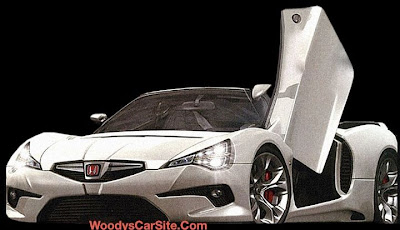
Honda is reviving the NSX with an all new version of the sportscar icon, revealed by president and CEO Takanodu Ito.

Part of what Ito is setting out to enhance is the power-to-weight ratio, as he comments “I spent part of my early career at Honda developing the NSX, and specifically the aluminum body…I really enjoyed that experience, and learned much, so it is my wish that Honda engineers have the experience of developing a sportscar like the NSX in the future. Within Honda, our engineers are already looking at developing such a car.”

Previous plans for a 2010 release of the NSX were up cancelled due to economic decline back in 2008. Since then, Honda has decided to enhance the sport aspect of the brand, but in a manner more conducive to the economic climate.

Ito says “Our recent efforts have been focused on fuel efficiency, and that perhaps gives the impression Honda is behind with pushing the brand image of sportiness, but let me assure you that is not the case…We will address that impression with our new generation of cars.”
- By: Alexandra Koken

Source;
http://www.egmcartech.com/2011/09/13/honda-confirms-new-nsx-supercar/

Remembering the curio classics: the 1989 Honda NSX

What a car.... By Ben Whitworth 28 March 2011 12:15 I spotted the NSX heading London-bound up the A3 early on Saturday morning, on the way to attend my best mate’s stag do. It was pristine, its cherry red paintwork and unscarred five-spoke silver alloys glinting in the sunlight. Low, sleek and barrelling along at a very decent pace, it looked utterly gorgeous. I was instantly struck at just how fresh and modern it looked. For a car launched in 1989, the Honda NSX is still contemporary, clean and head-turningly handsome, pop-up headlamps and all. Honda NSX: still contemporary today Even today, the elements to the car’s development sound fantastic. The perfect distillation of its engineering prowess, it was developed as Honda basked in F1 success. Its mid-engined cab-forward styling was inspired by an F16 fighter jet. Ayrton Senna, Satoru Nakajima and Bobby Rahal honed its dynamics. It was the world’s first car to go into production with a all-aluminium monocoque chassis complete with a sophisticated extruded aluminium bodywork. The NSX's wailing 2977cc V6 V-TEC engine was fitted with titanium conrods – another world first – and it revved to 8000rpm. The suspension was fashioned entirely from forged aluminium. It had telepathic electric power steering. It was hand assembled by a hand-picked crew of just 200 engineers. It weighed just 1350kg. And, of course, the Honda NSX was a gem to drive. The NSX – a supercar ahead of the game The Honda was defined by its brilliant chassis balance and superb agility, qualities that showed its contemporary rivals like Ferrari 328 GTB and Porsche 911 the dynamic back door. Visibility was panoramic, the spacious cabin was an ergonomic delight and reliability was exceptional. But despite this deep-seated talent, the NSX never really took off. It was, perversely, not seen as exotic enough for a blue-blooded supercar. It was criticised as being mundane simply because it was easy to see out of, didn’t break down, didn’t try and spit you into the nearest ditch at every opportunity and had a straightforward cabin design. Our loss, really. I gave the driver a thumbs up as he peeled off the carriageway and he grinned, dropped a cog and nailed it up the exit ramp. The lucky bugger. I spent the rest of my trip up to London trying to figure out where on earth I could find the £40k for a low-mileage 1997 3.2-litre with a six-speed manual. Source (with better pics); http://www.carmagazine.co.uk/Community/Car-Magazines-Blogs/Ben-Whitworth/Remembering-the-curio-classics-the-1989-Honda-NSX/

BorgWarner to supply EFR turbochargers to Honda’s CR-Z Hybrid race car

Looks nice!
The EFR turbochargers for three of Honda Performance Development (HPD)’s projects will be supplied by BorgWarner. These projects are the following: the 2011 ALMS LMP2 engine, the CR-Z Racer and the CR-Z hybrid R concept car. With BorgWarner's technology, the cars’ performance will surely be improved but Honda seeks to keep its fuel consumption at a low level. In a statement, BorgWarner revealed that its new turbochargers use last-generation components, including Gamma TiAl (titanium aluminide) turbine wheels, ceramic ball bearings, stainless steel turbine housings and internal wastegates activated by BorgWarner's compact brushless actuator.

The company revealed that twin EFR turbochargers will be fitted on the 2.8-liter V6 LMP2 engine that will make it to the 2011 American Le Mans Series, European Le Mans Series, 24 Hours of Le Mans, and Intercontinental Cup competitions. In addition, an EFR turbocharger will be installed by BorgWarner and Honda on a race version of the CR-Z equipped with a 1.5-liter engine.But Honda clarified that it will still attempt to maintain fuel efficiency. BorgWarner believes that the overall power can be boosted by 50%, without any support from the hybrid function. If you want to see this for yourself, the final project can be viewed live in the 25 Hours of Thunderhill from December 3 to 5.

"BorgWarner's EFR turbocharging technology delivers increased thrust capacity, quicker boost response, greater efficiency and improved durability—everything professional race car drivers desire," said Roger Wood, Executive Vice President, BorgWarner. "BorgWarner is pleased to collaborate with Honda Performance Development to put our advanced technologies to the test in the one of the most challenging environments: on the race track."

Source;
http://www.4wheelsnews.com/borgwarner-to-supply-efr-turbochargers-to-3-honda-performance-devt-projects/

Measuring Honda CR-Z Performance

For those who ponder how aftermarket parts and performance upgrades are available as soon as an automobile hits the market, this Honda CR-Z measuring session is the answer. The Specialty Equipment Marketing Association, or SEMA, brings the big car makers together with aftermarket gurus far enough ahead so that the good stuff is ready for action as soon as the automobile is. The three 2011 Honda CR-Z hybrids shown here are being measured for everything from seat covers to supercharger systems. Constructing a 2700 or so pound production automobile that has an electric motor, an internal combustion engine, multiple batteries – and survives the NHTSA giant mechanized robot gorilla and evil steam shovel gnashing of cars test is a feat in itself. The new Honda sporting hybrid is a departure from the usual drab green automobile formula. This joint Honda-SEMA measuring session means the titans of the automotive aftermarket are already at work, and that Honda CR-Z owners will have a choice of suspension, brake, wheel, and engine modifications ready straight away. Now if Ford would finally build the Nucleon, we could hop up the on board atomic reactor with some hot control rods and exotic fissile isotopes.

Source (via autoblog);
http://clunkbucket.com/measuring-honda-cr-z-performance/

2010 Honda Civic HFP Si Review

Frequent Trips to the Redline May Put Your Driving Record at Severe Risk
Given the fact that I have to relinquish the keys to my 2010 Honda Civic HFP (Honda Factory Performance) Si coupe tomorrow, I am left to wonder if perhaps they make a patch that could
help curb my withdrawal symptoms. Quite frankly, my Dyno Blue Pearl colored Civic HFP Si should come with a Surgeon General's Warning: "Frequent Trips to the Redline May Put Your Driving Record at Severe Risk."

At least in my case, it is utterly and totally impossible to drive this whirling dervish of a car in a calm and sedate manner. The engine cries out to be revved and the manual transmission is the most pleasurable unit I have ever used. And I have tested the Mazda Miata, Nissan 370Z, Mini Cooper and a number of BMW manual transmissions. It is, quite simply, the best manual transmission in the world.

As follows is my review of the many aspects of this two door Honda Civic HFP Si that truly make it an unforgettable driving experience. You think you need an utterly impractical sports car to have a good time? Well, this sports car has a spacious 11.5 cubic foot trunk, split folding rear seats, brilliantly designed cupholders and enough cubbies in the interior to hold all of your junk.

And if you need even more utility the Civic Si is also available as a hugely practical four door family sedan. Mind you, this is a family sedan that also just so happens to have an engine that revs all the way to a stratospheric 8,000 RPM.

What is HFP?

Honda Factory Performance (HFP) is the line of accessories that you can add to your standard Civic Si coupe at the dealer. My tester boasted uprated 18 inch wheels on Summer tires (standard wheel size is 17 inches), a stylish front under spoiler with more aggressive looking foglights, a rear under spoiler, side skirts and a sport muffler. All told they would add about $4,000 to the price of your Civic Si not including installation but the overall look is well worth it.

The uprated tire/wheel combo makes the Civic Si not only look cooler but they also improve the handling with a slight penalty in ride quality. If you are going to use your Si as a family car, however, you might want to consider sticking with the 17 inch HFP wheel upgrade. The sport muffler, however, turns the Si into a howling screamer as you reach the engine's 8000RPM redline. The noise the motor makes is well and truly addictive making it nigh on impossible to drive this car slowly.

Exterior Styling

The Civic Coupe is a styling two door to begin with but with the rear spoiler that comes standard with the Si and all the visual add-ons courtesy of HFP it looks positively menacing. This may cause problems because this car looks like it is going fast even standing still. The Dyno Blue Pearl exterior color is deeply luminescent and would be my choice were I to buy this car for myself.

Interior Design, Materials Quality and Utility

Unlike most Civics, the Si has a digital speedometer that reads in a slightly devilish red color (instead of the usual soothing blue). The interior is airy and spacious although the coupe feels more cramped in back than the rear seat of the sedan. So if you carry passengers often buy the four door Si sedan.

The black seat fabric on the seats is positively gorgeous with red Si logos stitched into the seatback and these sport seats offer plenty of comfort over long drives. All of the plastics are of high quality and the air conditioning easily battled the high Memorial Day Weekend temperatures in Southern California.

The shift knob is a tactile delight made from some metal alloy and is perfectly for hands of all sizes. The two tiered speedometer/tachometer design is still inspired and all of the knobs and switches move with a high quality feel. Overall, this is Honda interior design at its most delightfully whimsical, practical and forward thinking.

Driving Experience

Driving the Civic HFP Si around the suburban streets near my home I could not keep my speeds below 60 miles per hour which can be troubling on streets with 35 mile per hour speed limits. Thankfully most of the roads near where I live have 50 mile per hour speed limits. But once you rev the engine to redline in first and second you are at 60 miles per hour. To paraphrase the inimitable Britney Spears, "Oops, officer, I did it again."

Thanks to the 18 inch summer tires, the 2010 Honda Civic HFP Si handles corners as tightly as Joan Rivers clings onto the phone number of her plastic surgeon. To use a horrible cliché, this coupe really does corner like it is riding on rails. I can't believe I just said that but it's true.

As I have said earlier the shifter is such an utter joy to use that you will find yourself using the perfect gearing to slow the car down as you approach stop lights instead of applying the strong brakes. This will no doubt slow wear of the brake pads as those wear far quicker than clutches. Especially clutches made by Honda.

The steering in the 2010 Honda Civic HFP Si has a precise feel yet never feels darty like the racks in some competitors such as the Mini Cooper S. Although the engine screams as you hit the redline, the engine does quiet down sufficiently in sixth gear on the freeway to facilitate a peaceful interior at cruising speeds. But what fun is that?

Is This Car Family and Dog Friendly?

The interior of the Civic Si has durable plastics, the sturdiest feeling cloth upholstery I have ever seen in a test vehicle and everything is obviously assembled with the typical Honda level of care. The only issue is that this car accelerates so quickly and can handle such high cornering speeds that you should invest in a safety harness for your dog and an Indy 500 strength car seat for your youngsters.

Final Thoughts

As this car returns to Honda tomorrow I am going to cut this review short so I can go take it for a drive on my favorite twisty road near my house. The 2010 Honda Civic HFP Si just screams "bad influence" but given its practicality, fuel efficiency and low price when compared to vehicles with similar levels of performance it remains the sports car buy of the century. So when you go out and buy yourself a Civic HFP Si also be sure to pick yourself up a really good radar detector.

Vehicle Tested: 2010 Honda Civic HFP Si Coupe with Navigation & Summer Tires

Price as Tested: $24,055 plus HFP Accessories

Engine: 2.0 liter 4 Cylinder

Power: 197 horsepower/139 lb. feet of torque

Transmission: 6-Speed Manual (No automatic offered)

Economy: 21 city/29 highway

0-60: 6.7 Seconds

Trunk Size: 11.5 Cubic Feet

Safety Ratings (Government):
Front Impact (Five Stars)
Side Impact: Front Seat (Four Stars)
Rear Seat: (Five Stars)
Rollover: (Four Stars)

Source;
http://www.associatedcontent.com/article/5441622/one_week_test_the_2010_honda_civic.html?singlepage=true&cat=27

Honda's new Type R model oozes race-winning DNA

Here's a nice write up on a car we'll probably never see in North America....
Honda's new Type R model oozes race-winning DNAHonda's hottest hatchback, the highly desirable and thoroughly entertaining Civic Type R, has just gained a new sibling that turns red-hot to white-hot - literally!

Based on the existing Type R - which is still offered in the traditional Milano Red and Nighthawk Black paint finishes only – the new derivative is known as the Type R Championship Edition, thanks to its unique, Championship White exterior colour.

Celebrating Honda's extensive track record of international motorsport successes, the Type R Championship Edition is a winner in own right, thanks to its raft of special features.

Chief among these is the fitment of a standard limited-slip differential, which not only underscores the considerable performance potential of the Type R, but allows the driver to attack corners with even greater confidence.

BELLS AND WHISTLES

Other standard features unique to the Championship Edition version include both an iPod USB connector and a mini-jack auxiliary audio input for non-Apple devices.

Together, they ensure that owners of this special Type R can conveniently enjoy their own music collections.

Also offered by the Championship Edition Civic Type R are several exclusive convenience features. These include an auto-dimming rear-view mirror, a tyre deflation warning system, rear-mounted park distance control, and impact-sensing door locks.

"The Type R Championship Edition does not replace the existing Type R. Instead, it's aimed at extending the high-revving hatchback's fan club with an even more comprehensive package of meaningful features, including items such as park distance control and a limited-slip differential," says Graham Eagle, general manager of sales and marketing at Honda South Africa.

For dyed-in-the-wool motoring enthusiasts, the Championship Edition's limited-slip diff will be the most telling improvement over the standard version. Usually the preserve of racing and rallying machines, the so-called LS diff improves traction by limiting wheel spin when cornering hard, at high speed.

The result is a sharper, more resolute turn-in action, linked to an almost uncanny ability to carry speed through corners without losing grip and falling prey to potentially terminal understeer.

The remainder of the mechanical package remains identical to that of the standard Civic Type R. A free-revving 2,0-litre i-VTEC engine delivers 148 kW and 193 Nm to the front wheels via a six-speed manual gearbox.

Like the standard Type R, the Championship Edition sprints from standstill to 100 km/h in only 6,6 seconds, and has a top speed of 235 km/h. Combined-cycle fuel consumption comes to 9,3 litres/100 km, while the CO2 emissions rating is 219 g/km. top.DisplayAds('SquareAV',19,855);

Music fans will be particularly pleased about the inclusion of both an iPod USB interface, and an analogue stereo auxiliary audio connection in the Type R Championship Edition.

Usually an added-cost extra in similarly positioned rivals, the two connections allow the seamless interface of personal music collections on iPods and other MP3 players with the Type R’s integrated sound system.

Enhanced convenience and safety is provided by the new auto-dimming rear-view mirror, which prevents traffic approaching from behind from blinding the driver by automatically dimming the mirror. Also new are rear parking sensors to assist the driver when reversing.

CORE ISSUES

Safety is also at the core of two additional systems introduced exclusively on the Type R Championship Edition.

A Deflation Warning System has been included, which informs the driver if the tyre pressure on one or more tyres is too low. In addition, impact sensors have been fitted to all door locks, which will unlock the doors in the case of an accident, allowing the occupants of the vehicle to exit safely.

"The Honda Civic Type R is a performance icon with a particularly loyal following. The changes incorporated into the new Championship Edition enhance its performance legacy, while adding a substantial list of meaningful convenience and safety features," says Eagle.

"Perhaps most telling of all, we have been able to introduce the Championship Edition at a relatively small premium, compared to the standard version, which ensures that value remains a key component of the Type R package," he concluded.

The Honda Civic Type R Championship Edition has a recommended retail price of R299 900, and is available from all accredited Honda dealers countrywide. The standard Civic Type R’s current recommended retail price is R290 900.

Exclusive Championship Edition version of iconic Civic Type R added to existing model
-New derivative celebrates Honda’s strong motorsport heritage
-Introduction of limited-slip diff enhances dynamic appeal and cornering performance
-Significant convenience upgrades include iPod interface and MP3 player connectivity
-New safety enhancements include Tyre Deflation Warning system and impact-sensing locks
-Free-revving i-VTEC powerplant and six-speed manual gearbox remain unchanged

Source;
http://www.motoring.co.za/index.php?fArticleId=4877842&fSectionId=855&fSetId=381

A requiem - Honda admit future F1 return possible

Honda Motor Co.'s incoming chief executive has left the door open to the struggling Japanese manufacturer returning to formula one in the future.

Under the stewardship of departing CEO Takeo Fukui and amid the brunt of the global financial crisis, Honda decided to pull out of the sport after the 2008 season, citing the need to "protect its core business activities."

But with Takanobu Ito set to take over in June, the future Honda CEO and president insisted that elite motor racing is "very challenging but also fun."

"Unfortunately, our company has a slight cold right now. But we would like to cure this cold as quickly as possible and work towards reaching that happiness (of racing)," the 55-year-old explained in a press conference in Tokyo.

Honda contested grands prix as a standalone manufacturer in 1963-1968 and 2005-2008, but achieved its greatest success as a F1 engine supplier in the 80s and 90s.

Source;
http://www.worldcarfans.com/9090224.031/a-requiem---honda-admit-future-f1-return-possible